
Domestic violence is a specific criminal offense under Florida law, defined by Fla. Stat. § 741.28 (2026) to include assault, battery, stalking, kidnapping, and any criminal offense resulting in physical injury or death between family or household members.
A Fort Lauderdale domestic violence attorney handles both sides of the issue — helping a victim obtain an injunction for protection and defending someone facing an accusation — because the same allegation can affect a pending divorce or custody case regardless of which side of it a person is on.
A domestic violence conviction can trigger a rebuttable presumption against shared parental responsibility under Fla. Stat. § 61.13 (2026), and a judge can weigh the underlying evidence even without one.
Key Takeaways
- Florida defines domestic violence under Fla. Stat. § 741.28 (2026) as a specific list of criminal offenses — assault, battery, stalking, kidnapping, false imprisonment, or any offense causing physical injury or death — committed against a family or household member.
- A victim can petition for an injunction for protection under Fla. Stat. § 741.30 (2026), separate from and typically faster than a divorce filing, and there is no filing fee for the petition itself.
- A conviction for a domestic violence misdemeanor of the first degree or higher creates a rebuttable presumption that shared parental responsibility is detrimental to the child, under Fla. Stat. § 61.13(2)(c) (2026).
- Even without a conviction, a judge must still weigh evidence of domestic violence as one of the statutory best-interest factors under Fla. Stat. § 61.13(3) (2026) when deciding custody and timesharing.
Every domestic violence allegation affects a family law case differently depending on timing and evidence. A confidential consultation with Scott Levine clarifies what a specific situation means for custody and support.
What Legally Counts as Domestic Violence in Florida?
Florida law defines domestic violence narrowly and specifically — it is not a catch-all term for any family conflict. Fla. Stat. § 741.28 (2026) lists the exact offenses that qualify, and the alleged conduct has to occur between “family or household members,” a term the statute also defines specifically: spouses, former spouses, blood or marriage relatives, people currently or formerly residing together as a family, and people who share a child in common regardless of marital status.
| Qualifying Offense | What It Covers |
| Assault / Aggravated Assault | An intentional threat of violence coupled with apparent ability to carry it out |
| Battery / Aggravated Battery | Actual physical contact or harm, or battery involving a deadly weapon or serious injury |
| Sexual Assault / Sexual Battery | Non-consensual sexual contact |
| Stalking / Aggravated Stalking | A pattern of harassing or threatening conduct directed at a specific person |
| Kidnapping / False Imprisonment | Unlawful confinement or restraint of another person |
| Any offense causing physical injury or death | Any criminal act, beyond the categories above, that results in physical injury or death of a family or household member |
If you’re ready to get started, call us now!
How Can a Victim Get an Injunction for Protection in Broward County?
A person who has been the victim of domestic violence, or who has reasonable cause to believe they’re in imminent danger of becoming a victim, can petition a Florida circuit court for an injunction for protection against domestic violence under Fla. Stat. § 741.30 (2026).
There is no filing fee for the petition, no minimum residency requirement, and no requirement that either party be represented by an attorney to file.
This process is separate from — and typically faster than — filing for divorce, and you can pursue it whether or not a divorce case is already underway.
Depending on the circumstances, the court can restrain the respondent from further acts of domestic violence, award the petitioner temporary exclusive use and possession of a shared home, and — on the same statutory basis as § 61.13 — set a temporary parenting plan and timesharing schedule, which may award the petitioner up to 100% of the timesharing while the injunction is in effect.
The Broward Family Court contact guide covers where injunction petitions are filed locally.
Anyone in immediate danger should call 911; the Florida Domestic Violence Hotline (1-800-500-1119) is also available 24 hours a day for safety planning and referrals to a local certified domestic violence center.
What Happens to Someone Accused of Domestic Violence in Florida?
An accusation of domestic violence can lead to a criminal case, a civil injunction, or both running at the same time — and either one can directly affect a pending divorce or custody matter.
Someone facing a restraining order petition or a criminal charge has the right to respond and be heard in both proceedings.
Whether and how a decision made in one proceeding carries weight in another — a plea, a stipulated order, an agreed continuance — depends heavily on the specific facts, the record, and the procedural posture, and is a judgment call for counsel familiar with both the criminal and family sides of the case rather than a fixed rule.
A Broward County divorce attorney who regularly handles both can help someone understand what’s actually at stake in a specific decision before it’s made.
How Does a Domestic Violence Conviction Affect Child Custody?
A conviction changes the legal starting point for a custody decision. Fla. Stat. § 61.13(2)(c) (2026) creates a rebuttable presumption that shared parental responsibility is detrimental to the child when a parent has been convicted of a misdemeanor of the first degree or higher involving domestic violence, as defined in § 741.28.
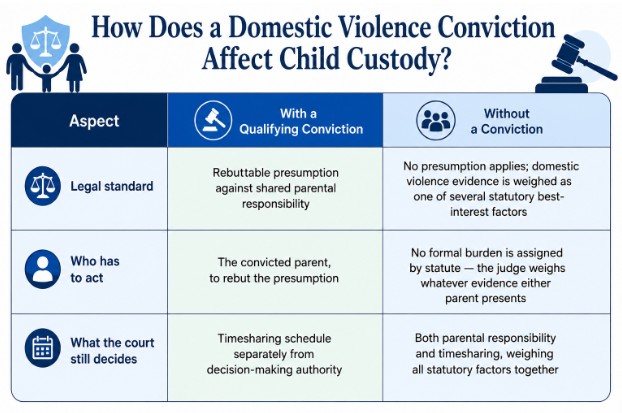
Once that presumption applies, the convicted parent generally does not receive shared decision-making authority over the child’s welfare unless the presumption is overcome—and timesharing is decided separately based on the child’s best interests.
| With a Qualifying Conviction | Without a Conviction | |
| Legal standard | Rebuttable presumption against shared parental responsibility | No presumption applies; domestic violence evidence is weighed as one of several statutory best-interest factors |
| Who has to act | The convicted parent, to rebut the presumption | No formal burden is assigned by statute — the judge weighs whatever evidence either parent presents |
| What the court still decides | Timesharing schedule separately from decision-making authority | Both parental responsibility and timesharing, weighing all statutory factors together |
If you’re ready to get started, call us now!
Does a Judge Consider Domestic Violence Even Without a Conviction?
Yes. Fla. Stat. § 61.13(3) (2026) directs a judge to consider evidence of domestic violence — and evidence that a parent has reasonable cause to believe they or their child are in imminent danger of becoming a victim of it — as one of the factors in every custody and timesharing determination, regardless of whether a prior or pending criminal or injunction case exists.
A judge weighs that evidence alongside the other statutory factors rather than applying an automatic presumption.
This is why an allegation that never results in a conviction can still shape a parenting plan: the family court applies its own best-interest standard, separate from whatever a criminal court decides. The Florida child custody factors guide covers the full list of factors a Broward County judge weighs alongside domestic violence evidence.
A domestic violence allegation running alongside a custody case adds real complexity to how the timeline plays out.
A case evaluation with Levine Family Law maps out how the criminal, injunction, and family court sides of a specific situation are likely to interact.
What Should Someone Do If Domestic Violence Is Affecting a Divorce or Custody Case?
Anyone involved in a domestic violence situation that overlaps with a divorce or custody matter benefits from understanding all three proceedings — criminal, injunction, and family court — before making decisions in any one of them.
A person seeking protection should document incidents, preserve evidence, and understand what an injunction can and can’t do alongside a pending or future divorce filing.
A person facing an accusation should understand that a decision made in the criminal or injunction case can carry weight in the family court case before agreeing to it.
The child custody, parental responsibility, and relocations page covers how custody terms get established and modified once these issues are part of the record.
Contact Us Today For An Appointment
Frequently Asked Questions
What legally qualifies as domestic violence in Florida?
Fla. Stat. § 741.28 (2026) defines domestic violence as assault, aggravated assault, battery, aggravated battery, sexual assault, sexual battery, stalking, aggravated stalking, kidnapping, false imprisonment, or any criminal offense causing physical injury or death, committed against a family or household member.
Who counts as a “family or household member” under Florida’s domestic violence law?
Spouses, former spouses, people related by blood or marriage, people who currently or previously lived together as a family, and people who share a child in common regardless of marriage. Except for parents who share a child, the people involved must currently or previously have resided together.
How does someone get a restraining order for domestic violence in Florida?
A petition for an injunction for protection against domestic violence is filed under Fla. Stat. § 741.30 (2026) in circuit court, with no filing fee and no attorney requirement. The process is separate from divorce and can address immediate safety, temporary exclusive use of a home, and a temporary parenting plan while a case is pending.
Does a domestic violence conviction automatically take away custody in Florida?
Not automatically, but it changes the starting point. A conviction for a domestic violence misdemeanor of the first degree or higher creates a rebuttable presumption against shared parental responsibility under Fla. Stat. § 61.13(2)(c) (2026); the convicted parent has to overcome that presumption, and timesharing is still decided separately.
Can domestic violence affect a custody case even without a conviction?
Yes. Fla. Stat. § 61.13(3) (2026) requires a judge to weigh evidence of domestic violence, or reasonable cause to believe a parent or child is in imminent danger of it, as a best-interest factor in every custody decision, regardless of whether a conviction or pending case exists.
Can someone file for an injunction and a divorce at the same time in Florida?
Yes. An injunction for protection under Fla. Stat. § 741.30 (2026) is a separate civil proceeding from a divorce filing, and you can pursue either independently or alongside the other, depending on the circumstances.
Can an injunction include a temporary parenting plan?
Yes. Under Fla. Stat. § 741.30(5) (2026), a court granting a temporary injunction can, on the same basis as § 61.13, set a temporary parenting plan and timesharing schedule — which may award the petitioner up to 100% of the timesharing until a court in the underlying case addresses it.
What happens if a parent is accused of domestic violence but never convicted?
The criminal case and the family court case are decided separately. Even without a conviction, a family court judge still weighs the domestic violence evidence presented under the best-interest factors in Fla. Stat. § 61.13(3) (2026) when deciding parental responsibility and timesharing.
Where can someone in Broward County get immediate help for domestic violence?
Anyone in immediate danger should call 911. The Florida Domestic Violence Hotline, 1-800-500-1119, is available 24 hours a day for safety planning and referral to a local certified domestic violence center, separate from any legal proceeding.
Bottom Line:
Domestic violence is a defined criminal offense under Fla. Stat. § 741.28, and it intersects with family law through three separate proceedings: a victim can seek an injunction under § 741.30, a criminal case can proceed independently, and a family court judge decides custody under § 61.13 — applying a rebuttable presumption against shared responsibility if there’s a qualifying conviction, and weighing the evidence as a best-interest factor either way.
Domestic violence issues rarely stay contained to one court. Call Scott Levine at (954) 587-2244 or request a confidential consultation to address the safety and custody sides of a case together.