
Fort Lauderdale Divorce Attorney

Scott A. Levine, Esq., an AV Peer Review Rated Fort Lauderdale divorce attorney and Florida Supreme Court Certified Family Mediator with membership on the Florida Bar Family Law Section, represents clients in Fort Lauderdale and throughout Broward County in contested divorces, uncontested dissolutions, and high-net-worth cases under Florida Statute §61.052.
If you need direct guidance from the first call through final judgment, contact Scott A. Levine at Levine Family Law — 954-587-2244 — for a confidential consultation about your Fort Lauderdale divorce.
What Are the Legal Requirements to File for Divorce in Fort Lauderdale?
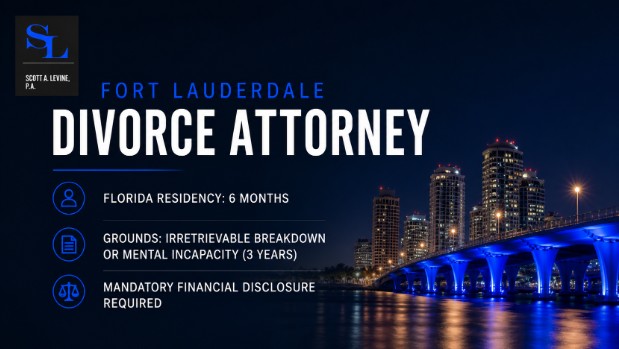
Florida Statute §61.052 sets two requirements before a Fort Lauderdale divorce petition can be filed in Broward County.
First, at least one spouse must have been a Florida resident for at least 6 months immediately before filing.
Second, the petition must state grounds — either that the marriage is irretrievably broken or that one party has been adjudicated mentally incapacitated for at least three years.
Florida courts do not assign blame, and neither spouse must prove wrongdoing to obtain a dissolution.
Once the petition is filed with the Seventeenth Judicial Circuit Court in Broward County, both parties must complete mandatory financial disclosures under Florida Family Law Rule of Procedure 12.285, which covers income, assets, debts, and monthly expenses.
Residency documentation, proof of service, and a complete financial disclosure are the three records that determine whether your case starts cleanly or stalls immediately.
Gather tax returns, pay stubs, bank statements, retirement account records, and a full debt inventory before filing, so your case starts without a disclosure dispute.
What Happens Step by Step in a Fort Lauderdale Divorce?
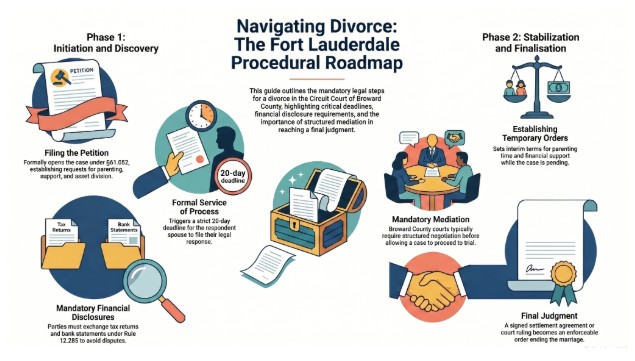
Understanding the sequence before filing prevents missed deadlines, avoidable costs, and decisions made under pressure. For a deeper walkthrough, read the Florida divorce process and the marriage dissolution guide.
For Broward County-specific logistics, the filing guide for the Broward County Courthouse and the Broward Family Court contact guide cover what you need locally.
Step 1 — File the petition.
The petition for dissolution of marriage is filed with the Circuit Court of Broward County under §61.052. This formally opens the case and sets the framework for the relief you are requesting — parenting, support, and asset division — so you can enter the process with a clear plan rather than making foundational decisions under deadline pressure. Filing without a clear plan for those three areas is the most common early mistake.
Step 2 — Serve the other spouse.
The respondent must be formally served, which triggers a 20-day deadline to file a response. Improper or delayed service stalls the case before it gains any momentum. Keep proof of service on file from the start.
Step 3 — Exchange financial disclosures.
Both parties must provide mandatory financial disclosures under Rule 12.285 — tax returns, income records, bank statements, retirement accounts, and a complete debt inventory. Incomplete or inconsistent disclosure creates leverage disputes and motions that drive up costs on both sides.
Step 4 — Address temporary orders.
If parenting time, support, or access to funds need to be stabilized while the case is pending, temporary orders establish those terms. Clients who delay requests for temporary orders risk allowing an informal arrangement to become the assumed baseline at final judgment.
Step 5 — Negotiate or mediate.
Broward County courts typically order mediation before trial. Most divorces in Fort Lauderdale are resolved through structured negotiation at this stage. Preparing a real settlement position — with specific numbers, parenting terms, and asset allocation — before mediation determines whether you reach a durable agreement or return to court.
Step 6 — Finalize settlement or prepare for trial.
A marital settlement agreement becomes a final judgment enforceable as a court order. If issues remain unresolved after mediation, the court decides them at trial. Vague or ambiguous language in agreed terms is the single most common driver of post-judgment enforcement problems.
What Is the Difference Between an Uncontested and Contested Divorce in Fort Lauderdale?
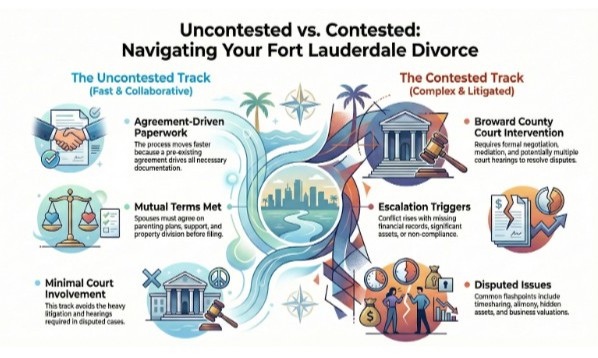
The distinction is whether both spouses agree on parenting, support, and financial terms before the case requires sustained court involvement.
An uncontested Fort Lauderdale divorce is paperwork-driven. Both parties have reached an agreement on a parenting plan, child support, alimony, and property division before the court needs to intervene.
The case requires fewer hearings, lower attorney fees, and produces less post-judgment conflict than a contested matter.
A contested divorce is a Broward County litigation matter. One or more issues — timesharing, alimony, hidden assets, business valuation, or the disposition of the marital home — remain disputed and must be resolved through negotiation, mediation, or a hearing. When financial complexity or repeated noncompliance further escalates the case, it becomes complex divorce litigation with discovery, expert witnesses, and trial preparation.
| Topic | Uncontested Divorce | Contested Divorce | What Typically Escalates It |
| Parenting plan and timesharing | Schedule and decision-making are agreed upon before filing | Disputes require negotiation, mediation, or court input | Allegations, communication breakdown, and inconsistent routines |
| Child support and alimony | Numbers are agreed or straightforward to calculate | Income, expenses, or needs are disputed | Variable income, undisclosed benefits, disputed monthly expenses |
| Property and debt division | Clear inventory and agreed split | Marital vs. nonmarital disputes, valuation conflicts | Tracing issues, commingling, and missing documentation |
| Process and pace | Paperwork-driven, with fewer hearings | Motions, mediation, and possible trial preparation | Delayed disclosure, strategic stalling, repeated noncompliance |
| Cost and predictability | Lower and more predictable | Higher and less predictable | Experts, enforcement actions, and repeated court involvement |
The most common escalation triggers are incomplete financial disclosure, high-conflict co-parenting dynamics, significant or hard-to-value assets, and one party’s use of delay as a negotiating strategy.
Identifying those pressure points early — before filing — determines which track your case will follow and what it will cost.
If you are unsure whether your Fort Lauderdale divorce is likely to be contested or uncontested, contact Scott A. Levine at Levine Family Law at 954-587-2244 or visit the contact page for a confidential consultation before you file anything.
How Is Property and Debt Divided in a Florida Divorce?
Florida divorce follows equitable distribution under Florida Statute §61.075. Courts classify every asset and debt as marital or nonmarital, then divide them using statutory fairness factors rather than a default 50/50 split.
For a plain-language breakdown of how classification and valuation work in practice, read what equitable distribution means and the property division guide for Florida divorces.
The assets that generate the most disputes in Fort Lauderdale cases are bank accounts, retirement funds, and business interests — because small documentation gaps create large leverage problems.
If cash and accounts are a concern, review how to split bank accounts in a Florida divorce. If retirement is a key asset, the Fort Lauderdale retirement account division guide covers the QDRO process and common mistakes.
If the marital home is the centerpiece of your settlement decisions, read keep or sell the family home in a South Florida divorce before committing to a timeline.
| Asset or Debt | What Matters Most | Common Traps |
| Bank accounts and cash | Tracing deposits, timing of transfers, and commingling | Missing statements, cash withdrawals before filing |
| Retirement accounts | Marital portion calculation and correct QDRO language | Tax penalties, premature withdrawal, and incorrect division method |
| Marital home | Equity, buyout feasibility, and affordability after divorce | Agreeing to keep without a realistic post-divorce budget |
| Business interests | Income, value, hidden benefits, and control structure | Undervaluation, expense manipulation, and delayed disclosure |
| Credit cards and loans | When debt was incurred, and for what purpose | Assuming joint debt becomes the other party’s obligation |
| Taxes and refunds | Filing status, refund allocation, and exposure | Signing joint returns without understanding shared liability |
How Is Alimony Determined in a Fort Lauderdale Divorce?
Alimony decisions in Fort Lauderdale divorce cases are driven by evidence, not assumptions. Florida courts evaluate need, ability to pay, the length of the marriage, the standard of living established during the marriage, and each spouse’s earning capacity and health.
The 2023 amendments to Florida Statute §61.08 eliminated permanent alimony and restructured durational alimony caps, making the current documentary record more important than ever.
Financial records consistent across affidavits, tax returns, and bank statements carry far more weight at mediation and a hearing than self-reported estimates that cannot be verified.
The records that determine alimony leverage include pay stubs, tax returns, 1099s, bonus and commission history, a documented monthly budget, medical records that show health limits earning capacity, and any evidence of the marital standard of living.
Alimony also interacts directly with property division — so you can negotiate both levers in the same conversation rather than conceding one to win the other. An asset-heavy settlement often reduces or eliminates an alimony claim.
Getting both right requires a coordinated strategy rather than treating them as separate negotiations. For background on how durational and bridge-the-gap alimony work in Broward County cases, see the alimony and asset division.
What Goes Into a Parenting Plan and Child Support Order in Broward County?
In Broward County divorce cases involving children, the parenting plan is the document courts scrutinize most. Florida courts apply a best-interest-of-the-child standard under Florida Statute §61.13, evaluating each parent’s ability to support the child’s stability, each parent’s history of involvement, and the quality of communication between co-parents.
A strong parenting plan defines the timesharing schedule, decision-making authority for school and medical matters, exchange locations and procedures, communication rules and response expectations, child expense allocation and reimbursement deadlines, and travel notification requirements. Vague plans create enforcement problems within months of the final judgment.
Child support in Florida follows the Income Shares Model under Florida Statute §61.30, which factors in both parents’ net incomes, daycare costs, health insurance premiums, and the number of overnights each parent exercises.
Under §61.30 as amended through 2023, support obligations run until the child turns 18 or graduates from high school, whichever occurs later.
Before agreeing to a timesharing schedule, review the Florida child custody factors to understand how the overnight count affects both the parenting plan and the support calculation.
The Broward County child timesharing guide covers how local courts approach schedules in practice.
If a modification becomes necessary after the final judgment — due to a relocation, change in income, or parenting conflict — the child custody and parental responsibility page covers the modification and enforcement standards that Broward County courts apply.
What Should Fort Lauderdale Residents Know About High-Net-Worth Divorce?
High-net-worth divorce in Fort Lauderdale involves asset categories and valuation issues that standard cases do not. Business interests, investment portfolios, deferred compensation, executive benefits, real estate holdings, and offshore accounts each require specific documentation, valuation methodology, and — in contested cases — expert testimony.
Confidentiality risks increase as asset complexity grows, and opposing counsel uses the discovery process strategically to pressure settlement in proportion to that complexity.
The warning signs that a Fort Lauderdale divorce will involve hidden assets include a sudden, unexplained drop in reported income, business expenses that do not align with lifestyle, selective or delayed financial production, unexplained transfers to family members or new accounts, and new loans with unclear repayment terms.
Courts impose sanctions when concealment is demonstrated, but the claim must be supported by records, not suspicion.
Scott A. Levine, Esq., represents high-net-worth clients in Fort Lauderdale, where the case requires forensic-level financial review, coordination of business valuation, and a strategy built on documentation rather than guesswork.
Why Do Fort Lauderdale Clients Choose Scott A. Levine for Divorce Representation?
Attorney Levine is admitted to practice before all Florida courts and the Federal District Court of the Southern District of Florida. Scott A. Levine, Esq. holds membership on the Florida Bar Family Law Section and brings both litigation experience and certified mediation competency to every Fort Lauderdale divorce matter.
Clients in Fort Lauderdale and across Broward County choose Levine Family Law because the representation is strategic from the first call.
You receive a clear picture of what happens next, what to gather now, and where cases like yours typically stall. Parenting time, support, and asset division are handled with structure and documentation.
Settlement is pursued when the terms serve you, and trial preparation begins early enough to matter if it does not.
Reach Scott A. Levine at 954-587-2244 or slevine@scottlevinepa.com. Office: 500 East Broward Boulevard, Suite 900, Fort Lauderdale, FL 33394.
Frequently Asked Questions
How long does a divorce take in Fort Lauderdale, Florida?
A Fort Lauderdale divorce timeline depends on whether the case is contested or uncontested, the completeness of financial disclosure, and whether parenting disputes require hearings. Uncontested cases with complete records move faster. Contested cases drag on when documents are missing, valuations are disputed, or noncompliance requires repeated court appearances.
What are the residency requirements to file for divorce in Florida?
Florida Statute §61.052 requires at least one spouse to have been a Florida resident for six months immediately before filing the petition. Residency is typically established through a Florida driver’s license, voter registration, or utility records showing continuous presence in the state for the required period.
Do I need a lawyer for a divorce in Fort Lauderdale?
Florida law does not require an attorney to file for divorce, but legal representation is strongly recommended when children, significant assets, alimony, hidden-asset concerns, or a high-conflict dynamic are involved. A Fort Lauderdale divorce attorney protects your rights, prevents filing mistakes, and drafts enforceable terms that reduce future disputes.
How does equitable distribution work in a Florida divorce?
Equitable distribution under Florida Statute §61.075 means courts divide marital assets and debts based on statutory fairness factors, not automatically 50/50. The court classifies each asset as marital or nonmarital, values disputed items, and allocates them based on factors such as length of marriage, contributions, and asset origin.
What happens to the marital home in a Fort Lauderdale divorce?
The marital home is sold with proceeds divided equitably, or one spouse retains it through a buyout funded by refinancing or asset offset. The right option depends on equity, affordability, and parenting logistics. Keeping the home without a realistic post-divorce budget produces a predictable post-judgment financial problem.
How is alimony calculated in a Florida divorce case?
Florida alimony under Florida Statute §61.08 is based on demonstrated need and the other spouse’s ability to pay, weighted by marriage length, standard of living, and earning capacity. The 2023 amendments to Florida Statute §61.08 eliminated permanent alimony and restructured durational caps. Financial records consistent across affidavits and tax returns determine leverage at mediation.
How are child support and timesharing connected in Broward County?
Florida child support under §61.30 uses the Income Shares Model, factoring in both parents’ net incomes, daycare, health insurance, and the number of overnights each parent exercises. The timesharing schedule directly affects the support calculation. A higher overnight count for one parent typically reduces that parent’s child support obligation.
What are the warning signs of hidden assets in a Fort Lauderdale divorce?