
Florida Supreme Court Certified Family Mediation is a confidential, attorney-led negotiation process that lets Broward County families resolve divorce, time-sharing, alimony, and parenting disputes without a trial.
Scott A. Levine, Esq. holds this certification, effective September 1, 2017, and offers both pre-suit mediation (before a case is filed) and court-ordered mediation for pending Broward County cases.
Key Takeaways
- Family mediator certification is governed by the Florida Rules for Certified and Court-Appointed Mediators — Attorney Levine holds this credential effective September 1, 2017.
- Broward County courts routinely refer contested family cases to mediation before trial under authority granted by Fla. Fam. L.R.P. 12.740; this is standard local practice built on that referral authority, not an absolute statewide mandate in every case.
- Mediation communications are confidential and generally protected from disclosure under Florida’s Mediation Confidentiality and Privilege Act, Fla. Stat. § 44.405.
- Pre-suit mediation, court-referred mediation through the 17th Judicial Circuit, and private mediation are all available, with cost and timeline varying by path.
Unresolved disputes over parenting time, alimony, or property division can stall for months without the right process. Schedule a confidential consultation with Scott A. Levine to discuss whether mediation fits your situation.
What Is Florida Supreme Court Certified Family Mediation?
Florida Supreme Court certified family mediation is a confidential negotiation process led by a neutral mediator who holds the state’s highest family mediator credential, governed by the Florida Rules for Certified and Court-Appointed Mediators, Rule 10.100.
Certification as a family mediator is granted under a points-based framework combining approved mediation training, qualifying education or professional experience, and supervised mentorship, with the specific point requirements set out in Rule 10.105.
The rules were most recently amended effective January 1, 2025, which revised the mentorship and observation point requirements for new applicants.
Attorney Levine was certified as a Family Mediator by the Florida Supreme Court on September 1, 2017, under the certification standards in effect at that time, and has maintained that certification since.
What Does a Certified Family Mediator Actually Do?
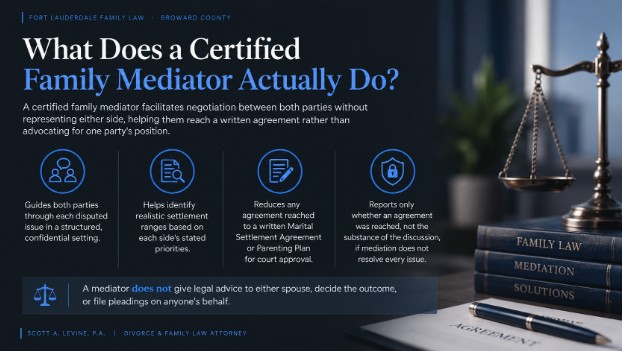
A certified family mediator facilitates negotiation between both parties without representing either side, helping them reach a written agreement rather than advocating for one party’s position.
That distinction matters: a mediator does not give legal advice to either spouse, decide the outcome, or file pleadings on anyone’s behalf. Instead, the mediator:
- Guides both parties through each disputed issue in a structured, confidential setting
- Helps identify realistic settlement ranges based on each side’s stated priorities
- Reduces any agreement reached to a written Marital Settlement Agreement or Parenting Plan for court approval
- Reports only whether an agreement was reached, not the substance of the discussion, if mediation does not resolve every issue
Mediation communications are confidential under Florida’s Mediation Confidentiality and Privilege Act, Fla. Stat. § 44.405, and generally cannot be used later at trial.
Parties considering alimony and asset division or contested time-sharing disputes often use mediation to test settlement terms before committing to a litigated position.
How Does Family Mediation Work in Broward County?
Broward County family mediation runs through two tracks: the Seventeenth Judicial Circuit’s Court Mediation and Arbitration Program, and private mediation arranged directly between the parties and a certified mediator such as Attorney Levine.
The 17th Judicial Circuit’s Court Mediation and Arbitration Program is located at the Broward County Courthouse, 201 SE 6th Street, West Wing Tower, Room 19150, Fort Lauderdale, FL 33301.
To use the court program, a case must be filed in Broward County, and a Broward judge must sign a family mediation order; the program is subject to a combined net income limit of less than $100,000, per the 17th Judicial Circuit’s published program guidelines.
Parties who do not qualify for or prefer not to use the court program, or who want mediation before a case is ever filed, can retain a private mediator directly.
Broward’s family court operates under the Florida Family Law Rules of Procedure and the Seventeenth Judicial Circuit’s local administrative orders; the Broward Family Court contact guide covers details on filing and court contacts.
Which Family Law Disputes Can Be Mediated?
Most contested family law issues in Broward County can be referred to mediation, including parental responsibility, time-sharing, child support, alimony, and equitable distribution.
Under Fla. Stat. § 61.183, courts may refer parties to mediation whenever parental responsibility, primary residence, time-sharing, or child support is contested. Florida Family Law Rule of Procedure 12.740 extends that authority to contested family matters generally, including:
- Divorce and equitable distribution disputes
- Alimony disputes, including modification requests
- Parenting plans and time-sharing schedules
- Paternity matters involving unmarried parents with minor children
- Pre-suit disputes, before either party files a petition
A limited category of matters is excluded from referral absent good cause or the parties’ consent under Fla. Fam. L.R.P. 12.740(c): Title IV-D child support enforcement cases, post-judgment contempt and enforcement proceedings, and modifications of injunctions between the parties.
Is Mediation Required Before a Broward County Divorce Trial?
Florida Family Law Rule of Procedure 12.740 authorizes courts to refer contested family matters to mediation, and Broward County judges routinely exercise that authority before scheduling a contested case for trial.
This is standard local practice based on the referral authority in Rule 12.740, not an absolute statutory mandate applied identically in every case; the presiding judge retains discretion over whether and when to refer a specific matter.
Courts can also waive or modify the mediation requirement where safety concerns exist, such as a history of domestic violence between the parties, and Rule 12.740 requires the parties to advise the court of any such circumstance before referral.
Cases proceeding toward a contested hearing are addressed further on the Fort Lauderdale divorce attorney page.
Broward County mediation deadlines and referral orders do not wait. Contact Scott A. Levine to protect your position before a court-ordered timeline passes.
What Does Family Mediation Cost and How Long Does It Take?
Family mediation is generally faster and less expensive than litigation, though cost and timeline depend on whether the parties use the court program or a private mediator.
| Mediation Path | Typical Cost | Timeline |
| Court Mediation and Arbitration Program (Broward, 17th Circuit) | Reduced fee, based on income; available to combined net income under $100,000 | Scheduled by court order after case filing |
| Private mediation (pre-suit or court-referred) | Hourly rate set by agreement, or by the presiding judge when no agreement exists | Must be completed within 75 days of the first mediation conference under Fla. Fam. L.R.P. 12.740(e), absent a court order extending that period |
Mediation fees are apportioned between the parties, and the presiding judge may determine the reasonableness of a private mediator’s rate if the parties dispute it, per Fla. Fam. L.R.P. 12.740(c). Pre-suit mediation, arranged before either party files, allows flexible scheduling and rate arrangements agreed to directly between the parties and the mediator.
What Happens If Mediation Does Not Resolve Every Issue?
Partial agreement is common, and mediation can resolve some issues while leaving others for the court to decide.
If the parties reach agreement on any issue, the agreement is reduced to writing, signed by both parties, and submitted to the court.
If the parties reach agreement on any issue, the agreement is reduced to writing, signed by both parties, and submitted to the court. Fam. L.R.P. 12.740(f). Unresolved issues then proceed toward negotiation, further hearings, or trial.
The complex divorce litigation page covers unresolved high-conflict or high-asset disputes in more detail.
How Does Mediation Compare With Litigation and Collaborative Divorce?
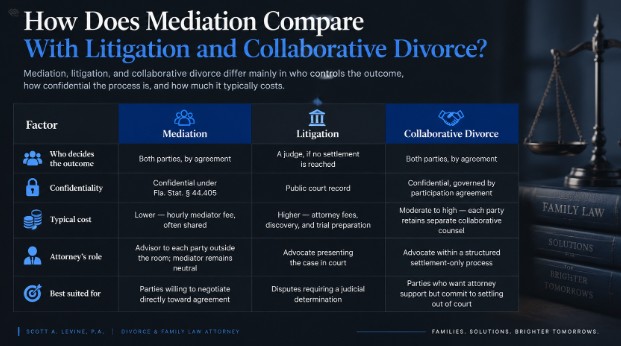
Mediation, litigation, and collaborative divorce differ mainly in who controls the outcome, how confidential the process is, and how much it typically costs.
| Factor | Mediation | Litigation | Collaborative Divorce |
| Who decides the outcome | Both parties, by agreement | A judge, if no settlement is reached | Both parties, by agreement |
| Confidentiality | Confidential under Fla. Stat. § 44.405 | Public court record | Confidential, governed by participation agreement |
| Typical cost | Lower — hourly mediator fee, often shared | Higher — attorney fees, discovery, and trial preparation | Moderate to high — each party retains separate collaborative counsel |
| Attorney’s role | Advisor to each party outside the room; mediator remains neutral | Advocate presenting the case in court | Advocate within a structured settlement-only process |
| Best suited for | Parties willing to negotiate directly toward agreement | Disputes requiring a judicial determination | Parties who want attorney support but commit to settling out of court |
Because Attorney Levine is both a litigator and a certified family mediator, he advises clients on which path fits their specific dispute rather than defaulting to one approach for every case.
For disputes where mediation stalls or isn’t appropriate, his litigation background carries directly into the case; parties aren’t left starting over with new counsel.
Every week spent undecided about mediation versus litigation costs leverage in a Broward County family law matter. Call Scott A. Levine at (954) 587-2244 or visit the contact page for a confidential consultation today.
Frequently Asked Questions
What is Florida Supreme Court Certified Family Mediation? It is a confidential negotiation process led by a mediator certified under the Florida Rules for Certified and Court-Appointed Mediators. The mediator helps both parties reach a written settlement agreement without deciding the outcome or representing either side.
Is mediation confidential in Florida family law cases? Yes. Mediation communications are confidential under Florida’s Mediation Confidentiality and Privilege Act, Fla. Stat. § 44.405, and generally cannot be used as evidence at trial, subject to limited statutory exceptions such as threats of violence or mandatory abuse reporting.
Does mediation replace the need for a family law attorney? No. A mediator serves as a neutral facilitator and cannot give legal advice to either party. Most parties consult their own attorney before and during mediation to understand their rights and evaluate proposed settlement terms.
How long does family mediation take in Broward County? Private mediation must be completed within 75 days of the first mediation conference under Fla. Fam. L.R.P. 12.740(e), unless the court orders otherwise. Court-referred mediation through the 17th Judicial Circuit is scheduled according to the referral order’s timeline.
Can mediation be used before filing for divorce? Yes. Pre-suit mediation lets parties negotiate a settlement before either spouse files a petition, which can reduce the cost and duration of the eventual filing if they reach an agreement in advance.
What issues can be resolved through family mediation? Parental responsibility, time-sharing, child support, alimony, and equitable distribution are commonly mediated under Fla. Stat. § 61.183 and Fla. Fam. L.R.P. 12.740. Post-judgment enforcement and Title IV-D child support cases are generally excluded absent good cause or consent.
Is family mediation mandatory in Broward County? Broward judges routinely refer contested family cases to mediation under Fla. Fam. L.R.P. 12.740 before scheduling trial. This is standard local practice, not an absolute requirement in every case, and courts retain discretion to waive it.
What does family mediation cost in Broward County? Cost depends on the path chosen. The 17th Judicial Circuit’s Court Mediation and Arbitration Program offers reduced-fee mediation for parties with combined net income under $100,000. Private mediation is billed hourly, with fees apportioned between the parties.