

Which Type of Alimony Applies After Florida’s 2023 Reform?
Florida eliminated permanent alimony for cases filed after July 1, 2023, under SB 1416, leaving four statutory forms under Fla. Stat. § 61.08: temporary, bridge-the-gap, rehabilitative, and durational.
Which form applies depends on the length of the marriage, the requesting spouse’s demonstrated need, and the other spouse’s ability to pay. Durational alimony, the most commonly awarded form for longer marriages, ties its length to the marriage-length category set out in Chapter 61.
The comparison table below breaks down what each type is for and what proof matters most for each.
Florida divorce finances require two coordinated decisions. A Florida court divides marital assets and marital debts under equitable distribution, then evaluates whether one spouse qualifies for alimony based on demonstrated need and the other spouse’s ability to pay.
Equitable distribution starts with a presumption of equal split unless statutory factors justify an unequal distribution under Florida Statute 61.075.
Florida courts award only the forms of alimony authorized by Florida Statute 61.08. Alimony determines monthly cash flow.
Scott A. Levine represents Fort Lauderdale and Broward County clients in Florida divorce matters involving alimony, equitable distribution, retirement division, and post-judgment modification.
Equitable distribution determines who keeps which assets and which debts. For procedural context on filing steps and timelines, review the Florida divorce process.
Key Takeaways
- Florida courts classify property as marital or nonmarital, value the marital estate, and distribute marital assets and liabilities under Florida Statute 61.075.
- Florida courts may award only the alimony forms and durations authorized by Florida Statute 61.08.
- Florida’s enacted alimony reform removed “permanent alimony” from the statutory forms shown in the enacted text for SB 1416.
- Florida durational alimony limits are tied to marriage-length categories under Chapter 61.
- Florida treats retirement benefits earned during the marriage as marital assets under Florida Statute 61.076.
- Florida allows modification or termination of support under qualifying circumstances pursuant to Florida Statute 61.14.
Why Alimony And Asset Division Decisions Affect Your Financial Stability
Divorce financial outcomes depend on admissible documents and defensible valuations. Alimony analysis depends on verified income, verified expenses, and statutory factors under Florida Statute 61.08, so you can forecast a realistic post-divorce cash flow.
Equitable distribution analysis depends on classification, tracing, and valuation under Florida Statute 61.075, so you can protect long-term assets while accounting for debt, taxes, and liquidity.
Fort Lauderdale and Broward County divorces often involve real estate equity, retirement assets, and business or professional income.
High-income cases often require business valuation, complex compensation analysis, and privacy planning, similar to the issues described in high-net-worth divorce in Florida.
Florida Alimony Update
The Florida alimony law changed through enacted legislation in 2023. Florida courts apply the current statutory forms and factors in Florida Statute 61.08, and the enacted bill text for SB 1416 shows the removal of “permanent alimony” from the statutory form list.
Alimony In Florida
Florida courts may award alimony only in the forms listed in Florida Statute 61.08.
The Core Test Florida Judges Apply
Florida courts evaluate alimony using two threshold findings. One spouse must prove alimony need.
The other spouse must have the ability to pay. Florida courts then apply statutory factors to select the alimony type, amount, and duration under Florida Statute 61.08.
Types Of Alimony Recognized By Florida Statute
Florida law authorizes these alimony forms under Florida Statute 61.08.
- Temporary Alimony. Support while the divorce case remains pending.
- Bridge The Gap Alimony. Short-term support for identifiable transition needs.
- Rehabilitative Alimony. Support is tied to a defined rehabilitation plan.
- Durational Alimony. Support for a set period within statutory limits.
Durational Limits Matter
Florida ties durational limits to marriage-length categories under Chapter 61. Marriage length often sets the outer boundary for the duration of alimony when spouses dispute the duration.
Alimony Comparison Table
| Alimony Type | What Is Alimony For | Typical Duration Frame | Proof That Matters Most |
| Temporary | Maintain financial stability during the case | Until the final judgment | Current income, current expenses, interim ability to pay |
| Bridge The Gap | Cover short-term transition expenses | Short duration by design | Identifiable near-term needs, documented transition costs |
| Rehabilitative | Fund a defined training or education plan | Until plan completion or statutory endpoint | Written rehabilitation plan, cost schedule, timeline, progress proof |
| Durational | Provide support for a set period | Capped by statutory limits | Marriage length category, budgets, ability to pay, and statutory factors |
Schedule a confidential consultation with a Fort Lauderdale alimony and asset division attorney at Scott A. Levine so you can confirm alimony exposure, equitable distribution risk, and the documents needed for proof.
How Florida Courts Decide Alimony
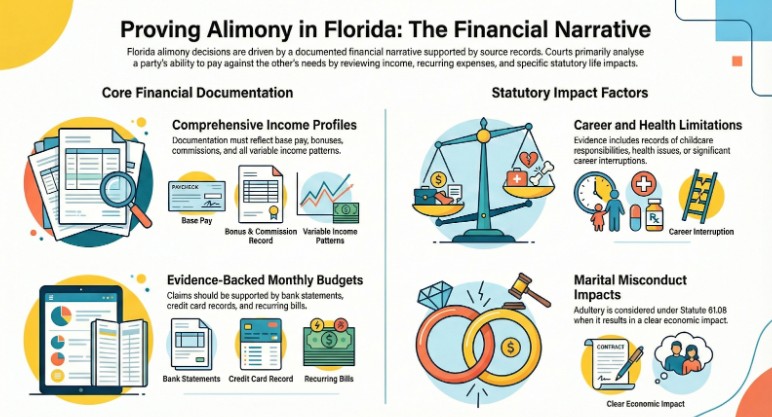
A persuasive alimony position starts with a documented financial narrative supported by source records. Income records, tax returns, evidence of recurring expenses, insurance costs, and non-wage compensation documentation shape the ability-to-pay analysis.
Evidence That Commonly Drives The Outcome
- Income documentation that reflects base pay, bonuses, commissions, and variable income patterns.
- A monthly budget supported by bank statements, credit card statements, and recurring bills.
- Career interruption evidence, childcare responsibility records, and health limitation documentation are provided when the facts support those claims.
- Economic impact evidence is tied to marital misconduct when a party raises adultery as a statutory consideration, because Florida allows consideration of adultery and economic impact under Florida Statute 61.08.
Modifying Or Terminating Alimony
Florida law allows modification or termination of alimony when the statutory requirements in Florida Statute 61.14 are satisfied.
Post-judgment support changes typically require documented proof of a substantial change in circumstances.
What Usually Triggers A Modification Review
- A significant income change supported by employment records, compensation records, or business financial records.
- A substantial health or employability change supported by medical or vocational evidence.
- A supportive relationship that meets statutory criteria, because Florida authorizes reduction or termination on that basis under Florida Statute 61.14.
Equitable Distribution In Florida
Florida divides marital assets and liabilities under the equitable distribution framework in Florida Statute 61.075.
Florida courts set apart nonmarital assets and nonmarital liabilities, then distribute marital assets and marital liabilities.
Florida courts start from an equal distribution premise unless statutory factors justify a different result under Florida Statute 61.075.
Marital Vs Nonmarital Property
Property classification controls the financial outcome. A deed name or account label does not always control classification. Florida classification analysis depends on acquisition timing, funding source, commingling, and tracing evidence.
Unequal Distribution And Dissipation
Florida courts may order an unequal distribution when evidence supports statutory factors.
Florida’s statutory factor list includes contribution to the marriage, economic circumstances, career interruption, and intentional dissipation, waste, depletion, or destruction of marital assets under Florida Statute 61.075.
Hidden asset claims often require a documentation strategy similar to the approach described in Hidden Assets in Broward County divorces.
Marital Vs Nonmarital Comparison Table
| Category | Common Examples | Classification Risk | Proof That Usually Resolves The Issue |
| Nonmarital Property | Premarital assets, inheritances, gifts to one spouse | Commingling, retitling, mixed deposits | Account statements from before marriage, gift letters, and inheritance records |
| Marital Property | Assets acquired during marriage, marital debt | Valuation disputes, tracing failures | Closing documents, statements during marriage, and debt statements |
| Mixed Property | Premarital account with marital contributions, home with premarital equity, and marital paydown | Tracing complexity | Tracing schedules, statement history, payoff histories, appraisals |
| Appreciation | Passive vs active growth questions | Business or real estate appreciation disputes | Valuation reports, financial statements, and contribution records |
Retirement Accounts, Pensions, And Deferred Compensation
Florida treats retirement benefits earned during the marriage as marital assets subject to distribution under Florida Statute 61.076.
Retirement division disputes often turn on premarital tracing, marital portion valuation, and the correct transfer mechanism for qualified plans.
Fort Lauderdale clients often start with the checklist for splitting retirement accounts.
Schedule a retirement division consultation to identify the marital portion, confirm the correct transfer mechanism, and avoid implementation errors under Florida Statute 61.076.
Common Assets And Debts In Fort Lauderdale Divorces
Accurate asset division requires a complete inventory. A complete inventory includes assets, liabilities, and records that prove classification and value.
Common Assets
- Real estate and home equity
- Bank accounts and cash management accounts
- Retirement plans, pensions, IRAs, and 401(k) plans
- Business interests, partnership interests, and valuation-sensitive professional interests
- Stocks, restricted stock units, stock options, and investment accounts
- Vehicles, boats, and high-value personal property
Bank account division often requires tracing deposits, transfers, and payee patterns across the separation period.
Common Debts
- Mortgages and HELOCs
- Credit cards and personal lines of credit
- Business debts and contingent liabilities
- Tax debts and repayment plans
Decision Tests for Alimony And Asset Division In Florida
Alimony Decision Test
- Identify the requesting spouse’s need using documented income and documented expenses.
- Identify the paying spouse’s ability to pay using verified income sources and recurring obligations.
- Select the appropriate statutory alimony type under Florida Statute 61.08.
- Apply duration rules and marriage-length limits under Chapter 61.
- Set an amount and duration that align with statutory factors, evidence, and budgets.
Equitable Distribution Decision Test
- Identify every asset and debt with account statements and title documents.
- Classify each item as marital or nonmarital under Florida Statute 61.075.
- Value the marital estate using credible valuation methods and appropriate valuation dates.
- Start from equal distribution, then test whether statutory factors justify an unequal distribution.
- Build a distribution plan that accounts for liquidity, taxes, and implementation steps.
What To Bring To An Alimony And Asset Division Consultation
Clients make faster, more accurate decisions when the evidence is complete. These documents help verify need, ability to pay, classification, and valuation so settlement terms track statutory requirements.
Income
- Last two years of tax returns
- Recent pay stubs, W-2, 1099, and K-1 documents
- Bonus plans, commission plans, and incentive documentation
- Business financials when self-employed, including P&L and balance sheet
Accounts And Assets
- 12 to 24 months of bank and brokerage statements
- Retirement statements for 401(k), IRA, pension, and deferred compensation
- Real estate documents, including deeds, mortgage statements, and closing documents
Debts
- Credit card statements
- Loan statements, HELOC statements, and repayment schedules
- Tax debt documentation and payment plans
Insurance And Recurring Costs
- Health insurance, homeowners insurance, auto insurance
- Childcare, tuition, and recurring household bills
The Alimony And Asset Division Process
Verified records and defensible valuations increase settlement leverage and reduce avoidable surprises. Durable outcomes require enforceable orders and a budget that can sustain the post-divorce plan.
Typical Case Steps
- Document income, expenses, assets, and debts with source records.
- Classify assets as marital or nonmarital under Florida Statute 61.075.
- Value marital assets using appropriate valuation dates and credible valuation methods.
- Analyze alimony exposure or entitlement under Florida Statute 61.08 and structure proposals that follow statutory constraints.
- Negotiate settlement terms or prepare an evidence package for a hearing or trial.
Alimony And Asset Division Outcomes In Florida
A high-quality financial strategy narrows disputes, reduces surprises, and creates cleaner settlement terms. Effective outcomes prioritize enforceable orders, predictable cash flow, and an implementable division plan.
Common Results We Aim For
- Clear classification and tracing proof that reduces post-judgment litigation risk.
- A support structure that aligns with statutory requirements and documented budgets.
- A division plan that accounts for liquidity constraints, tax exposure, and implementation steps.
- Documentation that supports enforcement, modification, or termination when the statute allows changes under Florida Statute 61.14.
Frequently Asked Questions
Is Florida A 50 50 State For Property Division
Florida begins with an equitable distribution presumption, applying an equal split to marital assets and liabilities. Florida courts may order an unequal distribution when statutory factors justify the deviation under Florida Statute 61.075.
What Evidence Proves Dissipation Of Marital Assets In Florida
Dissipation claims usually require a spending timeline and a paper trail showing intentional waste or depletion of marital funds. Florida courts evaluate dissipation under the statutory framework set forth in Florida Statute 61.075.
How Do Florida Courts Treat Bonuses, Commissions, And RSUs For Alimony
Florida alimony analysis focuses on the need and ability to pay, using the statutory factors under Florida Statute 61.08. Variable compensation often requires proof of historical averages, vesting schedules, and whether the income is recurring.
How Long Is A Short-Term, Moderate-Term, And Long-Term Marriage In Florida
Florida uses marriage-length categories in Chapter 61 for several divorce finance decisions, including durational limits. Marriage-length definitions and related provisions appear in Chapter 61.
Does Florida Still Have Permanent Alimony
Florida’s statutory list includes temporary, bridge-the-gap, rehabilitative, and durational alimony under Florida Statute 61.08. Florida’s enacted reforms removed “permanent alimony” from the statutory forms, as shown in the enacted text for SB 1416.
Can A Supportive Relationship End Alimony In Florida
Florida law allows the reduction or termination of alimony in qualifying circumstances involving a supportive relationship under Florida Statute 61.14. Supportive relationship claims typically require documented proof of shared finances, cohabitation patterns, and economic interdependence.
Are Retirement Accounts Split In A Florida Divorce
Retirement benefits earned during the marriage qualify as marital assets under Florida Statute 61.076. Retirement division mechanics depend on plan type, marital portion tracing, and the final judgment terms.
Does Equitable Distribution Include Debt And Tax Liabilities
Equitable distribution applies to marital assets and liabilities under Florida Statute 61.075. Marital liabilities can include debts incurred during the marriage and tax liabilities when evidence supports classification and allocation.
Talk With A Fort Lauderdale Alimony And Asset Division Attorney
Contested alimony and complex asset division disputes reward early documentation and early strategy. Start with the Fort Lauderdale divorce attorney intake path, or review the broader scope of the family law practiceto confirm fit.
Contact Scott A. Levine in Fort Lauderdale to protect your cash flow and your asset division outcome so you can move forward with enforceable orders, clean documentation, and a financial plan you can execute.