

Time-sharing is the Florida term for the schedule that sets when a child lives with each parent. Since July 1, 2023, Florida law presumes equal time-sharing serves a child’s best interests under Fla. Stat. § 61.13(2)(c)1.
A parent opposing a 50/50 split must rebut that presumption by a preponderance of the evidence.
Broward County child custody cases add a second layer: the Seventeenth Judicial Circuit’s administrative orders govern the sequence in which that question reaches a judge.
Key Takeaways
- Fla. Stat. § 61.13(2)(c)1 creates a rebuttable presumption of equal time-sharing, overcome only by a preponderance of the evidence.
- Broward County Administrative Order 2026-06-UFC caps contested temporary time-sharing hearings at one hour and bars any such hearing until the parties report a mediation impasse.
- Fla. Stat. § 61.30(11)(b) applies a gross-up calculation once each parent reaches 73 overnights per year, and Fla. Stat. § 61.13(5) confirms that equal time-sharing does not preclude a support award.
Broward County time-sharing cases move on court-set deadlines from the day of filing. A confidential consultation with Scott Levine can clarify your options early.
Does Florida Law Presume 50/50 Time-Sharing?
Florida presumes equal time-sharing is best for the child, and the parent who disagrees carries the burden of proving otherwise. Fla. Stat. § 61.13(2)(c)1 states the presumption and fixes the rebuttal standard at a preponderance of the evidence.
The presumption sits inside a broader policy declaration in the same subsection: Florida intends every minor child to maintain frequent and continuing contact with both parents after separation or dissolution.
That policy frames how a court reads a mixed record in Fort Lauderdale divorce proceedings.
Two limits apply. The presumption yields where the statute provides otherwise, including the separate presumption against time-sharing under § 61.13(2)(c)6 for a parent convicted of certain enumerated offenses against a minor.
It also yields where the parents agree to a different schedule, and the court approves it.
What Changed Under Florida’s 2023 Time-Sharing Amendment?
Florida House Bill 1301 rewrote § 61.13 effective July 1, 2023, altering three mechanics at once. The Florida Senate’s summary of CS/HB 1301 records each amendment.
The first installed the equal time-sharing presumption, replacing a neutral posture under which no particular arrangement was favored at the outset.
The second removed the requirement that a change in circumstances also be unanticipated—substantial and material remain required; unanticipated does not.
The third added a geographic trigger: where parents lived more than 50 miles apart when the last time-sharing order was entered, one parent’s move to within 50 miles of the other may constitute a substantial and material change.
A fourth consequence applies in contested proceedings that create or modify a time-sharing schedule.
Except where the parents agree, and the court approves, the judge must evaluate the applicable best-interest factors and enter specific written findings of fact. That converts the ruling into a reviewable record built from what the parties actually placed in evidence.
What Are the Statutory Best-Interest Factors Florida Courts Apply?
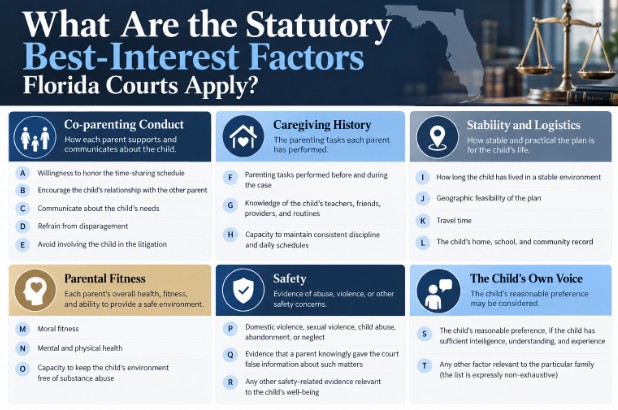
Fla. Stat. § 61.13(3) lists 20 factors, lettered (a) through (t), and the best interests of the child govern every parenting determination.
The list is expressly non-exhaustive; factor (t) permits the court to weigh anything else relevant to the particular family.
The factors group into recognizable evidentiary themes:
- Co-parenting conduct — willingness to honor the schedule, encourage the child’s relationship with the other parent, communicate about the child, and refrain from disparagement or involving the child in the litigation.
- Caregiving history — the parenting tasks each parent performed before and during the case, knowledge of the child’s teachers, friends, providers, and routines, and capacity to maintain consistent discipline and daily schedules.
- Stability and logistics — how long the child has lived in a stable environment, the plan’s geographic feasibility, travel time, and the child’s home, school, and community record.
- Parental fitness — moral fitness, mental and physical health, and capacity to keep the child’s environment free of substance abuse.
- Safety — evidence of domestic violence, sexual violence, child abuse, abandonment or neglect, and evidence that a parent knowingly gave the court false information about such matters.
- The child’s own voice — factor (i) permits the court to weigh a child’s reasonable preference where the child has sufficient intelligence, understanding, and experience, with no fixed statutory age.
Because the court must enter written findings on the applicable factors, each proposed schedule needs record evidence addressing the best-interest factors a parent intends to rely on.
How Do Broward County Judges Apply the Presumption in Practice?
Broward County adds procedural machinery that sets the order in which a time-sharing dispute reaches a hearing. The Seventeenth Judicial Circuit governs these cases through its Unified Family Court divisions and several standing administrative orders.
| Administrative Order | What It Establishes | Scope and Effect |
| 2026-06-UFC (Feb. 26, 2026) | Temporary relief other than child support limited to one hour per case; temporary child support limited to 30 minutes | Applies to temporary hearings only, not final hearings, unless the assigned judge or general magistrate authorizes additional time |
| 2026-06-UFC, paragraph 3 | No temporary relief hearing set until the parties submit to mediation and report an impasse | Mediation precedes any temporary time-sharing ruling; failure to appear draws an assessment of costs |
| 2026-05-UFC (Amendment 1) (Apr. 10, 2026) | Uniform Order of Referral to Family Mediation for Unified Family Court divisions | State-subsidized conferences priced at $120 or $240 by combined income and capped at three hours; private mediation is separately negotiated |
| 2019-15-UFC (Feb. 21, 2019) | Status Quo Temporary Domestic Relations Order for dissolution and paternity actions | Use is discretionary with each judge; where adopted, it binds the petitioner at filing and the respondent at service |
| 2019-15-UFC, paragraph 3 | Shared parenting guidelines, including joint conferral on education, discipline, religion, medical care and general upbringing | Expressly limited to dissolution of marriage cases |
| 2019-15-UFC, paragraph 4 | Four-hour Parent Education and Family Stabilization Course under Fla. Stat. § 61.21 | Dissolution: petitioner 45 days from filing, other parties 45 days from service. Paternity: petitioner 45 days from filing; other party 45 days from acknowledgment or adjudication of paternity, or an order granting that party time-sharing or support |
Two points follow for a Broward County parent. Mediation is the first required settlement stage before a contested temporary hearing can be set — it is a negotiation process, not a judicial determination of whether the presumption has been rebutted, which remains the court’s function.
And the one-hour limit governs the temporary stage only; a final hearing is not subject to it. Preparing for divorce mediation therefore carries weight it would not carry in a circuit without this sequencing.
Mediation impasse must be reported before a Broward temporary time-sharing hearing is set. Levine Family Law prepares parents for that session — schedule a consultation.
If you’re ready to get started, call us now!
What Is a Parenting Plan and What Must It Contain?
A parenting plan is the court-approved document that governs time-sharing and parental responsibility and is required in every Florida case involving a minor child. Fla. Stat. § 61.13(2)(b) fixes five minimum contents.
The plan must describe in adequate detail how the parents will share the daily tasks of raising the child. It must set out the time-sharing schedule specifying the time the child spends with each parent.
It must designate responsibility for health care, school-related matters (including the address used for school-boundary determination and registration), and other activities. It must describe the methods and technologies the parents will use to communicate with the child.
Unless both parents agree otherwise in writing, it must designate authorized exchange locations, and the court may require a neutral safe exchange location under Fla. Stat. § 125.01(8) where it finds a risk or imminent threat of harm.
Parental responsibility is a separate question from the schedule. Under § 61.13(2)(c)2, the court orders shared parental responsibility unless it finds shared decision-making would be detrimental to the child.
A parent with a minority of overnights can still have full joint decision-making authority, so the parenting plan should address each separately. The Florida Supreme Court-approved forms are published through the state courts’ self-help resources.
How Is a Time-Sharing Schedule Actually Built?
A workable schedule starts from the annual overnight count and works backward into the weekly rotation, because the overnight allocation drives both the plan and the support calculation.
Three structural decisions shape most plans. Exchange frequency comes first: rotations moving the child several times a week require short travel distances and cooperative communication, while week-on, week-off rotations reduce handoffs but lengthen the interval between contacts.
School logistics come second, since factor (e) directs the court to the plan’s geographic viability, with particular attention to school-age children and travel time.
Holiday and school-break allocation comes third, and specificity matters—start and end times with fixed or alternating assignments leave nothing for a later dispute to turn on.
The statute requires describing the methods and technologies for parent-child contact without prescribing particular terms.
Common drafting choices include naming the co-parenting application, specifying video-call arrangements during extended periods with one parent, and stating that the child does not carry messages between households.
Parents across Hollywood, Margate, Coconut Creek, and Pembroke Pines who settle these terms in mediation resolve them outside the one-hour temporary hearing.
When Will a Court Order Something Other Than Equal Time-Sharing?
A court departs from equal time-sharing when the opposing parent proves, by a preponderance of the evidence, that a 50/50 arrangement does not serve the child’s best interests, supported by the written findings § 61.13(2)(c)1 requires.
Certain fact patterns carry independent statutory weight. Fla. Stat. § 61.13(2)(c)3 creates a rebuttable presumption that shared parental responsibility is detrimental where a parent has been convicted of a first-degree misdemeanor or higher involving domestic violence, meets the criteria of § 39.806(1)(d), or has been convicted of or had adjudication withheld for an enumerated offense against a victim under 18. Where that presumption stands unrebutted after the court advises the parent of it, shared parental responsibility and time-sharing may not be granted to that parent, though the support obligation continues.
Section 61.13(2)(c)6 applies a parallel presumption against time-sharing, rebuttable only on a specific written finding that the parent poses no significant risk of harm.
Outside those categories, departures rest on record evidence tied to the statutory factors: attendance records covering exchanges, medical and school records, work schedules bearing on availability, or documented substance abuse.
Interference with time-sharing rights bears directly on factor (a).
How Is an Existing Time-Sharing Order Modified?
Modification requires two showings: a substantial and material change in circumstances since the last order, and proof that the change serves the child’s best interests. Fla. Stat. § 61.13(3) states both elements.
The 2023 amendment eliminated the additional requirement that the change be unanticipated, which lowered the threshold without removing it. Disagreement about parenting style or a preference for a different rotation does not satisfy the standard on its own.
Circumstances a parent may present include a relocation, a change in work schedule affecting availability, a documented deterioration in a parent’s capacity to care for the child, or a shift in the child’s educational or medical needs the existing schedule cannot accommodate.
The 50-mile provision operates narrowly. It applies only where the parents resided more than 50 miles apart when the last time-sharing order was entered, and one parent then moves within 50 miles of the other.
A move beyond 50 miles is governed by the separate relocation statute. Broward petitions are filed through the Family Division, and Broward court procedures determine docketing.
Enforcement follows a distinct track: schedule violations are addressed through the contempt and make-up time-sharing remedies in § 61.13(4), which do not provide a basis for permanent modification.
How Does Time-Sharing Affect Child Support in Florida?
Overnights change the support calculation without displacing the obligation. Fla. Stat. § 61.13(5) states that an order for equal time-sharing does not preclude an order for child support, because Fla. Stat. § 61.30 allocates the obligation by each parent’s share of combined income.
| Annual Overnights With the Minority-Time Parent | Method Applied | Effect on the Obligation |
| Fewer than 73 (under 20% of the year) | Standard guideline calculation under § 61.30(6) | No time-sharing adjustment; obligation follows income shares and the guideline schedule |
| 73 or more (at least 20% of the year) | Gross-up method under § 61.30(11)(b) | Basic obligation increased by 50%, then allocated by income share and overnight distribution |
| Equal or near-equal split | Gross-up method under § 61.30(11)(b) | Gross-up reduces the calculated obligation; the result depends on both parents’ incomes, the guideline schedule, and allowable adjustments |
The 73-overnight threshold is exact rather than approximate, which makes schedule drafting financially consequential — a plan producing 72 overnights and one producing 73 are calculated under different methods.
Health insurance is also treated differently under equal schedules: § 61.13(1)(b) provides that where the plan calls for equal time-sharing, coverage is accessible if usable in either county where the child resides, or another county if both parents agree.
Modeling support calculations against a proposed rotation before agreeing to it avoids reopening the question later.
Contact Us Today For An Appointment
Frequently Asked Questions
Does Florida automatically order 50/50 time-sharing?
No. Florida law presumes that equal time-sharing serves the child’s best interests, but the presumption is rebuttable. A parent who presents evidence under the 20 statutory factors in Fla. Stat. § 61.13(3) can persuade the court to order an unequal schedule.
What burden of proof applies to rebut the equal time-sharing presumption?
A preponderance of the evidence. The parent opposing equal time-sharing must show, by a preponderance of the evidence, that a 50/50 schedule does not serve the child’s best interests. Fla. Stat. § 61.13(2)(c)1 sets this standard for every contested case.
Do Broward County judges have to explain a time-sharing decision in writing?
Yes, in contested cases. Fla. Stat. § 61.13(2)(c)1 requires the court to evaluate every best-interest factor and enter specific written findings of fact whenever it creates or modifies a schedule. Schedules the parents agree on and the court approves are excepted.
Is mediation required before a Broward time-sharing hearing?
Yes, before a temporary one. Administrative Order 2026-06-UFC bars the Seventeenth Judicial Circuit from setting any temporary relief hearing, including time-sharing, until the parties attend mediation and report an impasse. Missing a scheduled session exposes a parent to costs.
How long does a Broward County temporary time-sharing hearing last?
One hour per case, unless the assigned judge or general magistrate authorizes more. Administrative Order 2026-06-UFC sets that limit for temporary relief other than child support, which receives 30 minutes. The limit governs temporary hearings, not final hearings.
Does a parent still pay child support under a 50/50 schedule?
Often yes. Fla. Stat. § 61.13(5) confirms that an equal time-sharing order does not bar a support award. Section 61.30 apportions the obligation by income share and applies the gross-up method, so a support obligation can remain even with evenly split overnights.
How many overnights trigger the child support gross-up?
Seventy-three overnights a year, which equals 20% of the calendar. Fla. Stat. § 61.30(11)(b) then applies the gross-up method, raising the basic obligation by 50% before dividing it between the parents according to income and overnight distribution. The threshold is exact, not approximate.
What standard applies to modifying a Florida time-sharing order?
A substantial and material change in circumstances since the last order, plus proof that the change serves the child’s best interests. Fla. Stat. § 61.13(3) states both elements. The 2023 amendment removed the separate requirement that the change be unanticipated.
When must Broward parents complete the parenting course?
Dissolution petitioners have 45 days from filing and other parties 45 days from service. In paternity cases, the other party’s 45 days runs from acknowledgment or adjudication of paternity, or an order granting that party time-sharing or support. Administrative Order 2019-15-UFC sets both.
Bottom Line
- Equal time-sharing is Florida’s starting point, and rebutting it requires a preponderance of the evidence organized around the statutory factors.
- Broward County requires a reported mediation impasse before a temporary time-sharing hearing, which is capped at one hour.
- Equal time-sharing does not preclude a support award, and the gross-up method turns on an exact 73-overnight threshold.
Florida requires written findings on the statutory factors, which rest on evidence in the record. Scott Levine offers Broward County parents a confidential case review.