
Broward County family court handles divorce, paternity, support, and related family law cases in Florida’s Seventeenth Judicial Circuit, with the Broward County Clerk of Courts handling filings at the Central Courthouse in Fort Lauderdale.
Florida’s statewide procedural rules, Broward administrative orders, and the assigned judge’s procedures govern filing, disclosure, mediation, and trial preparation.
Deadlines usually run from a specific event, such as service or a scheduled trial date, so parties must identify the applicable trigger before calculating when a response or document exchange is due.
Key Takeaways
- Broward family filings go through the Clerk of Courts at the Central Courthouse, Judicial Complex West Building, 201 S.E. 6th Street, Fort Lauderdale.
- Florida Family Law Rule 12.100(c)(3) requires a completed family court cover sheet, and proceedings are abated until the required form is properly filed.
- Florida Family Law Rule 12.285 generally requires mandatory financial disclosure within 45 days after service on the respondent when the rule applies.
- Broward Administrative Order 2026-06-UFC requires mediation and a reported impasse before the Family Division sets a temporary relief hearing.
Court deadlines can feel overwhelming. Scott A. Levine offers a confidential consultation to clarify filing requirements and next steps for Broward families.
Where Are Family Law Cases Filed in Broward County?
Family cases are filed with the Broward County Clerk of Courts. The Clerk’s Family Division handles matters including adoptions, termination of parental rights, paternity, child support, dissolution of marriage, name changes, annulments, and emancipations.
The Central Courthouse is located at 201 S.E. 6th Street in Fort Lauderdale.
The Clerk publishes current locations, office hours, filing information, fees, and self-help resources, so parties should confirm those details before an in-person visit.
Electronic filing is available through the statewide Florida Courts E-Filing Portal. Filing procedures differ depending on whether the filer is an attorney or a self-represented litigant and on the type of document being submitted.
The courthouse complex also provides self-help and law-library resources. Those services can help people locate forms and procedural information, but court and Clerk personnel cannot provide individualized legal advice.
Which Judicial Divisions Hear Family Law Matters?
Broward’s Seventeenth Judicial Circuit uses different divisions for general family cases, matters referred to general magistrates, Title IV-D child support cases, dependency, delinquency, and civil domestic violence matters.
Administrative Order 2026-33-UFC, effective Sep 14, 2026, establishes the current distribution system:
| Case Type | Divisions | Distribution Method |
| General family cases | 33, 35, 36, 37, 38, 40, 41, 42, 44 | Distributed equally, except as otherwise directed by the Administrative Judge or designee |
| Family cases assigned to general magistrates | 90, 91, 93, 98, 99 | 20% to each division |
| Title IV-D child support before hearing officers | 94, 95, 96 | Assigned according to the family/dependency division identified in AO 2026-33-UFC |
| Civil domestic violence | 59/57, 63, 45 | 37.5%, 37.5%, and 25%, respectively |
| Dependency | JM/30, JO/32, JQ/34, JT/46 | Equal distribution of Chapter 39 cases, subject to the exceptions in the order |
| Delinquency | JA, JB, JC, JD | Assigned by the Clerk |
Division assignments are based on Administrative Order 2026-33-UFC, effective Sep 14, 2026, which superseded Administrative Order 2026-10-UFC.
The order also provides that when a pleading or paper is filed in a closed Family Division case, the Clerk randomly reassigns the case among Divisions 33, 35, 36, 37, 38, 40, 41, 42, and 44.
A separate Clerk fee may apply when a closed case is reopened, and judicial action is required.
Division assignment matters because judges publish their own practices and procedures for scheduling, submission of materials, hearing logistics, and other division-specific matters.
Parties should review the assigned division’s procedures rather than assuming every Broward family judge handles hearings the same way.
What Documents Are Required to Open a Family Law Case?
The documents needed to open a Broward family case depend on the type of proceeding. Someone filing for divorce needs documents specific to dissolution of marriage.
A typical case may require a petition, summons, family court cover sheet, and additional identifying, financial, or child-related forms.
The precise package depends on the proceeding being filed, not on a one-size-fits-all approach.
Florida Family Law Rule of Procedure 12.100(c)(3), accessible through Florida Courts’ rules directory, requires Form 12.928, the Cover Sheet for Family Court Cases. If a party does not file the required cover sheet, the Court will abate proceedings until a properly executed cover sheet is filed.
The rule also addresses the Clerk’s responsibilities when a self-represented party files without completing the cover sheet.
Depending on the case, additional forms may include a Notice of Social Security Number, financial affidavit, Uniform Child Custody Jurisdiction and Enforcement Act affidavit when applicable, and Notice of Related Cases.
A dissolution of marriage also requires satisfaction of Florida’s residency requirement. Under section 61.021, Florida Statutes, at least one party must have resided in Florida for at least six months before filing the petition.
As of September 2026, the Broward Clerk lists a $409 filing fee for dissolution or annulment, $392.50 for a domestic-relations counter-petition, $301 for family actions under Chapters 742, 752, and 753, and $10 to issue each summons.
The Clerk also lists a $50 fee for qualifying reopen filings requiring judicial action.
The Clerk accepts specified forms of payment and does not accept personal checks.
A person who qualifies for civil indigent status under section 57.082, Florida Statutes, may have filing and summons fees waived, although other costs may not be waived.
Because fees and filing requirements can change, confirm current amounts and procedures with the Broward County Clerk before filing.
What Is Mandatory Disclosure and When Is It Due?
Mandatory disclosure is the exchange of financial information required by Florida Family Law Rule of Procedure 12.285 in proceedings covered by that rule.
When Rule 12.285 applies, the required financial documents generally must be served within 45 days after service of the initial pleading on the respondent, unless the rule, an agreement permitted by the rule, or a court order provides otherwise.
This requirement does not apply to every family-law proceeding. Rule 12.285 contains express exceptions, including proceedings involving adoption, simplified dissolution, enforcement, contempt, certain injunction proceedings, and specified uncontested dissolutions involving service by publication.
The rule also permits modification of portions of mandatory disclosure in certain circumstances.
Parties should therefore determine whether Rule 12.285 applies to their particular proceeding rather than assuming that every family case carries the same disclosure requirements.
When a financial affidavit is required, the applicable form depends on income. A party with gross annual income below $50,000 generally uses Form 12.902(b), while a party with gross annual income of $50,000 or more generally uses Form 12.902(c). Circumstances may require additional financial information.
Parties subject to automatic mandatory disclosure also use the applicable certificate of compliance to identify the documents served.
Mandatory disclosure should also be distinguished from filing documents in the public court record.
Rule 12.285 governs what must be exchanged and what must be filed, and parties should follow the rule’s requirements concerning financial affidavits, supporting financial documents, and certificates of compliance rather than assuming every document exchanged with the other side should be filed with the court.
Financial information may also need updating as a case proceeds. A financial affidavit that accurately reflected a party’s circumstances early in a case may no longer be sufficient if material financial circumstances change.
Court employees can explain filing procedures, but they cannot advise a party on what to disclose in a particular financial dispute.
That distinction matters most in cases involving alimony, child support, business interests, or significant marital assets.
When Is Mediation Required Before a Temporary Relief Hearing?
For temporary relief in Broward’s Family Division, mediation and a reported impasse must precede scheduling the hearing. Parties should check the assigned judge’s procedures before requesting hearing time.
Administrative Order 2026-06-UFC provides that no temporary relief hearing may be set unless the parties first submitted to mediation and reported an impasse.
The order also provides for the imposition of costs when a party fails to appear for scheduled mediation.
Administrative Order 2026-05-UFC, Amendment 1, establishes the circuit’s uniform order for referring family cases to mediation.
Administrative Order 2026-06-UFC also limits the time ordinarily allocated to temporary relief matters. Requests for temporary child support are scheduled for no more than 30 minutes per case unless the assigned judge or general magistrate instructs otherwise.
Other temporary relief issues, including spousal support, time-sharing, exclusive use and possession, and attorney’s fees and costs, are generally limited to one hour per case unless the assigned judge or general magistrate authorizes otherwise.
When both parties file temporary-relief motions, the order generally calls for the matters to be heard together unless the assigned judge or general magistrate determines that doing so is impracticable.
Parties should also distinguish the temporary-relief mediation requirement from other mediation obligations that may arise later in the case.
Broward’s Uniform Trial Order, for example, requires a written mediation impasse addressing the issues to be tried at least seven days before the first day of trial in cases governed by that order.
Does Broward Use a Status Quo Order in Divorce and Paternity Cases?
Broward judges may use a status quo order in divorce and paternity cases, but use is discretionary, not automatic.
Administrative Order 2019-15-UFC authorizes a Status Quo Temporary Domestic Relations Order for dissolution of marriage and paternity actions. Importantly, the administrative order makes its use discretionary with each judge. An assigned judge may use the status quo order and may modify, terminate, or amend its terms as appropriate.
When an assigned judge uses the order, the petitioner or the petitioner’s counsel must provide it to the respondent with the petition at service.
The status quo order addresses subjects such as preservation of assets, insurance, conduct affecting children, and other matters during the case. Because its application depends on the assigned judge, parties should review that division’s procedures and the order entered or applied in their case.
Uncertainty about temporary support adds financial pressure. Scott A. Levine offers private consultations to discuss preparation for Broward mediation and hearings.
If you’re ready to get started, call us now!
How Long Does a Broward County Family Case Typically Take?
Broward family cases have no single fixed duration; settlement, discovery, disputed finances, parenting disagreements, and court scheduling determine how quickly a case progresses.
Instead, cases move through a series of deadlines triggered by events such as filing, service, entry of a trial order, and the scheduled trial date.
Settlement, contested issues, discovery, mediation, judicial availability, motion practice, and the complexity of the parties’ finances or parenting dispute can all affect the total duration.
Examples of important statewide and Broward-specific timing rules include:
| Deadline | Trigger | Authority |
| Response to initial pleading. Generally 20 days | Service of original process and initial pleading | Fla. Fam. L. R. P. 12.140(a)(1) |
| Mandatory disclosure. Generally 45 days when Rule 12.285 applies | Service of initial pleading on respondent | Fla. Fam. L. R. P. 12.285 |
| Mediation before temporary relief | Before temporary relief hearing is set | AO 2026-06-UFC |
| Witness lists | 45 days before first day of trial | Broward Uniform Trial Order |
| Exhibit lists | 45 days before first day of trial | Broward Uniform Trial Order |
| Rebuttal witness list | 30 days before first day of trial | Broward Uniform Trial Order |
| Proposed parenting plan when disputed | 15 days before first day of trial | Broward Uniform Trial Order |
| Discovery completion | 15 days before first day of trial, subject to the order’s provisions | Broward Uniform Trial Order |
| Exhibit exchange and exhibit log | 10 days before first day of trial | Broward Uniform Trial Order |
| Written mediation impasse | At least 7 days before first day of trial | Broward Uniform Trial Order |
| Joint pretrial stipulation | At least 5 days before first day of trial | Broward Uniform Trial Order |
| Memoranda/legal authority | At least 5 calendar days before hearing/trial | Broward Uniform Trial Order |
| Exhibits premarked | Before the hearing/trial begins; checklist identifies 1 day before trial | Broward Uniform Trial Order |
The trial deadlines above come from Broward’s Uniform Trial Order established through Administrative Order 2020-91-UFC.
That order applies to contested family cases governed by the order and expressly excludes dependency, delinquency, domestic violence cases, and cases referred to general magistrates for trial.
The order also permits some deadlines to be changed in specified circumstances, including by a written stipulation ratified by the court for certain discovery and witness/exhibit deadlines.
Parties should follow the orders actually entered in their case.
Once a contested case is at issue and ready for trial under Florida Family Law Rule of Procedure 12.440, either party may file and serve a notice of readiness for trial. Under Administrative Order 2020-91-UFC, the presiding judge then assigns a trial date without another hearing.
What Happens at Each Stage, From Filing to Final Judgment?
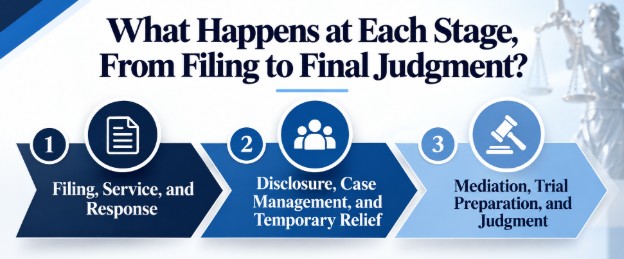
For dissolution cases, the divorce process follows the stages below. Other family proceedings may follow a different sequence.
Filing, Service, and Response
The case begins with the appropriate petition and required opening documents. After filing, the respondent must generally be formally served unless an applicable rule or law provides another procedure.
If the assigned judge uses Broward’s status quo temporary order in a dissolution or paternity action, the petitioner or petitioner’s counsel provides the order to the respondent with the petition at the time of service.
Parties should read the actual order because it may impose immediate restrictions and obligations.
A respondent may answer, file an answer and counter-petition, or file an authorized motion directed to the pleading. Under Rule 12.140(a)(1), the ordinary response period is 20 days after service of original process and the initial pleading unless a different period applies.
A party who fails to respond may face default procedures, but default does not necessarily eliminate the petitioner’s obligation to establish the legal basis for the relief requested.
Disclosure, Case Management, and Temporary Relief
When Rule 12.285 applies, the parties complete mandatory financial disclosure and any required certificates of compliance. The parties may also use other discovery procedures permitted by the Florida Family Law Rules of Procedure.
The court may use case-management procedures to identify disputed issues, address discovery, make referrals, and move the case toward resolution or trial.
Under Administrative Order 2026-06-UFC, the court cannot set a temporary relief hearing until the parties have submitted to mediation and reported an impasse. Hearing length and scheduling then depend on the type of temporary relief and the assigned judge or general magistrate’s procedures.
Mediation, Trial Preparation, and Judgment
Mediation may occur at multiple stages. It may be required before temporary relief and before trial. Settlement of some issues does not necessarily resolve every issue in the case.
Once a contested case governed by Broward’s Uniform Trial Order is set for trial, the order’s deadline schedule controls witness lists, exhibit lists, discovery completion, exhibit exchange, mediation impasse, pretrial stipulation, and other trial-preparation requirements.
The court decides unresolved issues after the required proceedings. The final judgment establishes the court’s final rulings on the matters before it, subject to any authorized post-judgment or appellate proceedings.
Later disputes about compliance may raise questions about enforcement and contempt after the court enters the final judgment.
Contact Us Today For An Appointment
Frequently Asked Questions
Where are family law cases filed in Broward County?
Broward County family cases are filed with the Clerk of Courts at the Central Courthouse in Fort Lauderdale. The Family Division handles divorce, paternity, support, and other domestic proceedings. Electronic filing is also available through Florida’s statewide portal, subject to applicable filing procedures.
What happens if the family court cover sheet is missing?
A missing required family court cover sheet causes proceedings to be abated under Florida Family Law Rule 12.100(c)(3). The party must file a properly executed Form 12.928 before proceedings continue. The rule also explains the Clerk’s responsibilities when self-represented parties omit the form.
How much does it cost to file a divorce in Broward County?
The Broward Clerk lists a $409 dissolution filing fee and $10 for each summons as of September 2026. Additional services can create separate charges. Qualifying applicants may receive filing and summons fee waivers through civil indigent status; other expenses may still remain payable.
How long does a respondent have to answer in Florida?
A respondent in a Florida family case generally has 20 days after service of the original process and the initial pleading to serve a response under Rule 12.140(a)(1). A different statute or applicable provision can change that period, so the served documents and governing rule require review.
When is mandatory financial disclosure due?
Mandatory financial disclosure generally must be served within 45 days after service of the initial pleading on the respondent when Florida Family Law Rule 12.285 applies. Exceptions and permitted modifications vary by proceeding. Parties should distinguish documents exchanged privately from documents required for filing.
Which financial affidavit form applies?
A required Florida family financial affidavit generally uses Form 12.902(b) when gross annual income is below $50,000 and Form 12.902(c) when income reaches $50,000 or more. Parties must check the applicable rule and case circumstances to determine filing requirements and necessary supporting financial information.
Is mediation required before a temporary relief hearing?
Broward Administrative Order 2026-06-UFC requires mediation and a reported impasse before setting a temporary relief hearing. Temporary child support hearings ordinarily receive 30 minutes; other temporary matters ordinarily receive one hour. The assigned judge or general magistrate may authorize different hearing arrangements.
What should a proposed parenting plan address?
A proposed parenting plan should address the parenting arrangements disputed in the Broward case. The firm’s guide to parenting plans explains local time-sharing standards. Under Broward’s Uniform Trial Order, disputed proposed plans generally must be filed at least 15 days before trial begins.
What is Broward’s Uniform Motion Calendar?
Broward’s Uniform Motion Calendar handles short motions under Local Rule 10A, generally from 8:45 to 9:30 a.m., Monday through Thursday. Scheduling ordinarily occurs electronically at least five days beforehand. Parties must attempt to resolve or narrow the dispute and follow the assigned division’s procedures.
When are witness lists and exhibits due before trial?
Broward’s Uniform Trial Order generally requires witness and exhibit lists 45 days before trial, rebuttal witness lists 30 days before trial, and exhibit exchange 10 days before trial. Court-approved changes may affect those deadlines. Parties must follow the actual trial order governing their case.
Preparing for Broward Family Court
Broward family-court procedure combines Florida rules, local administrative orders, and the assigned judge’s directions. Parties must calculate deadlines from the correct triggering event and follow the orders entered in their case. Required disclosure, mediation, and trial preparation depend on the proceeding.
Protecting your family starts with clarity. Scott A. Levine offers a confidential case review to discuss your Broward family matter and next steps.