
Broward County child custody cases require a court-approved parenting plan that assigns timesharing schedules, decision-making authority, and child support obligations under F.S. §61.13.
Florida’s 2023 reform (HB 1301) added a rebuttable presumption that equal timesharing serves the child’s best interest — shifting how Broward County judges build parenting plans from the first hearing forward.
Scott A. Levine, Esq., Florida Supreme Court Certified Family Mediator, FL Bar #89788, has represented parents in Broward County custody, timesharing, and child support cases since 1996 — including 45+ trials as lead counsel.
The firm handles initial custody establishment, contested modifications, enforcement of violated orders, and child support calculations for parents across Fort Lauderdale, Hollywood, Pembroke Pines, Plantation, and Coral Springs.
Custody disputes that drag on without a structured parenting plan cost parents thousands in legal fees and cost children months of instability. Scott A. Levine, Esq., builds enforceable plans that reduce repeat conflict — schedule a consultation.
How Does Florida Determine Child Custody and Timesharing?
Florida courts determine custody by evaluating the child’s best interests under 20 statutory factors listed in F.S. §61.13(3), then developing a parenting plan that assigns timesharing and parental responsibility.
Since July 1, 2023, Broward County judges have begun every custody determination from a rebuttable presumption that equal timesharing (50/50) serves the child’s best interest under HB 1301 (Chapter 2023-301).
Either parent can rebut the 50/50 presumption by proving, by a preponderance of the evidence, that equal timesharing does not serve the child’s best interest.
Grounds that commonly rebut the presumption in Broward County cases include a history of domestic violence, substance abuse, significant geographic distance between parents’ homes, a parent’s documented inability to provide consistent care, or a work schedule incompatible with overnight responsibility.
Florida uses the term “parental responsibility” rather than “custody.” Parental responsibility falls into two categories:
- Shared parental responsibility — Both parents retain full parental rights and share decision-making authority on education, healthcare, and extracurricular commitments. Broward County courts presume shared responsibility unless evidence demonstrates it would harm the child.
- Sole parental responsibility — One parent holds exclusive decision-making authority. Courts award sole responsibility only when shared responsibility would be detrimental to the child — typically in cases involving abuse, neglect, or incarceration.
The court evaluates each parent’s involvement in the child’s daily life, the stability of each home environment, the child’s school and community ties, each parent’s willingness to encourage the child’s relationship with the other parent, and the child custody factors that carry the most weight in the 17th Judicial Circuit.
What Should a Broward County Parenting Plan Include?
A Broward County parenting plan must address every recurring decision point that generates conflict between co-parents — timesharing schedules, holiday rotations, transportation, education, healthcare, communication, and travel.
Florida law requires a written parenting plan in every case involving minor children under F.S. §61.13(2)(b). Vague plans produce repeat motions; specific plans produce stability.
| Component | What the Plan Decides | Why Specificity Prevents Conflict |
| Timesharing schedule | Weeknights, weekends, overnights | Defines the overnight count that drives child support calculations |
| Holiday and break rotation | Major holidays, school breaks, birthdays | Eliminates annual disputes over Thanksgiving, winter break, and summer break |
| Transportation | Exchange locations, times, and driving responsibility | Removes ambiguity about who drives, where, and when |
| Education decisions | Enrollment authority, record access, conference attendance | Prevents unilateral school changes or information blocking |
| Healthcare decisions | Provider selection, consent authority, emergency protocols | Establishes who authorizes treatment and how emergencies are handled |
| Communication | Parent-child contact methods, co-parent response expectations | Reduces escalation by setting boundaries on frequency and platform |
| Travel and relocation | Travel notice requirements, passport custody, relocation provisions | Prevents one parent from moving the child without court approval |
The strongest parenting plans anticipate the pressure points that generate motions — late pickups, unilateral medical decisions, surprise travel, and blocked communication. Plans drafted with courtroom-level specificity reduce the likelihood of returning to court within the first two years.
A parenting plan that reads like a handshake agreement gives Broward County judges nothing to enforce when cooperation breaks down. Scott A. Levine, Esq. drafts plans with the specificity that makes enforcement straightforward — schedule a consultation or call (954) 587-2244.
How Is Child Support Calculated in Fort Lauderdale?
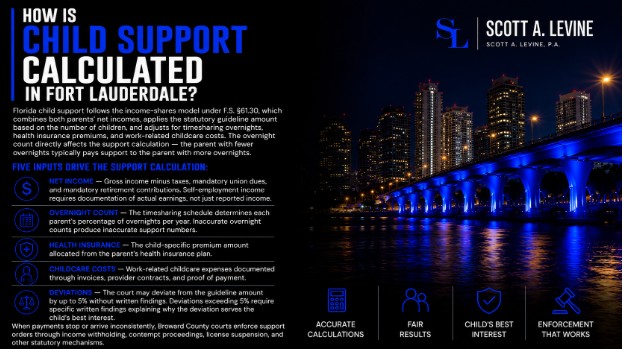
Florida child support follows the income-shares model under F.S. §61.30, which combines both parents’ net incomes, applies the statutory guideline amount based on the number of children, and adjusts for timesharing overnights, health insurance premiums, and work-related childcare costs.
The overnight count directly affects the support calculation — the parent with fewer overnights typically pays support to the parent with more overnights.
Five inputs drive the support calculation:
- Net income — Gross income minus taxes, mandatory union dues, and mandatory retirement contributions. Self-employment income requires documentation of actual earnings, not just reported income.
- Overnight count — The timesharing schedule determines each parent’s percentage of overnights per year. Inaccurate overnight counts produce inaccurate support numbers.
- Health insurance — The child-specific premium amount allocated from the parent’s health insurance plan.
- Childcare costs — Work-related childcare expenses documented through invoices, provider contracts, and proof of payment.
- Deviations — The court may deviate from the guideline amount by up to 5% without written findings. Deviations exceeding 5% require specific written findings explaining why the deviation serves the child’s best interest.
When payments stop or arrive inconsistently, Broward County courts enforce support orders through income withholding, contempt proceedings, license suspension, and other statutory mechanisms.
Parents facing nonpayment should document the arrears with payment records and promptly file an enforcement motion.
Can You Modify an Existing Custody or Support Order?
A Broward County court can modify an existing custody or support order when the requesting parent demonstrates a substantial change in circumstances that is material, involuntary, and permanent or long-term.
The 2023 reform (HB 1301) eliminated the prior requirement that the change be “unanticipated” — any substantial and material change now supports a modification petition under F.S. §61.13(3).
Common grounds for custody modification in Broward County include a parent’s relocation, a child’s changing educational or medical needs, a parent’s documented inability to follow the existing plan, or a pattern of timesharing interference. Common grounds for support modification include a substantial change in either parent’s income, a change in the overnight count, or a change in the child’s healthcare or childcare needs.
The modification process requires filing a supplemental petition with the Broward County Clerk of Court, serving the other parent, exchanging updated financial disclosures, and proceeding through mediation before trial.
Parents who document the change with pay records, calendars, and written communications build stronger petitions than parents who rely on verbal testimony alone.
How Much Does a Child Custody Attorney Cost in Broward County?
Broward County child custody attorneys charge $260–$600 per hour in 2026, with most family law practitioners billing $300–$400 per hour. Initial retainers range from $2,500 to $5,000 for straightforward custody matters and $5,000 to $7,500 for contested cases involving disputed timesharing, relocation, or modification.
| Cost Category | Range (2026) | Notes |
| Attorney’s hourly rate | $260–$600/hr | Most family law: $300–$400/hr |
| Initial retainer (uncontested) | $2,500–$5,000 | Applied against hourly billing |
| Initial retainer (contested) | $5,000–$7,500 | Reflects anticipated attorney hours |
| Filing fee (Broward Clerk) | $409 | Per the petition for dissolution |
| Modification filing fee | $295 | Per supplemental petition |
| Mediation (private) | $200–$500/hr | Typically split between parents |
F.S. §61.16 authorizes Broward County judges to order one parent to contribute to the other parent’s attorney fees when a significant income disparity exists.
The court evaluates each parent’s financial resources, earning capacity, and the reasonableness of the fees requested. Parents with limited income should raise the fee-shifting issue early in the case.
What Happens When a Parent Violates a Custody Order?
A parent who violates a Broward County custody order — by withholding timesharing, blocking communication, making unilateral decisions, or relocating without court approval — faces enforcement through contempt proceedings under F.S. §61.13(4).
The parent seeking enforcement must file a motion that documents the specific violations, including dates, written communications, and any evidence of the child’s disrupted schedule.
Broward County courts can impose remedies for custody violations:
- Make-up timesharing — The court orders additional overnights to compensate the parent whose time was withheld.
- Civil contempt — The violating parent faces fines, attorney fee awards to the other parent, or incarceration until compliance occurs.
- Modified parenting plan — Repeated violations may justify modifying the timesharing schedule to reduce the violating parent’s unsupervised access.
- Attorney fee shifting — The court may order the violating parent to pay the enforcing parent’s attorney’s fees and costs under F.S. § 61.16.
Parents who maintain a dated log of missed exchanges, saved text messages, and screenshots of blocked co-parenting communication build the strongest enforcement motions.
The court’s response to violations depends on the severity, frequency, and documentation quality that the enforcing parent provides.
Frequently Asked Questions
Does Florida presume 50/50 custody in every divorce?
Florida courts apply a rebuttable presumption of equal timesharing under HB 1301, effective July 1, 2023. The presumption means courts start from a 50/50 baseline, but either parent can rebut the presumption by proving equal timesharing does not serve the child’s best interest under F.S. §61.13.
Can a father get equal custody in Broward County?
Florida law does not favor mothers or fathers in custody determinations. F.S. §61.13 requires courts to evaluate both parents equally under the best-interest standard, and the 2023 equal timesharing presumption applies regardless of gender. Fathers who demonstrate active parental involvement receive equal consideration.
How do overnight counts affect child support in Florida?
The overnight count directly affects the child support calculation under the income-shares model in F.S. § 61.30. A parent with 20% of overnights pays more support than a parent with 40% of overnights, all other inputs held equal. Accurate timesharing calendars prevent support miscalculations.
What factors do Broward County judges consider in custody cases?
F.S. §61.13(3) lists 20 best-interest factors that Broward County judges evaluate, including each parent’s capacity to meet the child’s needs, the stability of each home, the child’s school and community ties, each parent’s willingness to encourage the other parent’s relationship, and any history of domestic violence.
Can I relocate with my child after a custody order is entered?
Florida Statute §61.13001 requires a parent to obtain either written consent from the other parent or court approval before relocating more than 50 miles from the current residence for more than 60 consecutive days. Unauthorized relocation can result in the court ordering the child’s return and modifying custody.
How long does a custody case take in Broward County?
Uncontested custody cases with agreed parenting plans typically finalize within six to ten weeks in Broward County. Contested cases involving disputed timesharing, relocation, or modification petitions take four to fourteen months, depending on mediation outcomes, discovery completion, and the court’s trial calendar.
Do I need a lawyer for a child custody case in Fort Lauderdale?
Florida does not require attorney representation in custody cases. Representation provides a measurable advantage when timesharing schedules are disputed, enforcement motions are filed, or the other parent has retained counsel. A custody attorney structures evidence and drafts enforceable parenting plan language to reduce recurring conflict.
Can child support be modified if my income changes?
Florida courts modify child support when a substantial change in income or circumstances makes the current order inequitable. The requesting parent must file a supplemental petition with the Broward County Clerk of Court and provide updated pay records, tax returns, and documentation showing when the change occurred.
Every week without a structured parenting plan and accurate support calculation costs Broward County parents time, money, and their children’s stability. Scott A. Levine, Esq., handles custody establishment, modifications, and enforcement under one retainer — schedule a consultation