
Florida eliminated permanent alimony on July 1, 2023, when Governor DeSantis signed CS/SB 1416 (Chapter 2023-315) into law. The reform replaced indefinite spousal support with durational caps tied to the length of the marriage, capped payments at 35% of the net income difference between spouses, and codified retirement as grounds for modification under the amended F.S. §61.08.
Scott A. Levine, Esq., Florida Supreme Court Certified Family Mediator, FL Bar #89788, has advised Broward County spouses on alimony and asset division since 1996 — through every prior reform attempt and through the three years since SB 1416 took effect.
Key Takeaways
- SB 1416 abolished permanent alimony in Florida effective July 1, 2023, leaving four remaining types: temporary, bridge-the-gap (2-year max), rehabilitative (5-year max), and durational (caps tied to marriage length).
- Durational alimony cannot exceed 50% of a short-term marriage (<10 years), 60% of a moderate-term marriage (10–20 years), or 75% of a long-term marriage (20 years or longer) under F.S. §61.08(8).
- Alimony payments cannot exceed the lesser of the recipient’s reasonable need or 35% of the difference between the parties’ net incomes — a hard statutory cap, not a guideline.
- The reform applies to all final judgments entered on or after July 1, 2023, but does not retroactively change pre-2023 alimony awards unless a party files for modification.
What Did Florida’s 2023 Alimony Reform Change?
SB 1416 made sweeping changes to Florida’s alimony statute (F.S. §61.08): the reform eliminated permanent alimony, imposed durational caps, introduced a 35% income cap, redefined marriage-length categories, codified retirement standards, and authorized courts to consider the economic impact of adultery.
The reform applies to every divorce for which a final judgment is entered on or after July 1, 2023.
| Feature | Pre-Reform Law (Before July 2023) | Post-Reform Law (SB 1416) |
| Permanent alimony | Available for long-term marriages | Eliminated — no longer awardable |
| Short-term marriage | Less than 7 years | Less than 10 years |
| Moderate-term marriage | 7–17 years | 10–20 years |
| Long-term marriage | 17+ years | 20 years or longer |
| Durational alimony cap | No statutory maximum | 50% / 60% / 75% of marriage length |
| Payment cap | No statutory formula | 35% of the net income difference |
| Adultery consideration | Not a statutory factor | Court may consider economic impact |
| Retirement | Court-created “reasonable retirement” standard | Codified; may petition 6 months before retirement |
Florida courts now recognize four alimony types:
- Temporary alimony — awarded during the divorce proceeding only, ending at final judgment.
- Bridge-the-gap alimony — covers short-term transitional needs, capped at two years, and cannot be modified in amount or duration.
- Rehabilitative alimony — supports education or job training under a specific written plan, capped at five years under F.S. §61.08(6).
- Durational alimony — provides support for a set period tied to marriage length, subject to both duration and income caps.
Three years after the reform, Broward County courts are still interpreting how SB 1416 applies to complex divorces involving long marriages and high-value assets. Scott A. Levine, Esq., navigates the new framework daily — schedule a consultation or call (954) 587-2244.
If you’re ready to get started, call us now!
How Do the New Durational Alimony Caps Work?
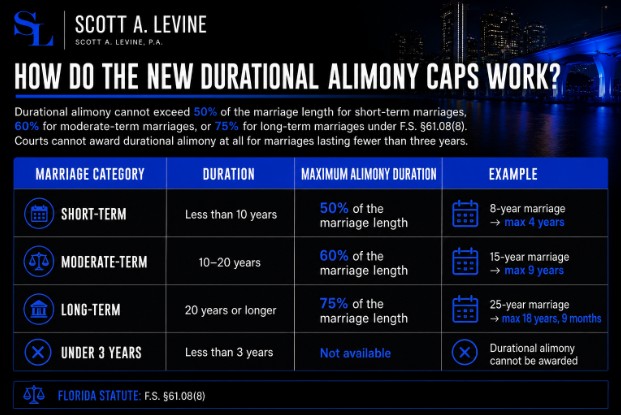
Durational alimony cannot exceed 50% of the marriage length for short-term marriages, 60% for moderate-term marriages, or 75% for long-term marriages under F.S. §61.08(8). Courts cannot award durational alimony at all for marriages lasting fewer than three years.
| Marriage Category | Duration | Maximum Alimony Duration | Example |
| Short-term | Less than 10 years | 50% of the marriage length | 8-year marriage → max 4 years |
| Moderate-term | 10–20 years | 60% of the marriage length | 15-year marriage → max 9 years |
| Long-term | 20 years or longer | 75% of the marriage length | 25-year marriage → max 18 years, 9 months |
| Under 3 years | Less than 3 years | Not available | Durational alimony cannot be awarded |
The marriage-length categories themselves shifted significantly. Under the old law, a 12-year marriage qualified as moderate-term (7–17 years). Under SB 1416, that same 12-year marriage still qualifies as moderate-term (10–20 years), but a 9-year marriage that previously fell in the moderate range now classifies as short-term — reducing the maximum durational award from 60% to 50% of the marriage length.
SB 1416 permits courts to exceed these caps only under “exceptional circumstances,” which the statute does not exhaustively define.
Broward County courts have begun interpreting this exception narrowly, typically reserving it for situations involving a spouse who became permanently disabled during the marriage and cannot achieve self-sufficiency.
Spouses navigating high-net-worth divorces near the 10- or 20-year threshold should evaluate how the timing of filing affects their marriage-length classification.
Does the 35% Income Cap Apply to Every Alimony Type?
The 35% cap applies specifically to durational alimony — the longest-term support option remaining after permanent alimony’s elimination. F.S. §61.08(8)(c) limits durational alimony to the lesser of the recipient’s reasonable need or 35% of the difference between the parties’ net incomes.
Bridge-the-gap alimony and rehabilitative alimony are not explicitly subject to the same statutory formula, though courts still evaluate need and ability to pay for every alimony type.
The cap operates as a hard ceiling, not a starting point. A Broward County judge determining durational alimony first calculates the net income difference between the spouses, applies the 35% cap, and then compares that figure against the recipient’s demonstrated reasonable need. The award cannot exceed the 35% cap or the demonstrated need, whichever is lower.
For example, if the paying spouse earns $12,000 per month net and the receiving spouse earns $4,000 per month net, the income difference is $8,000. The 35% cap limits durational alimony to $2,800 per month — but only if the recipient demonstrates a reasonable need of at least $2,800.
A recipient whose documented monthly expenses total $2,000 receives $2,000, not $2,800. Spouses should maintain detailed financial records to substantiate either need or ability to pay.
The 35% cap and durational limits make pre-filing financial preparation more consequential than under the old law. Scott A. Levine, Esq. structures alimony strategy around the specific math of each Broward County case — (954) 587-2244.
How Does Retirement Affect Alimony Under the New Law?
SB 1416 codified retirement as a statutory ground for alimony modification — replacing the vague “reasonable retirement” standard that Florida courts had developed through case law. Under the amended F.S. §61.14, an obligor may file a petition to modify or terminate alimony no sooner than six months before the planned retirement date.
The court evaluates five statutory factors when deciding whether retirement justifies modification:
- Age and health of the obligor at the time of the retirement petition.
- Type of retirement — voluntary or mandatory, and whether the retirement age is customary for the obligor’s profession.
- Motivation — whether the retirement is in good faith or primarily motivated by a desire to reduce or avoid alimony.
- Financial impact — the effect of retirement on the obligor’s ability to pay and the obligee’s continued need for support.
- Other income sources — Social Security, pensions, investment income, and other assets available to both parties.
The six-month advance filing window gives Broward County courts time to schedule hearings before the obligor’s income actually decreases.
Spouses approaching retirement who currently pay alimony under either the old or new law should consult a Fort Lauderdale divorce attorney to evaluate whether modification is viable.
Did the 2023 Reform Create a 50/50 Custody Presumption?
Florida’s 2023 family law reform package created a rebuttable presumption that equal timesharing (50/50 custody) serves the child’s best interest — but that provision came from companion bill CS/HB 1301 (Chapter 2023-301), not from SB 1416 itself. HB 1301 amended F.S. §61.13 and took effect on the same date: July 1, 2023.
The equal timesharing presumption means Broward County courts now start from a 50/50 baseline when establishing parenting plans. Either parent can rebut the presumption by proving, by a preponderance of the evidence, that equal timesharing is not in the child’s best interest.
Relevant rebuttal grounds include a history of domestic violence, substance abuse, significant geographic distance between parents’ homes, or a parent’s documented inability to provide consistent care.
The 2023 reform package — through both SB 1416 and HB 1301 — also eliminated the prior requirement that a parent seeking to modify an existing custody arrangement demonstrate an ‘unanticipated’ change in circumstances.
Under the new standard, any substantial and material change — whether anticipated or not — supports a modification petition, so parents seeking adjustments to timesharing or child support need only meet the lower evidentiary threshold.
If you’re ready to get started, call us now!
Can Pre-2023 Alimony Awards Be Modified Under the New Law?
SB 1416 does not retroactively change existing alimony awards. A spouse receiving permanent alimony under a pre-July 2023 final judgment retains that award unless the paying spouse files a petition for modification under F.S. §61.14 and demonstrates a substantial change in circumstances.
The new law’s durational caps and 35% income formula do not automatically apply to pre-existing awards.
Modification pathways available to paying spouses with pre-2023 permanent alimony orders:
- Supportive relationship — SB 1416 strengthened the supportive relationship provision. The obligor must prove by a preponderance of the evidence that the recipient has entered a supportive relationship resembling marriage. The burden then shifts to the recipient to prove the court should not reduce or terminate alimony.
- Retirement — The codified retirement standards apply to modification petitions regardless of when the original alimony was awarded. An obligor approaching retirement can petition for reduction or termination under the new statutory framework.
- Changed financial circumstances — A substantial decrease in the obligor’s income or a substantial increase in the obligee’s income remains valid grounds for modification under existing case law.
The governing statutory framework — pre-2023 or post-2023 — matters for the modification strategy. A Broward County attorney must determine which law controls the original award and then build the modification petition accordingly. The divorce filing date and the final judgment date both affect which rules apply.
Contact Us Today For An Appointment
Frequently Asked Questions
When did Florida’s alimony reform take effect?
SB 1416 took effect on July 1, 2023, and applies to all final judgments entered on or after that date. Divorces filed before July 1, 2023, that received final judgments after that date fall under the new law’s durational caps, 35% income formula, and elimination of permanent alimony.
Can a Florida court still award permanent alimony?
Florida courts cannot award permanent alimony under any circumstances after July 1, 2023. SB 1416 eliminated permanent alimony entirely from F.S. §61.08. Durational alimony, capped at 75% of the marriage length for marriages lasting 20 years or longer, replaced permanent alimony as the longest available support option.
Does the 35% alimony cap apply to all divorces?
The 35% cap under F.S. §61.08(8)(c) applies to durational alimony in divorces with final judgments entered on or after July 1, 2023. Bridge-the-gap and rehabilitative alimony are not subject to the same formula, though courts still evaluate demonstrated need and ability to pay.
What qualifies as a short-term marriage under the new law?
SB 1416 redefined a short-term marriage as one lasting fewer than ten years, measured from the date of marriage to the date of filing the dissolution petition. The prior threshold was seven years. Short-term marriages limit durational alimony to 50% of the marriage length.
Can adultery affect my alimony award in Florida?
SB 1416 authorizes Broward County courts to consider adultery and its economic impact when calculating alimony amounts. The court examines whether marital funds were spent on the extramarital relationship, not the adultery itself. Spouses must demonstrate a measurable financial impact to be included in the calculation.
Does the new law affect child support calculations?
SB 1416 did not change Florida’s child support guidelines under F.S. §61.30. Child support remains calculated through the statutory income-shares model based on both parents’ combined net income and the timesharing percentage. The companion bill HB 1301 changed timesharing presumptions, which can indirectly affect child support amounts.
What happens if I were married for exactly 20 years?
A marriage lasting exactly 20 years falls in the long-term category under F.S. §61.08, which defines long-term as “a marriage having a duration of 20 years or greater.” Durational alimony caps at 75% of the marriage length — a maximum of 15 years. A marriage lasting 19 years falls within the moderate term, capped at 60%.
Can I modify alimony if my ex enters a new relationship?
SB 1416 strengthened the supportive relationship provision under F.S. §61.14. The paying spouse must prove by a preponderance of the evidence that the recipient has entered a relationship resembling marriage. Relevant statutory factors include shared living expenses, financial interdependence, and the duration of the relationship.
The 2023 reform made Broward County alimony outcomes more predictable — and more dependent on filing strategy, financial documentation, and marriage-length classification. Scott A. Levine, Esq., builds every alimony case around the specific math SB 1416 requires — Call (954) 587-2244.