
Domestic violence under Florida law is any assault, battery, sexual assault, stalking, kidnapping, or other criminal act causing physical injury or death between family or household members.
Because these cases affect custody and time-sharing, Scott A. Levine, Esq., a Fort Lauderdale, Florida family law firm, represents petitioners and respondents in Broward County.
Attorney Scott A. Levine has handled domestic violence matters within Broward County family cases since 1996.
Key Takeaways
- Florida Statute 741.28 defines domestic violence as specific criminal acts committed against a family or household member, including current or former spouses and co-parents.
- Florida Statute 741.30 lets a victim request an injunction for protection, and a judge can grant a temporary injunction the same day without the other party present.
- Florida Statute 61.13(2)(c) creates a rebuttable presumption against shared parental responsibility and time-sharing after a domestic violence conviction.
- Florida Statute 741.31 makes violating an injunction a separate criminal offense, independent of any underlying family law case.
Broward County families facing a domestic violence matter need immediate counsel from an attorney practicing since 1996. Contact the firm for a confidential consultation.
What Qualifies as Domestic Violence Under Florida Law?
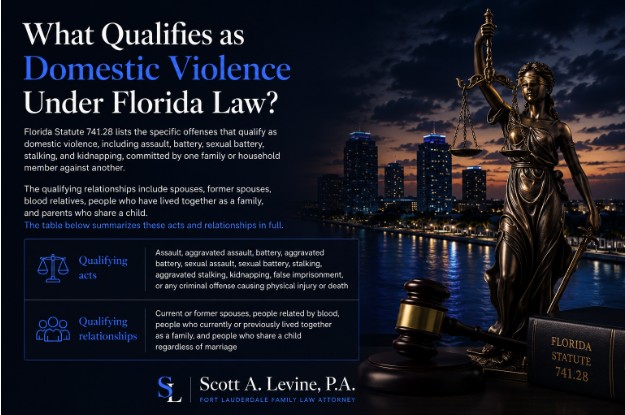
Florida Statute 741.28 lists the specific offenses that qualify as domestic violence, including assault, battery, sexual battery, stalking, and kidnapping, committed by one family or household member against another.
The qualifying relationships include spouses, former spouses, blood relatives, people who have lived together as a family, and parents who share a child. The table below summarizes these acts and relationships in full.
| Category | What Florida Law Covers |
| Qualifying acts | Assault, aggravated assault, battery, aggravated battery, sexual assault, sexual battery, stalking, aggravated stalking, kidnapping, false imprisonment, or any criminal offense causing physical injury or death |
| Qualifying relationships | Current or former spouses, people related by blood, people who currently or previously lived together as a family, and people who share a child regardless of marriage |
How Do You Get an Injunction for Protection in Broward County?
A victim files a sworn petition for an injunction for protection against domestic violence under Florida Statute 741.30 in Broward County Family Court.
A judge can grant a temporary injunction the same day, based solely on the sworn petition, and that temporary order lasts up to 15 days until a full hearing takes place.
At that hearing on the petition, the court can extend the injunction, deny it, or convert it into a final injunction that stays in effect until a judge dissolves it.
How Does a Domestic Violence Case Affect Child Custody in Florida?
A parent convicted of a qualifying domestic violence offense faces a rebuttable presumption against shared parental responsibility and time-sharing under Florida Statute 61.13(2)(c).
Even without a conviction, Broward County judges must weigh evidence of domestic violence as one of the 20 best-interest factors when creating or modifying a parenting plan.
Parents pursuing or defending against a domestic violence injunction while a custody or divorce case is pending should coordinate both matters so the resulting custody terms don’t conflict, since a family law order under Chapter 61 takes precedence over conflicting terms in an injunction.
What Happens If Someone Violates a Protective Injunction?
Violating a domestic violence injunction is a separate criminal offense under Florida Statute 741.31, independent of whatever family law case prompted the injunction.
Law enforcement can arrest a respondent for a violation without a warrant, and a violation can also affect an ongoing custody or divorce proceeding.
Parents already dealing with unmarried relationship complications or a pending paternity matter should understand how an injunction interacts with those cases before either party takes further action, so custody terms and criminal exposure don’t work against each other.
Waiting to address a domestic violence matter can affect both your safety and your custody case. Schedule a consultation to protect your rights.
Why Hire a Fort Lauderdale Domestic Violence Attorney?
Levine graduated Magna Cum Laude from Nova Southeastern University School of Law in 1996, and served as an Assistant Public Defender in Broward County, trying more than 45 jury trials as lead counsel before founding the firm.
He is admitted to practice before every Florida court and holds an AV Peer Review Rating.
That criminal trial background lets him handle injunction hearings, criminal charges, and family law disputes together in the same case, so you can avoid conflicting outcomes across courts.
Frequently Asked Questions
How quickly can I get a domestic violence injunction in Broward County?
A judge can grant a temporary injunction the same day the petition is filed, based solely on the sworn petition, without the other party present. That temporary order lasts up to 15 days until the court holds a full hearing at which the parties can present evidence.
Do I need proof of a conviction to get an injunction?
No. A petitioner can qualify by showing either that domestic violence already occurred or that they have reasonable cause to believe they are in imminent danger of becoming a victim. A conviction is not required to obtain either a temporary or final injunction.
Can an injunction affect my custody rights immediately?
An injunction can include temporary provisions addressing time-sharing, child support, and exclusive use of the family home while the case is pending. Those time-sharing, support, and residence provisions often shape the custody arrangement that follows in a related divorce or paternity case.
What happens at the full injunction hearing?
Both parties can present evidence and testimony, and the judge decides whether to grant a final injunction, extend the temporary order, or deny the petition. Unlike the temporary order, this hearing gives the respondent a full opportunity to contest the allegations.
Is domestic violence only physical abuse?
No. Florida Statute 741.28 also covers stalking, aggravated stalking, false imprisonment, kidnapping, and any criminal offense causing physical injury or death between family or household members. Threats alone can support a petition if they create reasonable fear of imminent violence, even without physical contact.
Can a domestic violence injunction be dismissed or modified?
Yes. Either party can ask the court to modify or dissolve an injunction, though the petitioner generally has more flexibility to request dissolution than the respondent has to end it unilaterally. A judge will only grant modification after reviewing the current circumstances at a hearing.
Does an injunction show up on a criminal record?
An injunction for protection is a civil order, not a criminal conviction, so it does not itself create a criminal record. However, violating the injunction is a criminal offense that can result in arrest and prosecution separate from the underlying civil case.
Can unmarried parents who never lived together get a domestic violence injunction?
Yes. Florida law extends coverage to people who share a child in common regardless of whether they were ever married or lived together, unlike the spouse, blood-relative, and cohabitant categories, which generally require a residence connection. This makes the injunction process directly available to co-parents.
A domestic violence case can shape your safety, your custody rights, and your family’s future. Call the firm at 954-587-2244 to discuss your Broward County case today.