
10 Essential Things to Consider Before Filing for Divorce in Florida: A 2026 Checklist

As of 2026, a Florida divorce requires careful planning around residency, finances, parenting, and alimony because recent reforms changed how courts handle support, time-sharing, and property division.
A structured Florida divorce checklist helps you protect your children, preserve assets, and avoid costly mistakes before you file.
A Florida divorce is a court process under Chapter 61 of the Florida Statutes that dissolves a legal marriage based on no-fault grounds that the marriage is irretrievably broken.
By preparing before you file, you can reduce stress, shorten the timeline, and enter negotiations from a position of informed strength.
Levine Family Law, led by Florida family law attorney Scott A. Levine, represents spouses in Broward County and throughout South Florida in divorce, custody, and support matters.
To help you make informed choices about your next steps, this 2026 checklist outlines 10 essential issues to consider before starting a Florida divorce.
1) Understand Florida Residency Requirements

As of 2026, Florida Statute § 61.021 requires at least one spouse to be a Florida resident for six consecutive months immediately before filing for divorce.
This six-month residency requirement applies even if the marriage occurred in another state or country.
A Florida court will expect objective proof of residency, such as a Florida driver’s license, state identification card, or voter registration card issued at least six months before the petition is filed.
To avoid dismissal of your case, you should confirm that your documents clearly show a qualifying Florida address and an issue date.
Military service members stationed in Florida may qualify for divorce in Florida if they have been physically present in the state for at least six months, even when they claim another state as their home of record.
Service members and spouses should ask a Florida military divorce attorney to review their orders and living history before filing for divorce.
Spouses who recently moved to Florida often need to wait until the six-month mark passes before filing in a Florida court.
Filing too early can cause the judge to dismiss the case, forcing you to start over and pay additional filing and attorney fees later.
Residency disputes often affect case timing, which is why early filing steps in the Florida divorce process matter before you submit a petition.
2) Consider the Impact on Children
A Florida divorce can significantly affect a child’s daily routine, emotional stability, and relationship with each parent. Parents should assess how a divorce will affect each child’s school schedule, extracurricular activities, transportation, and living arrangements.
Florida law focuses on the “best interests of the child” and requires parents to submit a written parenting plan that explains how they will share time, responsibilities, and decision-making.
Parenting plan proposals are stronger when they track the Florida child custody factors judges apply in time-sharing disputes.
To support your children’s well-being, you should begin thinking about realistic time-sharing schedules and communication routines before you file.
Children in divorce often experience confusion, sadness, anger, or guilt, especially when they see conflict, criticism, or inconsistent routines.
Parents can reduce emotional harm by avoiding negative comments about the other parent, maintaining predictable schedules, and reassuring children that the divorce is not their fault.
Many Florida families benefit from working with a licensed family therapist, child psychologist, or counselor to support children through the transition.
Professional guidance gives children a safe place to express concerns and helps parents learn strategies for co-parenting during and after the divorce process.
3) Evaluate Your Financial Situation
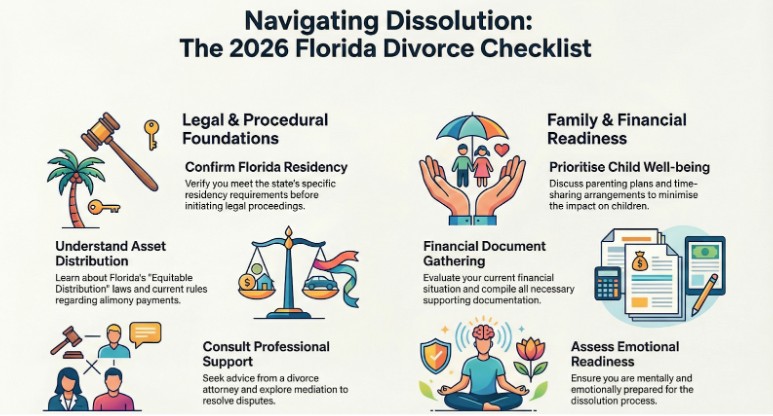
Spouses considering a Florida divorce should complete a detailed financial snapshot before filing so they understand what is at risk and what they may need post-divorce. This snapshot should cover income, assets, debts, and regular household expenses for both spouses.
Florida courts require each spouse to file a financial affidavit and exchange mandatory financial disclosure documents within strict deadlines.
Settlement leverage can change quickly when tax positions shift, especially with joint tax returns during divorce and refund or liability allocation.
To comply with court rules and negotiate effectively, you should gather pay stubs, tax returns, bank statements, credit card statements, loan documents, and retirement statements for at least the past 3 years.
Creating a post-divorce budget helps you estimate future rent or mortgage payments, utilities, transportation, childcare, health insurance, and other recurring costs.
When you compare that budget to your expected income and potential support, you can better evaluate whether you need temporary support, alimony, or a larger share of certain assets to stay financially stable.
Many spouses benefit from consulting a certified divorce financial analyst (CDFA) or financial planner familiar with Florida equitable distribution and alimony reforms.
A financial professional can model settlement options, explain tax impacts, and help you avoid agreeing to a short-term solution that harms long-term retirement or investment goals.
4) Gather Necessary Financial Documents
A Florida divorce relies heavily on documented financial information, so organized records are essential. Courts and attorneys use these documents to classify property as marital or non-marital, value assets and debts, and evaluate support claims.
Every spouse should gather complete federal tax returns for at least the last three years, including all schedules, W-2 forms, 1099 forms, and K-1 forms. These documents reveal income sources, business interests, and possible deductions that may affect child support and alimony calculations.
Current statements from checking accounts, savings accounts, brokerage accounts, and retirement plans such as 401(k) plans, 403(b) plans, IRAs, and pensions show account balances and contributions during the marriage.
To protect your share of marital assets, you should also collect documentation for stock options, restricted stock units, cryptocurrency holdings, and other digital or investment assets.
Credit card statements, mortgage statements, auto loan documents, student loan records, and personal loan agreements identify marital debts that a Florida court may allocate between spouses under equitable distribution rules in Florida Statute § 61.075.
Real estate records, including deeds, property tax bills, and appraisals, help define the equity and fair market value of the marital home and any rental or vacation properties.
If you feel overwhelmed by the volume of paperwork, Levine Family Law can provide a customized checklist of financial documents tailored to your situation. So you can move forward with clarity, you can call or text 954-587-2244 to schedule a confidential consultation with Scott A. Levine.
If you’re ready to get started, call us now!
5) Explore Mediation Options
As of 2026, most Florida family courts require parties to attempt mediation before scheduling a contested divorce trial.
Mediation is a structured negotiation process in which a neutral mediator helps spouses discuss property division, parenting time, and support in a private, non-adversarial setting.
Mediation can save time and money compared to a fully contested trial because spouses control the pace and outcome, rather than leaving every decision to a judge.
To preserve privacy and reduce conflict, you should ask your attorney whether mediation, collaborative divorce, or another alternative dispute resolution process is appropriate for your case.
To prepare for mediation, spouses should identify their priorities on key issues such as who will stay in the home, how to divide retirement accounts, and how to structure parenting schedules. Bringing organized financial documents and proposed parenting plan ideas to mediation sessions helps the mediator focus discussions on concrete options instead of vague disagreements.
Some spouses attend mediation with their attorneys present, while others choose to consult attorneys between sessions rather than during the meeting itself.
The right approach depends on the case’s complexity, the level of conflict, and each spouse’s comfort with direct negotiation.
6) Learn About Florida’s Equitable Distribution

Florida follows equitable distribution rules, which means marital assets and debts are divided fairly—not automatically 50/50—in a divorce. A clean framework for marital versus nonmarital classification is outlined in property division in Florida divorces.
Under Florida Statute § 61.075 Courts start with the premise that an equal split is fair and then adjust the distribution if specific factors justify a different result.
Marital property usually includes income, real estate, retirement accounts, and debts acquired by either spouse during the marriage, regardless of whose name appears on the title or account.
Non-marital property generally includes assets owned before the marriage, inheritances, and certain gifts kept separate from marital finances, although commingling can change that classification.
Courts consider factors such as the length of the marriage, each spouse’s economic circumstances, contributions as a wage earner or homemaker, and whether either spouse intentionally wasted or hid assets.
Complex assets such as closely held businesses, professional practices, rental portfolios, and stock option plans often require expert valuation. An attorney can coordinate appraisers or forensic accountants to ensure the property is properly valued before you agree to any settlement.
Retirement accounts are often significant marital assets. Learn more about how Florida courts handle these in Florida Statute § 61.076, which governs the distribution of retirement plans upon dissolution of marriage.
7) Discuss Parenting Plans and Time-Sharing
Florida no longer uses the old labels “custody” and “visitation” in most family law cases. Instead, parents must submit a detailed parenting plan that addresses time-sharing schedules, decision-making authority, and communication methods for their children.
A parenting plan outlines when the children will spend time with each parent on school days, weekends, holidays, birthdays, and during school breaks, as well as transportation responsibilities.
Holiday schedules work best when parents use defined rotations and overrides from holiday parenting plans in Florida.
To reduce future conflict, you should think through common friction points—such as pickup logistics, extracurricular activities, and travel plans—before you propose a schedule.
When a schedule stops working, the standards for changing a holiday parenting plan in Florida often turn on stability and the child’s need
Florida’s best interests standard requires judges to consider factors such as each parent’s capacity to foster a close relationship with the child, honor the time-sharing schedule, and put the child’s needs ahead of their own.
Courts increasingly expect both parents to be involved and may presume that substantial time with each parent is beneficial, absent safety concerns.
Parents should also decide how they will share information about school, medical care, and counseling, including which tools they will use for communication.
Parenting apps, shared calendars, and written protocols can make co-parenting more predictable and less emotional.
8) Assess Your Emotional Readiness
Divorce in Florida is not only a legal and financial process; it is also a significant emotional transition.
Before filing, you should honestly evaluate whether you are emotionally ready to manage conflict, make difficult decisions, and support your children through changes to their daily lives.
Many spouses experience cycles of grief, anger, fear, and relief during a divorce, which can affect judgment and communication.
To make clear, long-term decisions, you may benefit from working with a therapist, counselor, or divorce coach who understands the emotional and practical realities of Florida divorces.
Support from trusted friends, family members, or support groups can also help you feel less isolated and more grounded. Emotional readiness includes being able to separate short-term feelings from long-term goals, such as preserving co-parenting relationships and maintaining financial stability.
If you struggle to imagine life after divorce or feel overwhelmed by anxiety, you may want to pause and seek professional guidance before filing.
Taking time to stabilize your emotional health can improve your negotiation skills, reduce reactivity, and help you present confidently in mediation or court.
If you decide you are ready to move forward, Levine Family Law can guide you through each step of the Florida divorce process. So you can start with support, you can call or text 954-587-2244 to speak with Scott A. Levine about your options.
If you’re ready to get started, call us now!
9) Understand Alimony Rules in Florida
As of 2026, Florida no longer allows permanent alimony in new divorce cases because Senate Bill 1416 eliminated lifetime spousal support effective July 1, 2023.
Florida courts can now award only time-limited forms of alimony, including temporary, bridge-the-gap, rehabilitative, and durational support.
Under Florida Statute § 61.08, judges consider the requesting spouse’s need for support and the other spouse’s ability to pay, along with factors such as the length of the marriage, age, health, income, and contributions to the marriage.
To set realistic expectations, you should understand that alimony is not automatic and must be supported by evidence of need and the ability to pay.
In Florida, durational alimony is now capped by the length of the marriage, with maximum durations tied to whether the marriage is short-term, moderate-term, or long-term.
Many reforms also cap alimony at the lesser of the recipient’s demonstrated need and a percentage of the difference between the parties’ net incomes.
A Florida divorce attorney can analyze whether alimony is likely in your case and help you gather evidence, such as work history, earning capacity, health records, and lifestyle expenses.
10) Consult a Florida Divorce Attorney
Consulting a Florida divorce attorney before you file is one of the most important steps you can take to protect your rights.
Local filing and practice norms are a core reason many clients work with a Broward County divorce attorney early in the decision process.
An experienced lawyer can explain the divorce process, identify potential risks, and outline realistic options based on current Florida law.
During an initial consultation, you should be prepared to discuss how long you have been married, whether you have minor children, what major assets and debts you hold, and whether there has been any domestic violence.
Bringing financial documents, prior court orders, and any prenuptial or postnuptial agreements helps the attorney give more precise guidance.
A Florida family law attorney can help you decide whether to file a standard dissolution, a simplified dissolution, or a collaborative or mediated case, depending on your goals.
Legal representation can also protect you from signing unfair agreements, missing court deadlines, or misunderstanding the long-term consequences of a proposed settlement.
Levine Family Law, led by Scott A. Levine, focuses on divorce, parenting, and support matters in South Florida. So you can take the next step with confidence, you can call or text 954-587-2244 or complete the contact form to schedule a confidential consultation.
Contact Us Today For An Appointment
Frequently Asked Questions
What recent changes to Florida divorce law affect cases in 2026?
Florida divorces in 2026 are shaped by the July 1, 2023, alimony reform in Florida Statute § 61.08. Permanent alimony is unavailable in new cases, durational alimony is capped by marriage length, and courts enforce stricter financial disclosure timelines.
How is property, including the marital home, divided in a Florida divorce?
Florida divides marital assets and debts by equitable distribution under Florida Statute § 61.075, not automatic 50 50. Courts identify marital versus nonmarital property, value the marital estate, and then divide it fairly. The marital home is often sold, refinanced, or used as collateral.
What documents are essential to file for divorce in Florida?
To file for divorce in Florida, you generally need a Petition for Dissolution, the required family law cover sheets, and the filing fee. Early on, both spouses complete a Financial Affidavit and exchange mandatory disclosure documents. Proof of six-month residency is required.
How can parents navigate child time sharing and support during a Florida divorce?
Parents must submit a written parenting plan with a time-sharing schedule, decision-making rules, and communication terms. Courts apply the standard of the child’s best interests. Child support is calculated under Florida Statute § 61.30 based on income, overnights, insurance, and child care costs.
What steps can help minimize divorce expenses in Florida?
The most reliable way to reduce the costs of Florida divorces is to limit litigation. Mediation, collaborative divorce, and uncontested settlement negotiations reduce the need for hearings, discovery disputes, and expert fees. Some couples may qualify for simplified dissolution, but eligibility is narrow and requires full agreement.
How does a long-term marriage affect a Florida divorce settlement?
A long-term marriage can increase alimony exposure and complicate asset division because finances and retirement accounts are usually highly intertwined. Under Florida Statute § 61.08, durational alimony duration can be longer, but permanent alimony is not awarded in new cases.
This article is for informational purposes only and does not constitute legal advice. For advice about your specific situation, consult a qualified Florida family law attorney.