
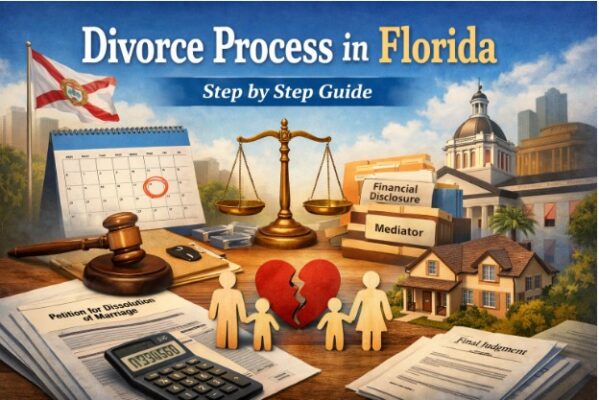
The Florida divorce process starts when one spouse files a Petition for Dissolution of Marriage, completes lawful service, exchanges required financial disclosure, and resolves parenting and financial issues through settlement or trial before a judge signs a Final Judgment.
Florida courts grant a divorce when a marriage is irretrievably broken.
Divorce decisions land fast, and small early mistakes can drive months of delay. Levine Family Law supports Florida divorce clients across Broward County, including Fort Lauderdale, Hollywood, and Dania Beach, so families can follow a clear process and protect leverage from day one.
Key Takeaways
- Florida courts grant a divorce when a marriage is irretrievably broken under Florida Statutes § 61.052.
- Florida divorce starts with the correct Petition forms from the Florida Courts 12.901 series.
- Mandatory financial disclosure shapes settlement leverage and property division outcomes under Florida’s equitable distribution law, § 61.075.
- Parenting plan decisions shape time-sharing, and time-sharing impacts child support calculations under § 61.30.
- In cases involving children, Florida parents often complete the required parenting course under § 61.21.
- Most divorces end with a written settlement or a judge’s Final Judgment after a hearing, and the Florida Courts summarize this pathway on the dissolution overview page.
Choose Your Florida Divorce Pathway
| Pathway | Who it fits | What changes in the process |
| Simplified dissolution | Spouses agree on all issues, no minor children, and both participate | Parties typically file a joint petition like Form 12.901(a) and move toward a faster final hearing |
| Uncontested standard divorce | Spouses agree on parenting and money, but need formal paperwork and court approval | Parties still complete disclosure and submit enforceable settlement documents aligned to § 61.075 requirements |
| Contested divorce | Parenting time, support, assets, or debt remain disputed | The case requires formal discovery, motion practice, mediation, and possible trial preparation, which aligns with complex litigation planning |
Florida Divorce Process in 2026. Step-by-Step Guide
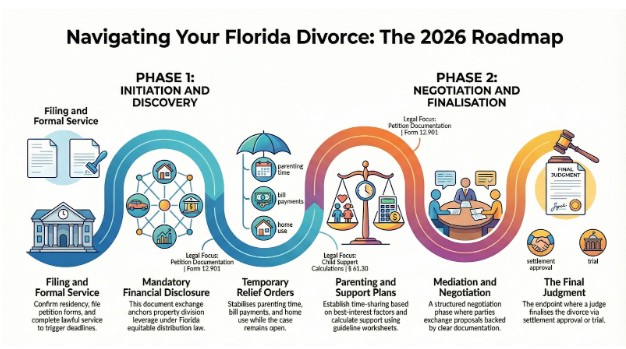
The Florida Divorce Process follows a predictable sequence that starts with filing and service, then moves into mandatory financial disclosure, temporary orders, mediation, and a Final Judgment.
Each step produces deadlines and documents that shape settlement leverage, parenting outcomes, and the final terms of divorce.
If you’re ready to get started, call us now!
1) Confirm residency and proper county filing
Florida divorce filings require Florida residency, and venue affects logistics, scheduling, and local procedures, as described in Broward County filing guidance, including the courthouse steps.
2) File the Petition for Dissolution of Marriage
The petitioner starts the case by filing the correct Florida Courts petition from the 12.901 forms, and the petition frames what the judge can order.
3) Complete lawful service of process
Service is a formal delivery method that creates due process and triggers deadlines, and Broward County procedures are often detailed in the local Broward guide when parties need clerk and courthouse routing.
4) Exchange mandatory financial disclosure
Mandatory disclosure is a document exchange that anchors property division and settlement leverage, and the final distribution framework follows Florida equitable distribution law under § 61.075.
A spouse who suspects hidden money often needs a disclosure strategy that aligns with the warning signs in hidden-asset scenarios.
5) Address temporary relief while the case is pending
Temporary relief can stabilize parenting time, child support, exclusive use of the home, and bill payment expectations while the divorce remains open, and a divorce planning sequence in the 2025 filing guide helps parties avoid timing mistakes.
6) Establish parenting plans and time sharing in cases with children
A parenting plan defines decision-making and time-sharing, and Florida parenting disputes often turn on the best-interest concepts organized in the firm’s custody factors explanation.
Florida parents also complete the required parenting course through a provider listed on the Florida DCF provider list when the case involves children and parental responsibility.
7) Calculate child support when applicable
Child support calculations follow Florida’s guideline framework under § 61.30, and parents who want the calculation mechanics can align the case file with the firm’s child support structure and worksheet-driven approach.
8) Negotiate and mediate toward a final agreement
Mediation is a structured negotiation process, and preparation improves outcomes when parties exchange clear proposals backed by documents and worksheet math. A planning mindset often starts with a timeline and a document checklist.
9) Finalize the divorce by settlement approval or trial
A judge finalizes divorce through a Final Judgment after approving a written settlement or after trial findings, and the Florida Courts dissolution overview explains the expected endpoint in plain language.
If you’re ready to get started, call us now!
Mandatory Financial Disclosure. What you exchange and why it matters
Mandatory disclosure is evidence production, not paperwork theatre. Mandatory disclosure shapes settlement leverage because property division requires classification and distribution decisions under § 61.075.
Common disclosure categories
- Income records, including pay stubs and tax returns
- Account statements for checking, savings, and brokerage accounts
- Retirement account statements and plan documents
- Real estate records, including deeds and mortgage statements
- Debt documentation, including credit cards and loan statements
- Business records in cases involving self-employment or ownership interests
A spouse who sees suspicious transfers often needs a targeted plan that matches the risk patterns described in hiding money situations.
Mediation in Florida Divorce. What to bring and what gets resolved
Mediation resolves issues by agreement, and mediated terms become enforceable when the written settlement becomes part of a Final Judgment.
A spouse who arrives prepared often increases settlement quality by bringing documents that support the numbers and reduce ambiguity.
Bring these items to mediation
- A proposed parenting schedule grounded in parental responsibility realities
- A current inventory of assets and debts aligned to property division categories
- Support calculations and supporting documents when child support applies under § 61.30
- A settlement outline that clarifies what each party gives and receives
Timing and Cost Drivers. What extends a Florida divorce
| Driver | What it means | How does it delay the case | How to reduce delay |
| Service problems | Incorrect service or missing proof | Deadlines do not start cleanly | Follow the local filing sequence in the Broward courthouse workflow |
| Disclosure gaps | Missing records or inconsistent affidavits | Discovery disputes increase | Build a clean document list using the dissolution guide structure |
| Business or complex assets | Valuation and tracing disputes | Expert work adds time | Use a complex strategy aligned with asset division needs |
| Parenting conflict | Disputed time sharing and decision making | Temporary motion practice increases | Ground proposals in custody factors evidence |
| Hidden assets concerns | Suspicious transfers or missing accounts | Discovery expands | Apply the warning signs in hidden assets reviews |
| Relocation issues | Proposed move affects parenting | Court scrutiny increases | Align relocation requests with relocation standards |
Broward County Divorce Logistics
Broward County family filings route through the clerk’s family division, and the Broward Clerk provides the Family Division entry point on the family page. The firm’s internal court contact guide helps families locate addresses, phone routing, and courthouse workflow without losing weeks to misdirected calls.
A Florida divorce plan improves outcomes when the petition, disclosure, parenting schedule, and settlement posture follow one strategy.
A confidential consult through the firm’s contact intake can clarify whether the facts support an uncontested pathway, a negotiated settlement posture, or a litigation-ready approach.
Contact Us Today For An Appointment
Frequently Asked Questions
What are the basic steps to get divorced in Florida?
A Florida divorce usually includes filing a petition, lawful service, mandatory disclosure, negotiation or mediation, and a Final Judgment signed by a judge once the marriage is irretrievably broken. The Florida Courts dissolution overview summarizes the same sequence.
What forms start a Florida divorce?
Most Florida divorces start with a petition using the Florida Courts 12.901 forms, and the correct petition depends on whether there are children, theagreement status, and simplified eligibility.
What is mandatory financial disclosure in a Florida divorce?
Mandatory disclosure is a required exchange of financial documents that supports equitable distribution decisions under § 61.075. Mandatory disclosure usually includes income records, account statements, retirement records, debt records, and business documents when ownership exists.
Can I file for divorce in Florida without my spouse’s signature?
A divorce petition does not require the other spouse’s signature to start the case, because lawful service creates notice and deadlines after filing. Florida courts can move a case forward after service, and the filing workflow described in the Broward courthouse steps helps parties avoid service errors.
What happens after mediation in a Florida divorce?
Mediation produces a written settlement when the parties agree, and the settlement becomes enforceable when the judge incorporates it into a Final Judgment. A settlement should clearly address parenting issues, support issues under § 61.30, and property distribution terms under § 61.075.
Do I have to go to trial to get divorced in Florida?
Most divorces are resolved through negotiated settlement and court approval, and trial becomes more likely when parenting time or asset division remains disputed. A spouse facing a complex case often prepares by using a litigation-oriented resource, such as complex divorce planning.
What makes a Florida divorce take longer?
Service delays, missing disclosures, business valuation, hidden asset concerns, and parenting conflicts often extend the timeline and increase costs. Families can reduce delays by organizing documents early and using a checklist, such as the Florida divorce 2025 overview, to anticipate common friction points.