

Florida courts in Broward County determine child custody under the legal term “time-sharing,” governed by Florida Statute § 61.13. As of July 1, 2023, Florida law establishes a rebuttable presumption that equal 50/50 time-sharing serves the best interests of every minor child.
A parent who disputes equal time-sharing must prove by a preponderance of the evidence that equal time-sharing does not serve the child’s best interests.
Florida House Bill 1301, signed June 27, 2023, reshaped every contested parenting case in Broward County — establishing a 50/50 starting point, eliminating the “unanticipated” change requirement for modifications, and mandating written findings of fact for every time-sharing schedule created or changed.
Key Takeaways
- Florida Statute § 61.13 replaced “custody” with “time-sharing” and “parental responsibility.” Every Broward County divorce or paternity case involving minor children requires a court-approved Parenting Plan using Florida Supreme Court Form 12.995(a).
- Florida House Bill 1301, effective July 1, 2023, created a rebuttable presumption that equal 50/50 time-sharing serves the best interests of every minor child in all new and modified cases filed in Broward County.
- A Broward County Family Division judge evaluates 20 enumerated best-interest factors under Fla. Stat. § 61.13(3) and must produce specific written findings of fact when creating or modifying any time-sharing schedule.
- Modification of a Broward County Parenting Plan in 2026 requires proof of a substantial and material change in circumstances — the pre-July 2023 requirement that the change also be “unanticipated” no longer applies.
What Is Time-Sharing and How Does Florida Define Child Custody?
Florida Statute § 61.13 governs all child custody decisions in Broward County under two legally distinct terms: “time-sharing,” which defines the physical schedule each parent follows, and “parental responsibility,” which defines decision-making authority over the child’s education, healthcare, and religious upbringing.
Florida eliminated “custody” from most family law proceedings in 2008 to promote cooperative co-parenting between separated parents.
| Term | Legal Definition Under Fla. Stat. § 61.13 | Practical Meaning in Broward County |
| Time-Sharing | The schedule specifying when the child spends time with each parent | Includes weekly rotation, holiday allocation, school-break schedule, and exchange logistics |
| Parental Responsibility | Authority to make major decisions about the child’s welfare | Shared in most cases; sole responsibility requires a written court finding of detriment |
| Parenting Plan | Court-approved document defining both time-sharing and parental responsibility | Required in every case involving minor children — even when both parents agree |
| Best Interest of the Child | The primary standard under Fla. Stat. § 61.13(3) | Evaluated using 20 enumerated factors, the judge produces written findings for each applicable factor |
Parental responsibility and time-sharing are not interchangeable. A Broward County Family Division judge may order shared parental responsibility — joint decision-making — alongside an unequal time-sharing schedule.
A parent holding 60% of physical overnights retains equal legal authority to make major decisions about the child’s life when the court orders shared parental responsibility.
A Fort Lauderdale divorce attorney with experience before the Broward County Family Division treats parental responsibility and time-sharing as two separately negotiated components — conflating them in a proposed Parenting Plan undermines credibility with the assigned judge from the outset of the case.
What Did Florida’s 2023 HB 1301 Reform Change for Broward County Time-Sharing Cases?
Florida House Bill 1301, signed by Governor Ron DeSantis on June 27, 2023, and effective July 1, 2023, amended Florida Statute § 61.13 to create a rebuttable presumption that equal 50/50 time-sharing serves the best interests of every minor child — replacing the prior neutral standard under which no specific schedule was presumed at the outset.
Every Broward County time-sharing case filed or modified on or after July 1, 2023, opens with equal time-sharing as the court’s starting position.
| Factor | Pre–July 1, 2023 Standard | Post–July 1, 2023 Standard (HB 1301) |
| Starting presumption | No presumption for or against any specific schedule | Rebuttable presumption that equal 50/50 time-sharing serves the child’s best interests |
| Burden to depart from 50/50 | The court evaluated the best-interest factors from a neutral baseline | Parent opposing 50/50 must prove by preponderance of evidence that equal sharing does not serve the child’s best interests |
| Modification standard | Substantial, material, AND unanticipated change required | Substantial and material change only — “unanticipated” requirement eliminated |
| Relocation modification trigger | Parent moving closer to the child is not specifically addressed | Parent relocating within 50 miles of the other parent may constitute a substantial and material change |
| Written findings requirement | Discretionary in most cases | The court must produce specific written findings of fact for every time-sharing schedule created or modified |
The 50/50 presumption does not guarantee equal time-sharing in every Broward County case.
The Broward County Bar Association’s 2023 Nuts & Bolts of Family Law report — which surveyed Broward County Family Division judges directly on how they are applying the new presumption in contested parenting cases — confirmed that local judges evaluate every applicable best-interest factor under Fla. Stat. § 61.13(3) before entering any time-sharing order, regardless of whether the HB 1301 presumption is contested.
A parent who fails to present evidence addressing those factors cannot rely on the presumption alone.
Scott A. Levine, who serves on the Florida Bar’s Children’s Issues Committee and has argued time-sharing disputes before the Broward County Family Division for over 25 years, advises clients that the HB 1301 presumption shifts the burden — it does not eliminate the need to build a documented, fact-based case for the schedule being proposed.
The child custody attorney team at Levine Family Law prepares the full evidentiary record for each applicable Fla. Stat. § 61.13(3) factor before filing, so the Broward County judge receives a complete, well-organized picture of the child’s best interests from the outset.
The Florida divorce process guide at Levine Family Law provides additional context on how Broward County family court proceedings are structured from initial petition through final judgment — relevant for parents navigating both divorce and time-sharing simultaneously.
If you’re ready to get started, call us now!
How Does the Broward County Family Division Determine the Child’s Best Interests?
A Broward County Family Division judge evaluates the 20 best-interest factors enumerated in Fla. Stat. § 61.13(3) to determine every time-sharing schedule — including whether to apply or depart from the HB 1301 rebuttable presumption. Florida law requires the judge to produce specific written findings of fact addressing each applicable factor in the Final Judgment or Parenting Plan order, creating a reviewable appellate record.
| Factor — Fla. Stat. § 61.13(3) | What Broward County Judges Examine |
| (a) Capacity to honor the time-sharing schedule | History of compliance, punctuality at exchanges, and a documented pattern of missed visits |
| (b) Division of parental responsibilities | Work schedules, childcare delegation, and third-party caregiver involvement |
| (c) Capacity to act upon the child’s needs | Medical appointment attendance, school involvement, and response to health and developmental needs |
| (d) Length of time in a stable environment | Residential history, school continuity, and disruption to established routines |
| (e) Geographic feasibility | Distance between parents’ homes, school proximity, and exchange logistics |
| (f) Moral fitness of each parent | Conduct demonstrably affecting or reasonably likely to affect the child |
| (g) Mental and physical health of each parent | Medical evaluations, psychological assessments, and documented substance use history |
| (h) Home, school, and community record | Academic performance, extracurricular stability, and peer relationships |
| (i) Child’s reasonable preference | Weight depends on the child’s demonstrated age, intelligence, and maturity — Florida sets no fixed minimum age |
| (t) Any other relevant factor | Catch-all permitting the judge to consider evidence not covered by factors (a)–(s) |
Florida sets no minimum age threshold for a child’s custody preference — distinguishing Florida from Georgia, which applies a fixed age of 14, and Texas, which applies a fixed age of 12.
Under factor (i), a Broward County judge weighs the child’s preference based on demonstrated intelligence, understanding, and experience.
Most Broward County judges learn about a child’s preference through a Guardian ad Litem report, an in-camera interview with the child, or a mental health professional’s evaluation — courts avoid placing minor children on the witness stand in open proceedings.
The HB 1301 rebuttable presumption changes how cases are argued — and how they are won. Schedule a confidential consultation with Scott A. Levine at Levine Family Law — call or text 954-587-2244 — to assess your evidentiary position before filing.
What Must a Broward County Parenting Plan Include?
Florida Supreme Court Approved Family Law Form 12.995(a) is the standard Parenting Plan document required in all Broward County cases involving minor children — including cases where both parents agree on all terms.
A court-approved Parenting Plan must define each parent’s time-sharing schedule, allocation of parental responsibilities, communication protocols between the parents and between each parent and the child, and procedures for healthcare and education decision-making.
| Element | Requirement Under Fla. Stat. § 61.13 | Broward County Court Standard |
| Daily time-sharing schedule | Must specify when and where the child spends time with each parent | Week-by-week calendar required; vague “reasonable visitation” language rejected at the final hearing |
| Holiday and school-break schedule | Must address all major holidays and school vacations | Specific start and end times designated; alternating or fixed assignment required |
| Exchange logistics | Must define pickup and drop-off procedures | Location, time, and the responsible parent’s name; a safe exchange location is ordered when the risk of harm exists |
| Communication between parents | Must address the method and frequency | Co-parenting app, email, or text specified; the child may not serve as a messenger between parents |
| Healthcare decision-making | Must distinguish routine from major decisions | Shared responsibility for major decisions; either parent may authorize routine care |
| Education decision-making | Must address enrollment, tutoring, and extracurriculars | Both parents receive notice of school conferences and events under shared parental responsibility |
| Child-to-absent-parent communication | Must outline electronic communication rights | Video call frequency and timing are specified for extended periods with one parent |
Cases involving domestic violence or supervised time-sharing use Form 12.995(b), the Supervised/Safety-Focused Parenting Plan. Cases where parents reside more than 50 miles apart use Form 12.995(c), the Relocation/Long-Distance Parenting Plan.
When a child exchange presents a documented risk of harm, the Broward County Family Division orders exchanges at a Broward County Sheriff’s Office safe exchange location under Fla. Stat. § 125.01(8), which mandates at least one designated exchange parking lot per county sheriff’s office statewide.
The fair child custody agreement guide at Levine Family Law examines Florida’s 20 best-interest factors, with practical examples drawn from Broward County cases, so parents can draft a Parenting Plan that a judge will accept without revision.
A family law attorney at Levine Family Law reviews proposed Parenting Plans for compliance with the Broward County Family Division’s expectations before submission — preventing delays in submission and protecting parental rights at the final hearing.
What Are the Most Common Time-Sharing Schedules in Broward County?
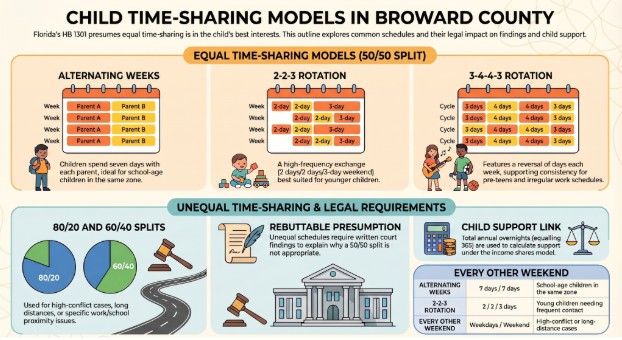
Broward County Family Division judges accept any time-sharing schedule that serves the child’s best interests under Fla. Stat. § 61.13 — Florida law mandates no specific arrangement.
The most common schedules in Fort Lauderdale, Hollywood, Margate, Coconut Creek, and Pembroke Pines reflect the equal-time-sharing presumption introduced by HB 1301, though parents often propose modified splits based on school proximity, work schedules, the child’s age, and each parent’s availability.
| Schedule | Structure | Best Fit | Broward County Note |
| Alternating weeks (50/50) | 7 days with Parent A, then 7 days with Parent B | School-age children; parents near the same school zone | Aligns directly with HB 1301 rebuttable presumption; requires consistent exchange protocol |
| 2-2-3 rotation (50/50) | 2 days / 2 days / alternating 3-day weekend | Young children need frequent contact with both parents | High exchange frequency — requires cooperative co-parenting and nearby residences |
| 3-4-4-3 rotation (50/50) | 3 days one parent / 4 days other, reversed the following week | Pre-teens; parents with irregular work schedules | Moderate exchange frequency; supports weekly school routine consistency |
| Every other weekend (80/20) | Primary parent weekdays; secondary parent every other weekend plus one weekday | High-conflict cases; long-distance parents | Requires written court findings specifically rebutting the HB 1301 equal time-sharing presumption |
| 60/40 split | 6 overnights per 10-day cycle with primary parent | Cases where school proximity or work schedules support an unequal split | Requires specific written findings addressing each applicable best-interest factor |
Annual overnights must be calculated and included in the Parenting Plan — the total must equal 365 and feeds directly into the child support calculation under the income shares model at Fla. Stat. § 61.30.
The Florida Department of Revenue’s parenting time plan resources illustrate how time-sharing percentages interact with child support obligations — a practical reference for parents negotiating a proposed schedule.
If you’re ready to get started, call us now!
What Is Shared Parental Responsibility and When Does Broward County Order Sole Responsibility?

Florida Statute § 61.13 requires Broward County Family Division judges to order shared parental responsibility — joint decision-making authority over the child’s welfare — unless competent evidence establishes that shared responsibility would be detrimental to the child.
Sole parental responsibility is the statutory exception and requires affirmative written findings tied to documented domestic violence, child abuse, or a parent’s demonstrated inability to make decisions in the child’s interest.
Florida law creates a rebuttable presumption against shared parental responsibility — and against any time-sharing — when a parent has been convicted of a first-degree misdemeanor domestic violence offense or higher, or convicted of a qualifying sexual offense against a victim under age 18.
The convicted parent bears the burden of proving by competent evidence that shared responsibility poses no significant risk of harm to the child.
Two categories of court-appointed experts assist Broward County Family Division judges in contested parental responsibility cases.
A Guardian ad Litem — appointed through Circuit 17 of the Florida Guardian ad Litem Office — interviews the child, both parents, teachers, and pediatricians, then submits a written best-interest recommendation to the judge independently of both parents’ attorneys.
A Social Investigator conducts a more comprehensive home-study evaluation. Both tools give the Broward County Family Division a child-centered factual record that neither parent controls.
Scott A. Levine’s 45+ jury trials as lead counsel in Broward County inform the evidentiary strategy Levine Family Law applies when building — or defending against — a contested parental responsibility claim.
Evidence-building requires parenting logs with dates and times, communication records, school attendance documentation, medical appointment records, and — where applicable — prior court orders, police reports, and substance abuse evaluations.
Concerned that shared parental responsibility is being used against your child’s best interests? Sole parental responsibility claims require specific, documented evidence — and the evidentiary standard is high. Contact Scott A. Levine at Levine Family Law
How Is a Broward County Parenting Plan or Time-Sharing Schedule Modified?
A parent seeking to modify a Broward County Parenting Plan in 2026 files a Supplemental Petition to Modify Parenting Plan/Time-Sharing at the Broward County Clerk of Courts, 201 SE 6th Street, Fort Lauderdale, FL 33301, and must prove two elements: that a substantial and material change in circumstances has occurred since the last court order, and that the proposed modification serves the child’s best interests.
Florida HB 1301 eliminated the prior requirement that the change also be “unanticipated,” reducing the evidentiary threshold for Broward County modification petitions filed on or after July 1, 2023.
| Circumstance | Qualifies as a Substantial and Material Change? | Key Documentation |
| Job loss or significant income reduction | Yes — when the change affects parenting time capacity or child support | Pay stubs, termination letter, tax returns, and new employment documentation |
| Parent relocating within 50 miles of the other parent | Yes — specifically authorized by HB 1301, effective July 1, 2023 | Change of address, lease or deed, or school enrollment records |
| Parent relocating more than 50 miles away | Requires separate relocation petition under Fla. Stat. § 61.13001 | Notice of intent to relocate; proposed long-distance Parenting Plan (Form 12.995(c)) |
| Child’s new school, medical, or special-needs requirements | Yes — when the current schedule creates documented instability | School records, IEP documentation, medical records, therapist notes |
| Domestic violence, substance abuse, or criminal conviction | Yes — creates emergency modification basis | Police reports, court records, substance abuse evaluation, prior injunctions |
Parenting Plan violations are addressed through contempt proceedings under Fla. Stat. § 61.13(4)(d) and Florida Family Law Rule 12.615 — not through modification petitions.
Under Fla. Stat. § 61.13(4)(c)(6), a Broward County judge may modify the Parenting Plan as part of an enforcement proceeding when modification separately serves the child’s best interests, but Florida appellate courts — including the Fourth District Court of Appeal, whose rulings govern Broward County — have consistently reversed trial court orders that used contempt hearings as the standalone basis for permanent custody modification without a separate best-interest finding.
Contempt produces make-up time-sharing, attorney’s fees, and civil or criminal sanctions; modification requires its own evidentiary basis.
The Broward Family Court contact guide at Levine Family Law identifies the specific clerk’s offices, filing procedures, and procedural steps for Broward County modification petitions.
For relocation petitions specifically, Fla. Stat. § 61.13001 governs the notice, consent, and court-approval process for any parent seeking to relocate more than 50 miles with a minor child.
What Happens When a Parent Violates a Broward County Parenting Plan?
A parent who willfully fails to comply with a court-approved Parenting Plan in Broward County violates a binding court order enforceable under Florida Family Law Rule of Procedure 12.615.
The receiving parent files a Motion for Contempt and Enforcement with the Broward County Family Division — the court’s primary enforcement mechanism, distinct from the separate modification petition process.
| Violation Type | Primary Remedy | Governing Authority |
| Repeated failure to appear at scheduled exchanges | Motion for contempt; court-ordered make-up time-sharing; attorney’s fees | Fla. Stat. § 61.13(4)(d); Florida Family Law Rule 12.615 |
| Refusal to return the child after the scheduled time-sharing | Emergency pick-up order; potential criminal referral for parental kidnapping | Fla. Stat. § 787.03; Broward County Sheriff’s Office |
| Denial of the other parent’s access to the child’s records | Court order compelling access; civil contempt sanction | Fla. Stat. § 61.13(2)(b)(7) — records access cannot be denied to either parent |
| Systematic parental alienation — documented interference with the co-parent relationship | Contempt plus separate petition for modification when pattern meets best-interest threshold | Fla. Stat. § 61.13(3)(a); Fourth DCA precedent requiring independent best-interest finding |
| Unauthorized relocation of the child | Contempt; mandatory return order; separate relocation petition required | Fla. Stat. § 61.13001 — relocation without court approval or written consent is unauthorized |
Contempt proceedings and modification petitions are legally separate procedural tracks. The Fourth District Court of Appeal — whose rulings govern Broward County — has reversed trial court orders that permanently modified time-sharing solely at a contempt hearing without an independent best-interest finding and without a separate pending modification petition (Chevalier v. Emmerson, 4D20-1034, Fla. 4th DCA 2020). A parent seeking both enforcement and modification files both a Motion for Contempt and a Supplemental Petition to Modify simultaneously, so the judge addresses each on its proper evidentiary record.
Documentation drives every enforcement proceeding before the Broward County Family Division.
A parenting log maintained with dates, times, and descriptions of each missed exchange, denied phone call, or withheld record constitutes the primary evidence a judge evaluates at a contempt hearing.
Levine Family Law represents parents in Fort Lauderdale, Hollywood, Margate, Coconut Creek, and Pembroke Pines in both enforcement and modification proceedings before the Broward County Family Division.
Documented violations require prompt action — contempt proceedings protect your parenting time and build the evidentiary record for any concurrent modification petition.Contact Levine Family Law at 954-587-2244 to discuss enforcement options for your case.
Contact Us Today For An Appointment
Frequently Asked Questions
Does Florida favor 50/50 custody in Broward County?
Florida law presumes that equal 50/50 time-sharing serves every minor child’s best interests under Fla. Stat. § 61.13, as amended by HB 1301 effective July 1, 2023. A parent opposing 50/50 must prove by preponderance of evidence that equal time-sharing does not serve the child’s best interests.
At what age can a child choose which parent to live with in Florida?
Florida sets no fixed minimum age for a custody preference. Under Fla. Stat. § 61.13(3)(i), a Broward County judge weighs the child’s preference when the child demonstrates sufficient intelligence and experience. Child preference is one of 20 statutory factors — the judge makes the final determination.
What is a Parenting Plan in Florida?
A Parenting Plan is a court-approved document required in every Broward County case involving minor children that governs time-sharing schedules and parental decision-making authority under Fla. Stat. § 61.13. The standard form is Florida Supreme Court Approved Form 12.995(a). Vague or incomplete Parenting Plans are rejected by Broward County judges.
How do I modify a custody order in Broward County in 2026?
A parent files a Supplemental Petition to Modify Parenting Plan/Time-Sharing at the Clerk of Courts, 201 SE 6th Street, Fort Lauderdale. The petition must prove a substantial and material change in circumstances and that the modification serves the child’s best interests. The “unanticipated” change requirement no longer applies as of July 1, 2023.
What is shared parental responsibility in Florida?
Shared parental responsibility is the joint authority both parents hold to make major decisions about a child’s education, healthcare, and religious upbringing under Fla. Stat. § 61.13. Broward County courts order shared responsibility in the majority of cases. Sole responsibility requires a written court finding that shared responsibility would be detrimental to the child.
Can a parent relocate with a child after divorce in Broward County?
A Broward County parent seeking to relocate more than 50 miles from the other parent must file a relocation petition under Fla. Stat. § 61.13001, obtain written consent, or obtain a court order approving the move. Relocating without approval violates the Parenting Plan and triggers emergency enforcement proceedings in Broward County Family Division.
What does the Broward County Family Division consider when deciding time-sharing?
The Broward County Family Division evaluates 20 best-interest factors under Fla. Stat. § 61.13(3), including each parent’s capacity to honor the schedule, the child’s school and community adjustment, geographic feasibility, each parent’s mental and physical health, and the child’s reasonable preference when the child demonstrates sufficient maturity.
What happens if one parent repeatedly violates the Parenting Plan?
A parent who willfully violates a Broward County Parenting Plan faces a Motion for Contempt under Fla. Stat. § 61.13(4)(d) and Florida Family Law Rule 12.615. Remedies include make-up time-sharing, attorney’s fees, and civil or criminal contempt sanctions. Modification requires a separate petition with an independent best-interest finding.
Does shared parental responsibility mean equal time-sharing?
Shared parental responsibility and equal time-sharing are legally distinct under Fla. Stat. § 61.13. Shared responsibility defines joint decision-making authority. Time-sharing defines the physical schedule. A Broward County judge may order shared responsibility with an unequal time-sharing split when best-interest factors support that outcome.
What does a Guardian ad Litem do in a Broward County custody case?
A Guardian ad Litem, appointed through Circuit 17 of the Florida Guardian ad Litem Office, represents the minor child’s best interests independently of both parents. The Guardian ad Litem interviews the child, parents, teachers, and pediatricians, then submits a written best-interest recommendation. Broward County judges assign significant weight to Guardian ad Litem findings in contested hearings.