
The Florida divorce process requires one spouse to meet a six-month residency requirement under Fla. Stat. § 61.021, file a Petition for Dissolution of Marriage with the Clerk of the Circuit Court, serve the other spouse, and exchange mandatory financial disclosures within 45 days of service.
Uncontested divorces in Broward County resolve in 4–8 weeks. Contested cases take 6–18 months, depending on the financial and parenting issues in dispute.
Florida’s divorce process affects property division, parental time-sharing, child support, and spousal support — all governed by Chapter 61 of the Florida Statutes. As of 2026, the process also operates under Florida’s 2023 alimony reform, which eliminated permanent alimony in all new filings.
Fort Lauderdale family law attorney Scott A. Levine — a graduate of Nova Southeastern University School of Law, Magna Cum Laude, and holder of an AV Martindale-Hubbell Peer Review Rating — has guided Broward County clients through divorce proceedings for over 25 years.
Key Takeaways
- Florida is a no-fault divorce state under Fla. Stat. § 61.052 — a petitioner establishes grounds by stating the marriage is irretrievably broken. Proof of adultery, abandonment, or fault is not required.
- At least one spouse must have resided in Florida for six continuous months immediately before filing, as required by Fla. Stat. § 61.021. A current Florida driver’s license or voter registration card satisfies this requirement.
- Both spouses must exchange financial affidavits and mandatory financial disclosures within 45 days of service under Florida Family Law Rule of Procedure 12.285, regardless of whether the divorce is contested or uncontested.
- Florida’s July 1, 2023, alimony reform eliminated permanent alimony in new divorce cases and capped durational alimony at 50% of the marriage length — statutory changes that govern every 2026 divorce filed in Broward County under the amended Fla. Stat. § 61.08.
Does Florida Require Residency Before You Can File for Divorce?
Florida requires at least one spouse to have resided in the state for a minimum of six continuous months immediately before filing a Petition for Dissolution of Marriage, under Fla. Stat. § 61.021.
A valid Florida driver’s license, Florida voter registration card, or a sworn affidavit from a corroborating Florida resident — submitted using Form 12.902(i) — satisfies the residency proof requirement in Broward County Circuit Court.
The six-month residency period must be uninterrupted. A spouse who relocated to Florida six months before the filing date and holds a current Florida driver’s license meets the standard.
A spouse who previously lived in Florida but relocated to another state does not qualify — unless the current Florida residency has lasted six continuous months.
Military servicemembers stationed at a Florida military installation satisfy the Fla. Stat. § 61.021 residency requirement under the same statute, even when Florida is not the servicemember’s declared home state.
When neither spouse currently meets the six-month threshold, the petition must be delayed until one spouse qualifies or is filed in a jurisdiction where a spouse does qualify.
Residency under Fla. Stat. § 61.021 determines the correct filing jurisdiction — residency does not govern how the court divides marital property or calculates child support.
All Broward County divorce petitions are filed at the Broward County Clerk of the Circuit Court, which serves Fort Lauderdale, Hollywood, Margate, Coconut Creek, Pembroke Pines, and surrounding municipalities.
What Are the Two Types of Florida Divorce, and Which One Applies to You?
Florida law provides two dissolution of marriage pathways: a simplified dissolution for couples with no minor children, no ongoing pregnancy, no alimony claims, and a complete pre-filing agreement on all terms; and a regular dissolution that covers every other situation, including cases involving minor children, contested assets, or spousal support claims.
As of 2026, most Broward County divorce filings proceed under the regular dissolution pathway.
| Factor | Simplified Dissolution | Regular Dissolution |
| Form Used | Florida Family Law Form 12.901(a) | Form 12.901(b)(1) or (b)(2) |
| Minor Children | Not available when minor children exist | Required pathway when minor children are involved |
| Alimony Claims | Neither spouse may request alimony | Either spouse may request alimony |
| Property Disputes | All terms must be pre-agreed upon before filing | Broward County Circuit Court resolves contested assets and debts |
| Both Spouses at Final Hearing? | Yes — both must appear together | Not required for uncontested final hearings |
| Typical Broward County Timeline | 30–45 days | 4–8 weeks uncontested; 6–18 months contested |
Within the regular dissolution pathway, a case is classified as uncontested — both spouses agree on parenting, support, and property division — or contested, meaning at least one material issue requires court resolution.
Contested regular dissolution cases in Broward County proceed through court-ordered mediation under Florida Family Law Rule 12.740 before a judge may schedule a trial.
A Fort Lauderdale divorce attorney evaluates which dissolution pathway applies before the petitioner files — submitting the wrong petition form triggers rejection by the Broward County Clerk, causes processing delays, and may require re-filing with corrected documents.
What Documents Do You Need to File for Divorce in Florida?
A petitioner opening a Florida divorce case submits a Petition for Dissolution of Marriage, a Civil Cover Sheet, and a Family Law Financial Affidavit to the Clerk of the Circuit Court.
Cases involving minor children additionally require a proposed Parenting Plan, submitted using Florida Courts Form 12.995(a), before the judge may schedule the final hearing.
Under Florida Family Law Rule of Procedure 12.285, both spouses must exchange the following financial records within 45 days of service:
| Document | Form Number | Deadline |
| Family Law Financial Affidavit — short form (income under $50K) | 12.902(b) | Within 45 days of service |
| Family Law Financial Affidavit — long form (income $50K+) | 12.902(c) | Within 45 days of service |
| Last 3 years of federal and state tax returns | N/A | Within 45 days of service |
| Last 3 months of pay stubs or income verification | N/A | Within 45 days of service |
| Last 3 months of bank and credit union account statements | N/A | Within 45 days of service |
| Retirement and investment account statements | N/A | Within 45 days of service |
| Mortgage statements and real property records | N/A | Within 45 days of service |
| Child Support Guidelines Worksheet | 12.902(e) | With financial affidavit — cases involving children |
| Proposed Parenting Plan | 12.995(a) | Before the final hearing — cases involving children |
| Marital Settlement Agreement | 12.902(f)(1) or (f)(2) | Before final hearing — uncontested cases |
Incomplete or internally inconsistent financial disclosures cause the majority of court delays and contested disputes in Broward County divorce proceedings.
A missing document generates a motion to compel, which adds attorney fees, postpones hearings by weeks or months, and signals to the assigned judge that the non-complying party is obstructing the process.
The Florida divorce preparation checklist at Levine Family Law identifies the exact financial records to assemble before the petition is filed, so you can avoid disclosure-related delays.
Florida Courts publishes all standardized Family Law forms at no cost through the Florida Courts Self-Help Resource Library. Using the current, correct version of each form is mandatory — the Broward County Clerk rejects outdated form versions without exception.
Scott A. Levine has represented Fort Lauderdale-area clients in contested and uncontested divorce proceedings for over 25 years. Call 954-587-2244 or schedule a confidential consultation to review your documents and filing timeline before you submit the petition.
If you’re ready to get started, call us now!
How Does the Florida Divorce Filing and Service Process Work?
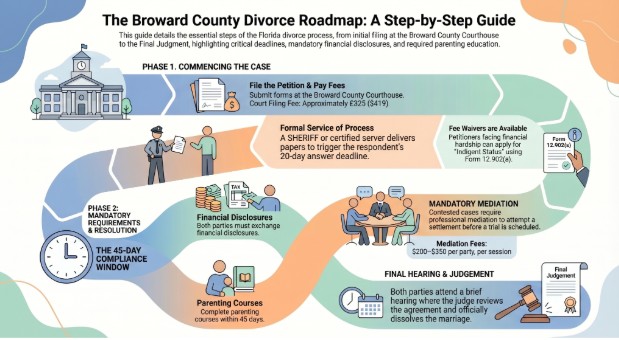
A Florida divorce case opens when the petitioner files the Petition for Dissolution of Marriage with the Clerk of the Circuit Court in the county where either spouse resides, pays the court filing fee — approximately $408–$409 in Broward County, plus a $10 summons issuance fee — and arranges formal service of process on the respondent.
The respondent then has 20 calendar days after being served to file a written Answer, under Florida Family Law Rule of Procedure 12.080.
Step 1 — File the Petition.
The petitioner submits completed forms and the court filing fee at the Broward County Courthouse, 201 SE 6th Street, Fort Lauderdale, FL 33301. Petitioners who cannot afford the filing fee apply for a waiver using Form 12.902(a), Application for Determination of Civil Indigent Status.
Step 2 — Serve the Respondent.
Florida law requires service of process by a Broward County Sheriff’s deputy, a Florida-certified process server, or — when the respondent voluntarily cooperates — an acknowledgment of service signed under oath using Form 12.900(a).
The respondent’s 20-day Answer deadline begins on the date of service, not the date of filing.
Step 3 — Exchange Mandatory Financial Disclosures.
Both spouses have 45 days from the date of service to exchange all financial documents specified under Rule 12.285. The 45-day disclosure deadline applies equally to contested and uncontested cases.
Step 4 — Complete the Parent Education and Family Stabilization Course.
When the divorce involves minor children, both parents must complete a Florida Supreme Court-approved Parent Education and Family Stabilization Course and file the certificate of completion with the Broward County Clerk within 45 days of filing. The court will not schedule the final hearing until both completion certificates appear in the case file.
Step 5 — Attend Mediation (Contested Cases).
Broward County family courts require contested parties to attempt mediation before a trial may be scheduled, under Florida Family Law Rule 12.740. Certified mediator fees in Broward County range from $200 to $350 per party per session. When mediation resolves all disputed issues, both parties execute a Marital Settlement Agreement, which the judge converts into a binding court order upon approval at the final hearing.
Step 6 — Attend the Final Hearing.
The assigned judge reviews the Marital Settlement Agreement and Parenting Plan at a final hearing — conducted in person or remotely via video conferencing — and enters the Final Judgment of Dissolution of Marriage.
Filing at the Broward County courthouse is procedurally navigable with proper preparation; form errors and improper service are the two most common causes of rejection and delay.
Florida imposes a statutory minimum waiting period of 20 days from the filing date before a judge may enter a Final Judgment, under Fla. Stat. § 61.19. No waiver of this waiting period exists under current Florida law.
How Does Florida Divide Property and Debt in a Divorce?
Florida distributes marital assets and debts under the equitable distribution standard codified in Fla. Stat. § 61.075, meaning the Broward County Circuit Court divides the marital estate fairly,n ot automatically on a 50/50 basis.
The court identifies marital property, assigns fair market value to each asset, and allocates assets and debts using statutory factors that include each spouse’s economic circumstances, contributions to the marriage, and the total length of the marriage.
Marital property includes assets and debts acquired by either spouse during the marriage, regardless of which spouse’s name appears on the title, deed, or account.
Non-marital property — assets owned by one spouse before the marriage, or property received as a gift or inheritance during the marriage — remains separate unless the owner commingled non-marital funds with marital assets, which converts non-marital property into marital property subject to equitable distribution.
Contested property disputes in Broward County divorce cases most commonly involve the family home, business ownership interests, employer-sponsored retirement plans, and brokerage investment portfolios.
Retirement accounts and pension plans accumulated during the marriage require a Qualified Domestic Relations Order (QDRO) — a separate court order submitted to the plan administrator — to divide the account without triggering early-withdrawal tax penalties or IRS reporting requirements.
Scott A. Levine, who serves on the Florida Bar’s Equitable Distribution Committee, applies current Florida case law directly to alimony and asset division strategy for Levine Family Law clients throughout Broward County.
How Does Florida Handle Alimony After the 2023 Reform?
Florida’s July 1, 2023, alimony reform amended Fla. Stat. § 61.08 to eliminate permanent alimony in all new divorce cases and cap durational alimony at 50% of the marriage length for short and moderate-length marriages.
Every 2026 divorce filed in Broward County is governed by the reformed statute — permanent alimony is unavailable in new cases regardless of the duration of the marriage, the earning disparity, or the age of either spouse.
| Alimony Type | Purpose Under Fla. Stat. § 61.08 | Duration Limit — 2026 |
| Temporary (Pendente Lite) | Financial support during active divorce proceedings | Terminates at Final Judgment |
| Bridge-the-Gap | Transition funding from marital to single-person finances | Maximum 2 years |
| Rehabilitative | Fund education, job training, or credentialing for workforce re-entry | Defined by a court-approved rehabilitation plan |
| Durational | Time-limited post-divorce support tied to demonstrated financial need | ≤ 50% of the marriage length for short and moderate marriages |
| Nominal | Reserve Broward Circuit Court jurisdiction to modify support later | As specified in the Final Judgment |
Broward County judges evaluate alimony claims using each spouse’s demonstrated financial need, ability to pay, length of the marriage, marital standard of living, age, health, and earning capacity — all factors enumerated in the amended Fla. Stat. § 61.08. Financial documentation that is internally consistent — tax returns that match financial affidavits, expense records that align with stated monthly budgets — directly determines settlement leverage and courtroom credibility.
Reviewing what alimony-related documents to preserve before and throughout the case prevents evidentiary credibility problems at mediation or at trial.
What Happens to Child Custody and Support in a Florida Divorce?
Florida statutes do not use the term “custody.” Florida Statute § 61.13 governs parental time-sharing and parental responsibility, requiring every dissolution of marriage involving minor children to produce a court-approved Parenting Plan that specifies each parent’s time-sharing schedule and decision-making authority.
Broward County Circuit Court judges apply a best-interest-of-the-child standard using 20 enumerated statutory factors under Fla. Stat. § 61.13(3) when parents cannot agree on a Parenting Plan.
Shared parental responsibility — where both parents retain equal decision-making authority over major decisions affecting the child — is the statutory presumption in Florida.
A Broward County judge departs from shared parental responsibility only when competent evidence establishes that shared responsibility would be detrimental to the child’s welfare.
Time-sharing schedules submitted to the court must address weekly rotation, holiday and school-break allocation, pickup and drop-off logistics, and communication protocols in specific, unambiguous terms.
Parenting Plans that use vague language are rejected by the Broward County Family Division and require revision before the case may proceed.
Florida calculates child support under the income shares model established by Fla. Stat. § 61.30, which applies both parents’ gross monthly income, the time-sharing percentage for each parent, monthly health insurance premium costs, and monthly childcare expenses to the Child Support Guidelines Worksheet (Form 12.902(e)).
A judge may deviate from the calculated guideline amount only when the deviation is supported by written findings of fact in the Final Judgment.
The Fort Lauderdale child custody attorneys at Levine Family Law structure Parenting Plans that meet Broward County court standards while remaining workable in day-to-day co-parenting.
The fair child custody agreement guide at Levine Family Law examines all 20 best-interest factors Florida courts apply, with practical examples drawn from Broward County cases.
Facing a contested custody or time-sharing dispute in Broward County? Scott A. Levine has argued parenting plan disputes before the Broward County Family Division for over 25 years. Call 954-587-2244 or request a consultation.
If you’re ready to get started, call us now!
What Happens After the Final Judgment — Post-Divorce Steps in Broward County
A Broward County judge’s signature on the Final Judgment of Dissolution of Marriage legally dissolves the marriage, but the financial and administrative obligations that follow the judgment are equally binding and time-sensitive.
Delays in executing post-judgment property transfers create title disputes, insurance coverage gaps, and IRS tax complications that require additional court proceedings to resolve.
The Broward Family Court contact guide at Levine Family Law identifies the specific agencies, clerks, and deadlines involved in each post-judgment step for Fort Lauderdale and Broward County residents.
- Obtain at least three certified copies of the Final Judgment of Dissolution from the Broward County Clerk of Courts, 201 SE 6th Street, Fort Lauderdale, FL 33301 — certified copies cost approximately $2–$5 per page and are required for every subsequent post-judgment action.
- Execute a quitclaim deed to transfer the marital home title from joint ownership to the designated spouse, consistent with the property division terms in the Marital Settlement Agreement.
- Submit the Qualified Domestic Relations Order (QDRO) to the relevant retirement plan administrator to divide employer-sponsored retirement accounts without triggering early-withdrawal penalties under IRS rules.
- Update beneficiary designations on life insurance policies, individual retirement accounts (IRAs), and employer-sponsored 401(k) and pension plans — Florida Statute § 732.507 automatically revokes will provisions that favor a former spouse upon divorce, but account beneficiary designations are not revoked automatically and must be changed directly with each financial institution.
- Submit Form SS-5 with a certified copy of the Final Judgment to the Social Security Administration to restore a former name in SSA records, then present a certified copy to the Florida Department of Highway Safety and Motor Vehicles (DHSMV) to update the driver’s license.
Levine Family Law represents clients in Fort Lauderdale, Hollywood, Margate, Coconut Creek, and Pembroke Pines in divorce proceedings, post-judgment modification petitions, and enforcement actions before the Broward County Family Division.
Delayed property transfers and unfiled QDROs create legal and financial exposure.Contact Scott A. Levine at Levine Family Law — call or text 954-587-2244 — to address post-judgment obligations before they become enforcement disputes.
Contact Us Today For An Appointment
Frequently Asked Questions
How long does a Florida divorce take in 2026?
A Florida divorce requires a minimum of 20 days from the filing date before a judge may enter a Final Judgment, under Fla. Stat. § 61.19. Uncontested Broward County divorces resolve in 4–8 weeks. Contested cases involving disputed parenting plans, asset valuation disputes, or alimony claims typically take 6–18 months from filing to Final Judgment.
How much does it cost to file for divorce in Broward County?
Filing for divorce in Broward County costs approximately $408–$409 in court fees plus a $10 summons issuance fee, paid to the Broward County Clerk of the Circuit Court. Additional costs include certified process server fees ($40–$75), mandatory mediation fees ($200–$350 per party per session), and attorney fees that vary by case complexity and contested issues.
Does Florida require a specific reason to file for divorce?
Florida does not require a specific reason to file for divorce because it is a no-fault divorce state under Fla. Stat. § 61.052. The petitioner states only that the marriage is irretrievably broken. Florida courts do not require proof of adultery, abuse, abandonment, or any fault-based ground to grant a dissolution of marriage.
What is mandatory financial disclosure in a Florida divorce?
Mandatory financial disclosure is the court-required exchange of tax returns, pay stubs, bank statements, and retirement account records between both spouses within 45 days of service, under Florida Family Law Rule 12.285. Failure to comply may result in a motion to compel, court-imposed sanctions, or an adverse ruling by the judge on financial issues.
Can a Florida divorce proceed if my spouse refuses to respond?
A spouse who refuses to file a written Answer within 20 days of being served in a Florida divorce cannot prevent the dissolution of the marriage from proceeding. The petitioner files a motion for default judgment with the Broward County Clerk of Courts, and the court enters a Final Judgment of Dissolution without the non-responding spouse’s participation.
Can I file for divorce in Florida if I am pregnant?
A petitioner may file a Florida divorce petition while pregnant, but the Broward County Circuit Court will not enter a Final Judgment of Dissolution until after the child is born. The court delays final judgment so paternity can be established, and child support and time-sharing orders can be included in the Final Judgment.
What did Florida’s 2023 alimony reform change for 2026 divorce cases?
Florida’s July 1, 2023, alimony reform amended Fla. Stat. § 61.08 to eliminate permanent alimony in all new Florida divorce cases and cap durational alimony at 50% of the marriage length for short and moderate marriages. Every 2026 divorce filed in Broward County is governed by the reformed statute — permanent alimony is unavailable regardless of the length of the marriage or income disparity.
Who receives the marital home in a Florida divorce?
No spouse holds an automatic entitlement to the marital home in a Florida divorce. Under Fla. Stat. § 61.075, the Broward County Circuit Court applies equitable distribution — the home is sold with proceeds split between spouses, awarded to one spouse through a buyout and refinancing of the mortgage, or deferred for a minor child’s residential stability until a court-specified date.
Does Broward County require mediation before a divorce trial?
Broward County family courts require contested divorce parties to attempt mediation before scheduling a trial, under Florida Family Law Rule of Procedure 12.740. Mediation sessions are confidential and give both spouses direct control over the outcome. When mediation fails to resolve all issues, the case is scheduled before the assigned Broward County Family Division judge for a contested hearing or trial.
How does Florida calculate child support in a divorce?
Florida calculates child support using the income shares model under Fla. Stat. § 61.30, applying both parents’ gross monthly income, time-sharing percentages, health insurance premium costs, and monthly childcare expenses to the Child Support Guidelines Worksheet (Form 12.902(e)). A judge may deviate from the calculated guideline amount only when the Final Judgment includes written findings of fact supporting the deviation.
What documents are required to file for divorce in Florida?
A Florida divorce petition requires a Petition for Dissolution of Marriage, a Civil Cover Sheet, a Family Law Financial Affidavit (Form 12.902(b) or (c)), and — when minor children are involved — a proposed Parenting Plan (Form 12.995(a)). Both spouses must also exchange supporting financial records, including tax returns, pay stubs, and bank statement,s within 45 days of service under Rule 12.285.
Can a Florida divorce restore a former name?
A Florida Circuit Court restores a petitioner’s former name as part of the Final Judgment of Dissolution of Marriage when the petitioner requests name restoration in the original divorce petition. The petitioner then presents a certified copy of the Final Judgment to the Social Security Administration using Form SS-5, followed by the Florida DHSMV, to update identification records.