
Can You Get Divorced Without Going to Court in Florida? (2026)
No Florida divorce finalizes without a judge’s review, but full agreement removes the trial — not always both spouses’ appearance.
A Fort Lauderdale divorce filed under Florida Family Law Rule of Procedure 12.105’s simplified dissolution track requires both spouses to appear together at the final hearing, in a regular uncontested dissolution.
Florida Supreme Court Approved Family Law Form 12.903(a) lets a respondent who admits the petition waive notice of the hearing and their own appearance at it.
Key Takeaways
- A judge must review and approve every Florida dissolution, but only Florida Family Law Rule of Procedure 12.105(b) — governing simplified dissolution — requires both spouses to appear together at a hearing.
- In a regular uncontested dissolution, only the petitioner must appear at the final hearing; the respondent may waive notice and appearance using Florida Supreme Court Approved Family Law Form 12.903(a).
- Spouses with no minor or dependent children, a completed property settlement, and no alimony request may qualify for simplified dissolution, avoiding depositions, formal discovery, and a trial.
- A 20-day waiting period runs from the filing date before any final judgment can be entered, under Fla. Stat. § 61.19 (2026).
Filing paperwork incorrectly can delay an otherwise uncontested divorce. Scheduling a confidential consultation with Scott Levine confirms eligibility for simplified dissolution before you file a single form.
What Is a Simplified Dissolution in Florida?
Four separate questions get collapsed into one when people ask about avoiding court: skipping a trial, skipping a joint appearance, skipping a courthouse trip, and skipping judicial review altogether. The first is achievable by any fully agreeing couple. The second depends on which track is used.
The third depends on how the specific hearing is conducted. The fourth is never true — a judge must review and sign every Florida dissolution.
A simplified dissolution of marriage is a streamlined divorce track under Florida Family Law Rule of Procedure 12.105 that lets fully agreeing spouses skip formal pleadings, discovery, and a contested trial.
What makes it faster than a regular uncontested filing isn’t Florida’s no-fault framework — that framework applies to every Florida divorce, contested or not.
The speed comes from what simplified dissolution removes: no financial affidavit requirement by default, no separate service of process, and a single joint petition instead of a filed petition and a filed answer.
Simplified dissolution is one path within a broader category of uncontested divorce, and the contested vs. uncontested divorce comparison shows how the two diverge the moment even one issue—property, support, or a shared child—remains unresolved.
A couple who no longer meets simplified dissolution’s requirements after filing must instead proceed under the standard dissolution process.
If you’re ready to get started, call us now!
Who Qualifies for Broward County’s Simplified Dissolution Process?
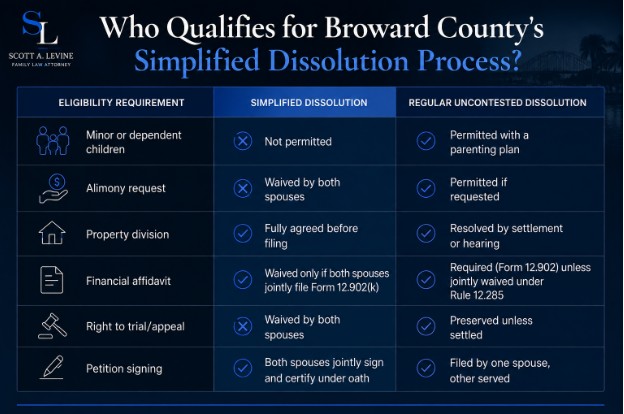
Florida Family Law Rule of Procedure 12.105 sets six conditions, and a Broward County couple must meet all of them to use the simplified track.
Levine Family Law’s marriage dissolution guide walks through both tracks side by side for spouses still deciding which one fits their situation.
| Eligibility Requirement | Simplified Dissolution | Regular Uncontested Dissolution |
| Minor or dependent children | Not permitted | Permitted with a parenting plan |
| Alimony request | Waived by both spouses | Permitted if requested |
| Property division | Fully agreed before filing | Resolved by settlement or hearing |
| Financial affidavit | Waived only if both spouses jointly file Form 12.902(k) | Required (Form 12.902) unless jointly waived under Rule 12.285 |
| Right to trial/appeal | Waived by both spouses | Preserved unless settled |
| Petition signing | Both spouses jointly sign and certify under oath | Filed by one spouse, other served |
Both spouses must appear together at the final hearing under this rule — one spouse cannot pursue a simplified dissolution alone, and neither can complete the hearing without the other.
The Broward County Clerk of Courts’ family division publishes the same eligibility list and provides Pro Se Self-Help staff who supply the required forms, though that staff cannot give legal advice on which track applies.
Can Mediation Replace a Court Hearing in a Florida Divorce?
No. Mediation resolves disputed issues — property division, debt allocation, timesharing when children are involved — before a case reaches a judge, but no mediated settlement finalizes a Florida divorce by itself.
A judge must still review the agreement and enter judgment at a final hearing. The 17th Judicial Circuit’s mediation program serves Broward County spouses whose combined net income falls under $100,000 and whose case has already been referred by a judge.
Once mediation produces a signed marital settlement agreement, the case proceeds as uncontested, and how mediation works in a Florida divorce explains what happens between a signed agreement and the hearing that finalizes it.
A Florida Supreme Court Certified Family Mediator can facilitate that agreement, but only a judge can enter the final judgment — and in a regular uncontested case, Form 12.903(a) still lets the respondent skip that hearing while the petitioner appears.
Which Court Steps Are Required Even in an Uncontested Divorce?
Three requirements apply regardless of how much spouses already agree on: filing the petition, satisfying the 20-day statutory waiting period under Fla. Stat. § 61.19 (2026), and securing a judge’s review at a final hearing before judgment enters.
Who must appear at that hearing depends on the track: simplified dissolution under Rule 12.105(b) requires both spouses, while a regular uncontested case requires only the petitioner if the respondent has filed Form 12.903(a).
The step-by-step guide to filing at the Broward County Courthouse covers where those filings happen and which forms accompany the petition.
A judge may waive the 20-day delay only if you show that injustice would result, and a waiver is the exception, not the rule.
Incomplete or incorrect paperwork—a missing signature, an unaddressed child support worksheet, a financial affidavit with calculation errors—is a common reason a scheduled final hearing is continued rather than finalized on the first date.
Confirming a settlement agreement and required forms with a Broward County divorce attorney before the hearing date reduces that risk.
Broward’s 17th Judicial Circuit Family Law Self-Help Information office can also confirm current local hearing procedures for self-represented filers, including whether a specific hearing will be conducted in person or, as Broward courts do for some matters, by Zoom.
If you’re ready to get started, call us now!
What Steps Can Broward County Couples Skip With a Full Settlement Agreement?
A completed marital settlement agreement removes several steps required in a contested case, though it never removes a judge’s review.
| Court-Required Step | Can Be Avoided With Agreement |
| Filing the petition | No — always required |
| 20-day statutory waiting period | No — always required, absent an injustice waiver |
| Judicial review at a final hearing | No — a judge must review and approve every case |
| Both spouses appearing together | Only required under simplified dissolution (Rule 12.105(b)) |
| Respondent’s personal appearance | Waivable in a regular uncontested case using Form 12.903(a) |
| Formal discovery/depositions | Yes — with a signed settlement |
| Financial affidavit | Yes — if both spouses jointly file Form 12.902(k) |
| Trial | Yes — with full agreement on all issues |
| Right to appeal | Waived voluntarily under simplified dissolution |
Every waiver in the right-hand column depends on the correct form being signed, notarized, and filed—none of it happens automatically just because spouses agree informally.
Broward County spouses should confirm current local hearing procedures with the 17th Judicial Circuit’s Family Law Self-Help Information Office or an attorney before assuming they can skip a step.
How Long Does an Uncontested Divorce Take in Broward County?
Florida’s only fixed timeline figure is the 20-day statutory floor under Fla. Stat. § 61.19 (2026) — no final judgment can enter before that date, regardless of how quickly paperwork moves.
Beyond that floor, how soon a case actually finalizes depends on how quickly both spouses complete the required forms and how far out the court’s hearing calendar is running, which varies by circuit and by season.
Broward’s Family Law Self-Help Information Office or an attorney with active cases in the 17th Judicial Circuit can speak to current scheduling.
The base court cost to open a case is $409 for the petition plus $10 for summons issuance, for a total of $419, according to the Broward County Clerk of Courts.
What Happens If the Case Isn’t Fully Uncontested?
If either spouse denies the marriage is irretrievably broken, or if the couple has a minor child of the marriage, Fla. Stat. § 61.052 (2026) permits the court to order counseling, continue the case for up to three months to allow reconciliation efforts, or take other action the court finds appropriate before entering judgment.
Once a genuine dispute surfaces, neither simplified dissolution nor a straightforward uncontested filing is available.
Cases that move into complex divorce litigation follow an entirely different timeline — formal discovery, expert valuations, and potentially a trial replace the streamlined steps available to fully agreeing spouses.
Confirming eligibility for the simplified or uncontested track before filing avoids the cost and delay of proceeding under contested procedures instead.
Simplified dissolution’s eligibility requirements leave no room for a mid-case surprise. Contact Levine Family Law before filing to confirm you meet every requirement the first time.
Contact Us Today For An Appointment
Frequently Asked Questions
Does every Florida divorce require a court appearance?
A judge must review and approve every Florida dissolution, but what counts as an “appearance” varies by track. Simplified dissolution under Rule 12.105(b) requires both spouses to appear together; a regular uncontested case may proceed with only the petitioner present if the respondent files Form 12.903(a).
What qualifies a Broward County couple for simplified dissolution?
Florida Family Law Rule of Procedure 12.105 requires no minor or dependent children, no pregnancy, a completed division of property and debts, and no alimony request from either spouse. Both spouses must also waive the right to trial and appeal before filing jointly.
Can mediation replace the final divorce hearing in Florida?
No. Mediation resolves disputed issues like property division before a case reaches a judge, but a judge must still review the agreement and enter judgment at a hearing. In a regular uncontested case, though, the respondent can waive their own appearance at that hearing.
How long does an uncontested divorce take in Broward County?
Florida imposes a mandatory 20-day waiting period after filing under Fla. Stat. § 61.19 (2026) before any final judgment can be entered. Beyond that floor, timing depends on paperwork completeness and the 17th Judicial Circuit’s current hearing calendar, which varies by season.
What is the filing fee for divorce in Broward County?
The Broward County Clerk of Courts charges $409 to file a Petition for Dissolution of Marriage plus $10 for summons issuance, for a total of $419 in initial court costs, according to the Clerk’s published fee schedule for 2026.
Do both spouses have to sign the simplified dissolution petition?
Yes. A simplified dissolution requires both spouses to jointly sign and certify the petition under oath, and both must appear together at the final hearing. One spouse cannot file or complete the hearing alone under Rule 12.105.
What happens if a spouse contests the divorce after filing?
If either spouse denies the marriage is irretrievably broken or a minor child is involved, Fla. Stat. § 61.052 (2026) allows the court to order counseling, continue proceedings for up to three months, or take other action before entering judgment.
Can a Florida divorce be finalized without hiring an attorney?
Yes, the Broward County Clerk’s Pro Se Self-Help Unit provides forms for spouses representing themselves. However, an incomplete settlement agreement or a missed simplified-dissolution eligibility requirement means the case must proceed under the regular dissolution process instead, adding time and paperwork.
Is alimony available through Florida’s simplified dissolution process?
No. Florida Family Law Rule of Procedure 12.105 requires both spouses to waive any claim to alimony as a condition of using simplified dissolution. Spouses who want to preserve a support claim must file under the regular dissolution process instead.
What residency requirement applies to filing for divorce in Florida?
At least one spouse must have resided in Florida for six months immediately before filing, under Fla. Stat. § 61.021 (2026). Residency is typically corroborated with a Florida driver’s license, voter registration card, or a third party’s sworn testimony.
Bottom Line: Simplified dissolution removes depositions, formal discovery, and a trial for spouses who fully agree — but not the joint petition, the 20-day statutory wait, or the requirement that both spouses appear together at the hearing. In a regular uncontested dissolution, only the petitioner has to appear, since the respondent can waive their own appearance using Form 12.903(a). No path skips a judge’s review entirely.