
Divorce Mediation vs Litigation in Florida — Full Comparison (2026)
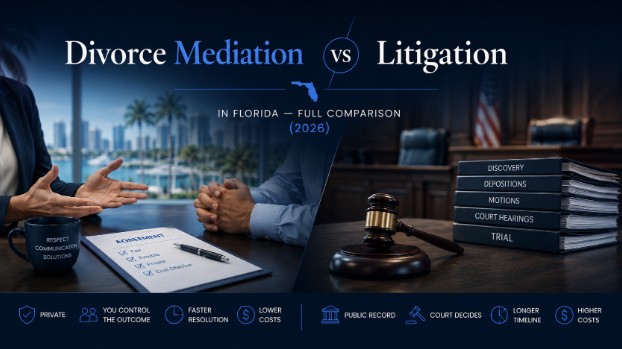
Divorce mediation resolves disputes through a neutral third party without a judge deciding the outcome; litigation puts contested issues before a Broward County judge who issues a binding ruling.
A Fort Lauderdale divorce attorney can pursue either path — Florida courts can require mediation for certain contested family issues under Fla. Stat. § 61.183 (2026), and hold broader authority to refer civil actions to mediation under Fla. Stat. § 44.102 (2026).
Mediation typically costs less and stays confidential; litigation creates a public record and gives the court the final decision.
Key Takeaways
- Mediation lets spouses negotiate their own settlement with a neutral third party; litigation puts the decision in a judge’s hands after a trial or contested hearing.
- Florida courts can refer contested divorce and parenting issues to mediation under Fla. Stat. §§ 44.102 and 61.183 (2026), and Broward County judges commonly order mediation before setting a trial date.
- Mediation communications are confidential under Fla. Stat. § 44.405 (2026); litigation proceeds mostly through public court filings, though some information stays protected either way.
- A signed mediated settlement agreement is generally binding on the spouses as a contract once executed; incorporating it into the final judgment is what makes it enforceable through the court’s contempt powers, and that step is required either way since only a judge can grant the dissolution itself.
Choosing between mediation and litigation affects cost and timeline. A confidential consultation with Scott Levine maps out which path fits.
What Is the Difference Between Divorce Mediation and Litigation in Florida?
Divorce mediation is a voluntary, confidential negotiation process in which a neutral third party — a Florida Supreme Court Certified Family Mediator — helps spouses reach their own settlement without a judge deciding the outcome.
Divorce litigation is the adversarial court process in which each spouse presents evidence and argument, and a judge issues a binding ruling after a contested hearing or trial.
Every Florida dissolution still ends with a judge’s signature on a final judgment; mediation determines who writes the terms first—the spouses or the court.
The process itself — what happens in a mediation session, how a mediator is selected, and what a signed agreement looks like — is covered step by step in how mediation works in a Florida divorce; this comparison focuses on how mediation and litigation stack up.
If you’re ready to get started, call us now!
How Do Mediation and Litigation Compare on Cost, Timeline, and Control?
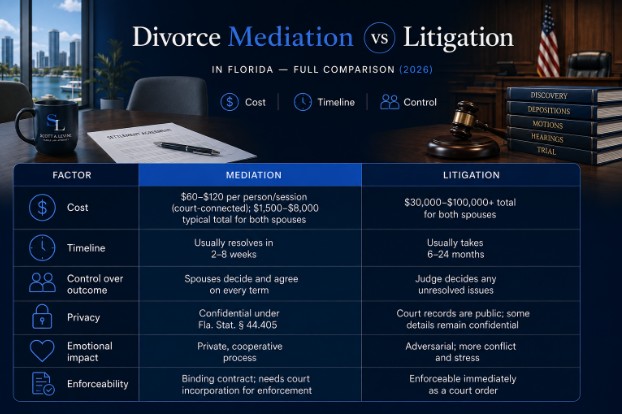
Mediation and litigation diverge most sharply on cost, timeline, and who controls the outcome — the table below lines up the six factors that matter most to a Broward County spouse weighing the two paths.
| Factor | Mediation | Litigation |
| Cost | Court-connected mediation costs $60–$120 per person, per session under Fla. Stat. § 44.108 (2026) for households earning under $100,000 combined; private mediators run $200–$500 per hour, with a typical four-hour session totaling $1,500–$8,000 for both spouses | Contested litigation totals $30,000–$100,000 or more for both spouses, per cost estimates published on Levine Family Law’s own site |
| Timeline | Court-connected sessions run two to three hours, and a full mediation typically resolves within two to eight weeks once both spouses are ready to negotiate | Contested litigation commonly runs six to 24 months from filing to final judgment, per estimates published on Levine Family Law’s own site, with timing driven heavily by the court’s calendar and case complexity |
| Control over outcome | Spouses negotiate and approve every term of the settlement | A judge decides any issue the spouses can’t resolve |
| Privacy | Mediation communications are confidential under Fla. Stat. § 44.405 (2026) | Court filings and most hearings are part of the public record, though Fla. R. Gen. Prac. & Jud. Admin. 2.420 keeps certain sensitive information — account numbers, minors’ identifying details — confidential either way |
| Emotional impact | Structured, private negotiation rather than adversarial testimony | Cross-examination and courtroom conflict can extend hostility between spouses |
| Enforceability | Binding on the spouses as a contract once signed; needs court incorporation into the final judgment for contempt remedies | Enforceable immediately as a court judgment or order |
A couple earning $45,000 combined, for example, pays $60 each for a single court-connected session under that statutory fee schedule — a fraction of what even one hour of litigation typically costs once attorneys, discovery, and hearing time are added.
Mediation resolves roughly 60–70% of contested Florida divorce cases without a trial, and once spouses sign a settlement agreement, a judge approves it in the large majority of filed cases.
Is Divorce Mediation Legally Binding and Enforceable in Florida?
A signed marital settlement agreement reached through mediation is generally binding on the spouses as a contract the moment both sign it—Florida treats a properly executed agreement seriously, and a spouse can’t simply walk away afterward absent a recognized legal ground like fraud or duress.
A signed agreement doesn’t, on its own, dissolve the marriage or carry the court’s contempt powers; only a circuit court judge can grant a Florida dissolution, so the agreement must be incorporated into the final judgment before it operates—and is enforced—as a court order.
For contested child-related issues specifically, Fla. Stat. § 61.183(2) (2026) requires the mediator to prepare a consent order for the parties’ and court’s review once they reach agreement; the statute states that once entered, “the consent order may be enforced in the same manner as any other court order.”
The practical difference is timing: a breach of the signed settlement agreement itself, before court entry, is addressed through an ordinary contract claim, while a violation after entry goes through the same enforcement and contempt process that applies to a fully litigated judgment.
If you’re ready to get started, call us now!
When Does Florida Law Require Mediation Before Litigation?
Florida courts have broad authority to refer any filed civil action—including complex dissolution cases—to mediation under Fla. Stat. § 44.102 (2026).
For issues involving parental responsibility, time-sharing, or child support specifically, Fla. Stat. § 61.183 (2026) lets a judge order mediation once those issues become contested, and Florida Family Law Rule of Procedure 12.740 reinforces this by generally barring a trial date until mediation has been attempted or the court has granted an exemption.
Broward’s 17th Judicial Circuit routinely orders mediation before setting a trial date and treats that mandate broadly—extending it to property, alimony, and child support disputes as well as custody issues. A court will not order mediation over a party’s objection where it finds a history of domestic violence that would compromise the process.
Spouses who want to control that timing rather than wait for a court order can pursue pre-suit mediation, which keeps negotiations private from the outset rather than starting inside a public court file.
That private, pre-filing option is a separate track from Broward’s court-connected mediation program described below — one starts before any case is opened, the other only after a judge refers a filed case.
Is Mediation Confidential While Litigation Is Public Record?
Largely, yes. Fla. Stat. § 44.405 (2026) makes mediation communications confidential, and a participant who discloses them outside the mediation can face court sanctions, including attorney’s fees, under Fla. Stat. § 44.406 (2026).
Litigation works mostly in reverse: petitions, financial affidavits, and most hearings become part of the public court file.
But not every document in a litigated file is open to anyone who asks — Fla. R. Gen. Prac. & Jud. Admin. 2.420 restricts public access to certain categories of sensitive information, such as financial account numbers and identifying details about minor children, even within an otherwise public case.
Spouses concerned about business valuations, income details, or personal conduct becoming public typically weigh the mediation-versus-litigation difference heavily even with those narrower litigation protections in place.
The 17th Judicial Circuit’s court-connected mediation program serves Broward County spouses whose combined net income falls under $100,000 once a judge has referred the case; spouses above that threshold use a private mediator instead.
When Does Mediation Fail and a Case Move to Litigation?
Mediation fails when spouses can’t reach agreement on a contested issue, and the case proceeds toward litigation on whatever remains unresolved — mediation itself never forces a settlement.
Practice Observation — Levine Family Law: In high-conflict Broward County divorces, disputes over parenting plans and financial disclosure are among the most common reasons cases become contested.
Cases involving hidden assets, a disputed business valuation, or a parent who won’t cooperate on a parenting plan often move into complex divorce litigation, where formal discovery and, if necessary, a trial replace the negotiation-first approach mediation depends on.
Mediation and litigation both run on court deadlines that don’t pause for indecision. A case evaluation with Levine Family Law clarifies which path fits.
Which Option Fits a Broward County Divorce: Mediation or Litigation?
Mediation may fit when spouses can still communicate directly or through counsel, broadly agree on the shape of a settlement, and want to control both the outcome and the cost.
Litigation may become necessary when one spouse won’t disclose finances, a parenting dispute can’t be resolved through negotiation, or domestic violence makes joint negotiation unsafe.
Many Broward County cases use both — mediating the issues spouses can agree on and reserving litigation, guided by a Broward County divorce attorney, for whatever remains contested.
The retainer and fee structure differs between the two paths, and the divorce lawyer retainer cost breakdown covers what to expect either way.
Contact Us Today For An Appointment
Frequently Asked Questions
What is the main difference between divorce mediation and litigation in Florida? Mediation lets spouses negotiate a settlement with a neutral third party; litigation puts contested issues before a judge, who decides the outcome after a hearing or trial. Both end with a judge signing the final judgment, but mediation gives spouses more control over the terms.
Is divorce mediation cheaper than litigation in Florida? Usually. Court-connected mediation costs $60 to $120 per person per session under Fla. Stat. § 44.108 (2026) for combined incomes under $100,000; private mediators run $200 to $500 per hour, with a typical four-hour session totaling $1,500 to $8,000 for both spouses. Contested litigation runs $30,000 to $100,000 or more total, per cost estimates published on Levine Family Law’s own site.
Can a judge order spouses into mediation in Florida? Yes. Fla. Stat. § 44.102 (2026) authorizes courts to refer filed civil actions, including dissolution cases, to mediation, and Fla. Stat. § 61.183 (2026) lets a judge order mediation for contested parenting or support issues once a dispute arises.
Is a mediated divorce settlement legally binding in Florida? Generally, yes, as a contract once both spouses sign it — Florida treats a signed settlement agreement seriously, and a spouse can’t simply back out afterward without a recognized legal ground. The court still must incorporate it into the final judgment before it can enforce it through contempt, since only a judge can grant the dissolution.
Are divorce mediation sessions confidential in Florida? Yes. Fla. Stat. § 44.405 (2026) makes mediation communications confidential, with narrow exceptions such as reporting suspected abuse or proving fraud. Litigation, by contrast, proceeds mostly through public court filings, though Florida court rules still shield certain sensitive information such as account numbers and minors’ identifying details.
What happens if mediation fails in a Florida divorce? The case proceeds toward litigation on whatever issues remain unresolved. Spouses can still settle some matters through mediation and litigate only the contested remainder — a judge decides only the issues the parties couldn’t agree on themselves.
How long does divorce mediation take compared to litigation in Florida? A single mediation session often runs two to three hours, and a full mediation typically resolves within two to eight weeks once both spouses are ready to negotiate. Contested litigation commonly runs six to 24 months from filing to final judgment, per estimates published on Levine Family Law’s own site, depending on the court’s calendar and case complexity.
Does Florida require mediation before a contested divorce goes to trial? Often, yes. Broward’s 17th Judicial Circuit routinely orders mediation before setting a trial date in contested family cases, consistent with the referral authority in Fla. Stat. §§ 44.102 and 61.183 (2026) and Florida Family Law Rule of Procedure 12.740, though a history of domestic violence can excuse that requirement.
Is a mediated agreement enforceable the same way as a litigated judgment? Yes, once incorporated into the final judgment. Before that point, a signed settlement agreement is enforceable as a contract between the spouses; Fla. Stat. § 61.183(2) (2026) requires the mediator to prepare a consent order for court review, and after entry, the same enforcement and contempt remedies apply regardless of whether the terms came from mediation or trial.
Which is better for a high-conflict Broward County divorce, mediation or litigation? It depends on the conflict. Mediation works when spouses can still negotiate despite disagreement; litigation becomes necessary when one spouse withholds financial disclosure, a parenting dispute can’t be resolved, or domestic violence makes joint negotiation unsafe.
Bottom Line:
Mediation and litigation both end with a judge’s signature on the final judgment — the difference is who writes the terms.
A signed mediated settlement agreement binds the spouses as a contract right away. However, it still needs a judge’s review and incorporation into the final judgment before the court’s contempt powers apply.
Litigation skips that two-step process because the court decides the terms directly. Florida law can order mediation before trial in contested cases, but it can’t force spouses to agree.
Deciding between mediation and litigation early shapes cost and timeline. Call Scott Levine at (954) 587-2244 or request a confidential consultation to start that conversation today.