

A Fort Lauderdale high-net-worth divorce attorney handles asset classification, business valuation, income tracing, and privacy-sensitive settlement planning for marital estates where value, complex compensation, or valuation-sensitive property determines the outcome.
Florida courts distribute marital assets under Florida Statute §61.075 and evaluate alimony under §61.08.
Scott A. Levine, AV Peer Review Rated Fort Lauderdale divorce attorney and Florida Supreme Court Certified Family Mediator, represents clients in Fort Lauderdale and throughout Broward County in contested high-net-worth divorce matters involving business interests, complex compensation, asset tracing, and privacy-sensitive settlement planning.
What Makes A Divorce “High Net Worth” In Fort Lauderdale
A high-net-worth divorce in Fort Lauderdale involves a marital estate where value, liquidity, and documentation determine the outcome. Cases commonly involve business interests, real estate portfolios, executive compensation, trust interests, and complex income structures that require expert valuation and strategic financial disclosure to be resolved equitably under Florida Statute §61.075.
A high-net-worth divorce involves a marital estate in which value, liquidity, and documentation drive the outcome.
High-asset cases in Fort Lauderdale and Broward County commonly include one or more of the following asset categories and risk conditions.
- Multiple real estate holdings and layered debt structures
- Closely held business interests and valuation-sensitive income
- Executive compensation, equity awards, deferred compensation, or partnership distributions
- Trust interests and complex asset ownership
- Tax exposure tied to sales, transfers, and investment reallocation
- Privacy risk tied to public filings, reputation, or business relationships
The asset division practice area covers how equitable distribution and alimony interact in high-asset cases.
How Long Does a High Net Worth Divorce Take in Fort Lauderdale?
A high-net-worth divorce in Fort Lauderdale typically takes 12 to 24 months when business interests, asset tracing, or contested support issues require expert involvement. Cases that resolve through mediation without trial commonly close in 9 to 14 months.
Cases proceeding to trial extend to 18 to 30 months or more, depending on discovery disputes and court scheduling in the Seventeenth Judicial Circuit.
Timeline in a high-net-worth Broward County divorce is driven by three variables: the number of contested issues, the quality of financial disclosure, and the availability of expert witnesses for valuation and tracing. Every stage that requires a qualified expert — business appraiser, forensic accountant, QDRO specialist — adds time because expert preparation, report production, and potential deposition each carry their own lead times.
The stages that cause the most delay in complex Fort Lauderdale cases are the mandatory financial disclosure under Florida Family Law Rule of Procedure 12.285, the completion of business valuation, and discovery disputes over income reconstruction.
When one party delays production, withholds records, or contests the valuation methodology, the case timeline extends at each subsequent stage because each step depends on the previous one.
Clients who control pace do three things before filing. First, they assemble a complete financial record set — tax returns, business financials, account statements, and retirement records — before the first attorney meeting, so disclosure is complete from the opening exchange rather than produced under motion pressure.
Second, they engage valuation experts early, so expert timelines run parallel to discovery rather than sequentially after it.
Third, they prepare specific, documented settlement positions before mediation so the session produces a durable agreement rather than a continuance.
The Florida divorce process overview covers the standard sequence from filing through final judgment. The marriage dissolution guide covers what each stage requires in practice for Broward County cases.
Why High Net Worth Divorce Cases Require A Different Strategy
High-net-worth divorce cases in Fort Lauderdale require a different legal strategy because asset classification, tracing, and valuation drive every contested issue. Property division, alimony, and child support disputes are all resolved through documented proof under Florida Statute §61.075, §61.08, and §61.30 — not assumptions about value or income.
High-asset divorce disputes are resolved through proof, not assumptions. Property division disputes require classification, tracing, and valuation under Florida Statute §61.075.
Alimony disputes require documented need and documented ability to pay under Florida Statute §61.08.
Child support disputes require guideline calculations — so you can establish an accurate support obligation — under Florida Statute §61.30, and complex income often drives deviation arguments.
What Are the Core Challenges in a High Net Worth Divorce?

Core challenges in a high-net-worth Fort Lauderdale divorce include asset valuation disputes, complex income proof for support calculations, tax-aware property division, and targeted discovery for hidden assets.
Each issue requires specialized documentation and expert coordination — not the standard financial disclosure that resolves most cases.
Asset Division Becomes A Valuation And Tracing Case
High-net-worth couples often hold assets that require expert valuation and clean documentation.
Asset classification and distribution follow Florida Statute §61.075, and the outcome changes when premarital assets were commingled or when transfers lack a clear paper trail.
For a practical overview of property division mechanics, review property division.
Child Support Gets More Complex With High Income
Florida uses an income-shares guideline approach through the child support schedule in Florida Statute §61.30, and child support orders must contain statutory termination language under Florida Statute §61.13.
High-income cases often require detailed proof of income sources, whether compensation is recurring or non-recurring, and child lifestyle expenses.
Florida courts generally do not require parents to pay college expenses as child support, absent a written agreement, although parents can contract for college contributions in a settlement agreement.
Property Appraisal Drives Leverage
High-net-worth divorce settlements often turn on defensible valuations of real estate, businesses, and intangible assets. Brokerage and investment accounts can fluctuate, so valuation dates and risk allocation decisions matter.
A valuation plan protects liquidity, helping you avoid trading stable assets for volatile ones without understanding the tax and cash-flow consequences.
Tax Exposure Can Change The “Real” Value Of A Settlement
Asset division decisions create tax consequences that can shift net outcomes. A settlement that appears equal on paper can produce unequal results due to capital gains, basis issues, and transaction costs. Tax-aware planning reduces avoidable friction so you can keep more of the marital estate.
Hidden Assets And Financial Misconduct Require Targeted Proof
Hidden asset disputes often involve trusts, offshore activity, nominee transfers, or strategic timing of distributions. A proof-driven strategy uses bank and business records, along with formal discovery tools, to create a defensible tracing narrative.
How Is Business Value Determined in a Florida Divorce?
Business value in a Florida divorce is determined using one or more of three standard valuation approaches: the income approach, the market approach, and the asset approach. Florida courts require a credible, defensible valuation under Florida Statute §61.075 before a business interest can be equitably distributed.
The chosen methodology, valuation date, and goodwill treatment each produce materially different outcomes.
Income approach. The income approach values a business based on its capacity to generate earnings for its owner. A certified business appraiser normalizes the owner’s compensation — removing above-market salary, personal expenses run through the business, and one-time items — then applies a capitalization rate or discounted cash flow model to the adjusted earnings. This approach is most common for professional practices and closely held businesses where the owner’s compensation is the primary financial variable in dispute.
Market approach. The market approach compares the business to recent sales of similar businesses in the same industry and geography. Comparables are drawn from transaction databases and adjusted for size, profitability, and risk differentials. Fort Lauderdale high-net-worth cases involving operating businesses with identifiable industry comparables often use the market approach as a cross-check against the income approach result.
Asset approach. The asset approach values a business based on the fair market value of its underlying assets minus liabilities. Asset-approach valuations are most common for holding companies, real estate entities, and businesses where asset value, rather than earnings capacity, drives value.
The goodwill dispute. Florida courts distinguish between enterprise goodwill — the value of the business independent of the owner — and personal goodwill, which is tied to the owner’s individual relationships, reputation, and skill. Enterprise goodwill is a marital asset subject to distribution under §61.075. Personal goodwill is not.
This distinction produces some of the most contested valuation disputes in Fort Lauderdale high-net-worth divorce cases because the allocation between enterprise and personal goodwill directly determines how much of the business value is included in the marital estate.
Valuation date. Florida courts apply the valuation date that yields the most equitable result under the circumstances, meaning the valuation date itself is a strategic issue. A business that appreciated or declined significantly between the date of separation and the date of trial creates a different settlement dynamic depending on which date the court adopts. Establishing the right valuation date early is part of the overall strategy.
The equitable distribution guide covers how Florida courts classify and divide assets once valuations are established. For a broader overview of how property disputes are resolved in Broward County divorce cases, see the property division guide.
How Do Premarital Agreements Affect a High Net Worth Divorce in Florida?
Premarital agreements affect a high-net-worth Florida divorce by defining which assets remain separate and limiting alimony exposure. Florida law governs enforceability under Florida Statutes § 61.079, which requires written agreements signed by both parties.
A validity review, disclosure analysis, and enforcement plan are standard elements of strategy in high-asset cases involving a prenup.
Florida premarital agreements must be in writing and signed, and Florida law addresses enforceability requirements under Florida Statutes § 61.079.
A high-net-worth divorce strategy often includes a validity review, a disclosure review, and an enforcement plan.
What Strategies Does a Fort Lauderdale High Net Worth Divorce Lawyer Use?
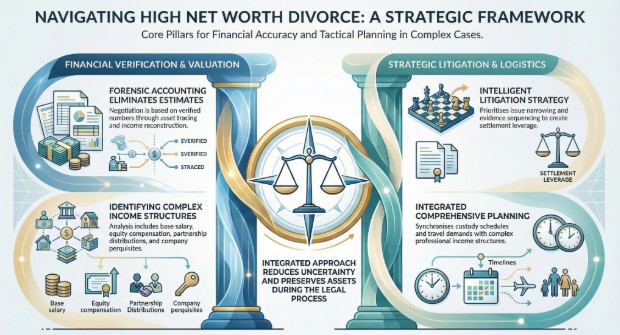
A Fort Lauderdale high-net-worth divorce lawyer applies forensic accounting, comprehensive financial planning, and targeted litigation strategy. Each approach is designed to establish verified asset values, protect liquidity, and isolate the issues requiring judicial resolution — so settlement leverage is built on documented numbers, not negotiating positions alone.
Forensic Accounting
Forensic accounting supports asset tracing, business valuation inputs, and income reconstruction in high-asset cases. Forensic accounting reduces uncertainty, so you can negotiate based on verified numbers rather than estimates.
Comprehensive Planning
High-net-worth divorce planning integrates custody schedules, travel demands, and income structures.
Complex income can include base salary, bonuses, equity compensation, options, partnership distributions, interest, and company perquisites.
Litigation Strategy
Litigation strategy prioritizes issue narrowing, evidence sequencing, and settlement leverage. A targeted approach reduces costs and disruption while preserving trial readiness for issues requiring judicial resolution.
What Is the Difference Between Marital and Nonmarital Property in a High Net Worth Divorce?
Marital property in a Florida divorce is any asset or liability acquired during the marriage, regardless of how the title is held. Nonmarital property is any asset owned before the marriage, received as a gift or inheritance, or excluded by a valid agreement.
Florida Statute §61.075 governs classification, and the distinction determines which assets enter the equitable distribution pool and which remain with the original owner.
In standard divorce cases, the marital/nonmarital classification is straightforward. In high-net-worth cases, the classification becomes a battlefield of litigation because the financial history of high-asset couples is rarely clean.
Three specific problems dominate classification disputes in high-asset divorces in Fort Lauderdale.
| Classification Problem | What It Means | What Triggers It | What Resolves It |
| Commingling | Nonmarital and marital funds become mixed to the point where the original source can no longer be traced with clean documentation | Depositing premarital funds into a joint account, using separate property to fund marital investments, or losing the paper trail across years of transactions | Complete statement history from the original account forward, transaction mapping, and forensic review — not oral testimony about intent |
| Appreciation of nonmarital property | Passive appreciation caused by market forces remains nonmarital; active appreciation caused by either spouse’s contribution to the asset’s growth is marital and subject to distribution | A premarital portfolio actively managed by a spouse during the marriage, a premarital business that grew because of marital-period labor, or real estate improved with marital funds | Documentation showing the source of growth — market data for passive appreciation, or contribution records for active appreciation — tied to the specific asset and period |
| Transmutation | A nonmarital asset is converted into a marital asset through the owner’s own conduct, regardless of intent | Retitling a premarital home into joint names, funding a jointly held account exclusively from nonmarital sources over time, or gifting a nonmarital asset to the marriage | Retroactive tracing using title records, account statements, and transfer documentation — the same evidence that would have protected the asset if preserved from the start |
Clean classification protects liquidity and prevents the marital estate from expanding beyond what the law requires — so you can enter settlement negotiations with a defensible asset inventory rather than a disputed one.
What Are the Key Steps in a High Net Worth Fort Lauderdale Divorce?
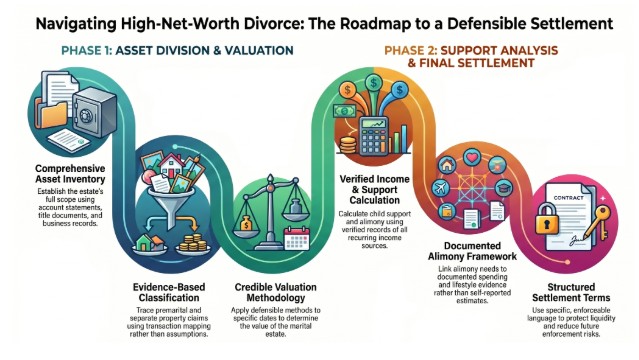
High-net-worth Fort Lauderdale divorce cases follow structured steps for asset division and support analysis. Building a complete asset inventory, classifying each item as marital or nonmarital, applying credible valuation methods, and calculating support under verified income records produce a defensible settlement position under Florida Statutes §61.075 and §61.30.
Asset division starts with a complete inventory.
Account statements, title documents, and business records establish the full scope of the marital estate before any classification or valuation work begins. An incomplete inventory is the most common reason asset division disputes extend past mediation.
Classification follows the inventory.
Every asset and liability is classified as marital or nonmarital under Florida Statute §61.075. Premarital and separate property claims are traced using statement history and transaction mapping — not assumptions about what was intended at the time of acquisition.
Valuation requires a defensible methodology and dates.
The marital estate is valued using credible methods tied to specific valuation dates. Equal distribution is the starting point, and statutory factors are then evaluated to determine whether the evidence supports an unequal allocation under §61.075.
Support analysis begins with verified income.
All income sources and recurring patterns are identified — base salary, variable compensation, distributions, and investment returns. Guideline child support is calculated under Florida Statute §61.30, and every child support order includes the termination language required under §61.13.
Alimony need and ability to pay are documented, not estimated.
Financial affidavits, tax returns, and lifestyle evidence establish the need and ability-to-pay framework under Florida Statute §61.08. Budgets tied to documented spending carry more weight at mediation and at hearing than self-reported estimates that cannot be verified.
Settlement terms are structured to protect liquidity and reduce enforcement risk.
Specific, enforceable language in the marital settlement agreement prevents the post-judgment disputes that arise when terms are vague, payment structures are ambiguous, or asset transfers lack a clear mechanism and timeline.
Schedule a strategy session with Scott A. Levine to pressure-test assumptions about equitable distribution, alimony, and child support against verified documents and Florida statutes before negotiations harden positions.
What Assets Require Proof in a Florida High Net Worth Divorce?
Assets requiring specialized proof in a Florida high-net-worth divorce include closely held business interests, executive compensation, real estate portfolios, investment accounts, trust interests, and retirement assets.
Each category carries distinct valuation risks, tracing requirements, and documentation standards that determine the final equitable distribution outcome.
| Asset Category | Common Examples | Primary Risk | Proof That Typically Resolves The Issue |
| Closely Held Business Interests | S-corp, partnership interest, professional practice | Valuation disputes, hidden income, goodwill issues | Tax returns, financial statements, owner agreements, and valuation reports |
| Complex Compensation | Bonus, commissions, RSUs, options, deferred comp | Recurring vs non-recurring income disputes | Pay records, plan documents, vesting schedules, and employer statements |
| Real Estate | Primary residence, investment property, vacation property | Equity valuation and debt allocation | Deed, mortgage, closing docs, appraisal, HELOC statements |
| Investment Accounts | Brokerage, managed portfolios, crypto exposure | Volatility and valuation date disputes | Statements, trade confirmations, and cost basis records |
| Trust Interests | Revocable or irrevocable trust benefits | Ownership and distribution complexity | Trust documents, distribution history, and account statements |
| Retirement Assets | 401(k), IRA, pension, plan benefits | Marital portion tracing | Statements across the marriage period, plan documents, and QDRO planning under Florida Statute §61.076 |
What Outcomes Should a High Net Worth Divorce Protect?
A high-net-worth divorce in Fort Lauderdale should protect five core outcomes: defensible valuation, a clean tracing narrative for separate property, liquidity against forced sales, privacy-sensitive resolution that limits reputational exposure, and enforceable final orders that prevent post-judgment conflict.
Each outcome requires a documented strategy, not general negotiating leverage.
| Outcome Goal | What The Outcome Means | Why The Outcome Matters |
| Defensible Valuation | Assets valued with credible methods and documentation | Defensible valuation reduces settlement distortion and trial risk |
| Clean Tracing Narrative | Separate property supported by statement history | Clean tracing prevents commingling arguments and unfair division |
| Liquidity Protection | The settlement plan accounts for cash needs and tax costs | Liquidity protection prevents forced sales and payment defaults |
| Privacy-Sensitive Resolution | Disclosures and filings managed strategically | Privacy planning reduces reputational and business damage |
| Enforceable Orders | Orders drafted to reduce ambiguity | Clear orders reduce enforcement litigation and post-judgment conflict |
What To Bring To A High Net Worth Divorce Consultation
Bringing complete financial records to a high-net-worth divorce consultation in Fort Lauderdale accelerates case strategy and reduces costly rework.
Income documentation, account statements, real estate records, retirement statements, and debt records allow Scott A. Levine to build a classification, tracing, and valuation plan on verified facts from the first meeting.
A complete document set accelerates strategy and reduces rework that adds unnecessary attorney hours. These records support classification, tracing, valuation, and analysis, so you can negotiate on verified facts.
Income And Compensation
- Last two to three years of tax returns and supporting schedules
- Pay stubs, W-2, 1099, K-1, and bonus or commission documentation
- Equity plan documents, vesting schedules, and deferred compensation records
- Business financials, including P&L, balance sheet, and general ledger summaries
Accounts And Assets
- 12 to 24 months of bank, brokerage, and crypto exchange statements
- Retirement statements for 401(k), IRA, pensions, and plan benefits
- Real estate documents, including deeds, mortgages, HELOCs, and closing documents
- Trust documents and distribution statements when applicable
Debts And Liabilities
- Credit card statements and loan statements
- Business debt documentation and contingent liability records
- Tax debt documentation and payment plans
Schedule a confidential consultation in Fort Lauderdale to convert financial records into a clean asset inventory, a tracing plan, and a valuation roadmap that supports settlement leverage.
Frequently Asked Questions
What Is A High Net Worth Divorce In Florida?
High-net-worth Florida divorce cases involve assets with high value, complex income, or valuation-sensitive property that requires business valuation, asset tracing, and privacy planning beyond the standard equitable distribution under Florida Statute §61.075.
What Assets Commonly Create Disputes In A High Net Worth Divorce?
Business interests, real estate portfolios, trusts, and equity compensation create disputes in most high-net-worth divorce cases because valuation and ownership structures require specialized proof. Florida courts classify and distribute marital assets under Florida Statute §61.075.
How Do Florida Courts Treat Premarital Agreements In High Net Worth Divorce?
Florida law requires a premarital agreement to be in writing and signed under Florida Statute § 61.079. Enforceability disputes in high-net-worth cases focus on disclosure, voluntariness, and statutory compliance. A validity review assesses whether the agreement will withstand judicial scrutiny.
How Does High Income Affect Child Support In Florida?
Florida calculates guideline child support using combined net income under Florida Statute §61.30, and child support orders include termination language under Florida Statute §61.13. High-income cases often require detailed proof of variable compensation and child expenses to support any deviation arguments.
Can Florida Courts Order Parents To Pay For College In Child Support?
Florida courts generally do not order college expenses as child support, absent a written agreement. Parents who contract for college contributions in a marital settlement agreement can create an enforceable obligation that survives the final judgment.
How Do Hidden Assets Get Proven In A High Net Worth Divorce?
Hidden asset claims in Florida require a paper-trail approach using statement review, transaction tracing, and formal discovery tools. Identifying inconsistent cash flow patterns and unexplained transfers is a common starting point. Courts impose sanctions when concealment is demonstrated with records.
Can Alimony Change After A High Net Worth Divorce Final Judgment?
Florida permits modification or termination of alimony under qualifying circumstances pursuant to Florida Statute §61.14. Modification requests require documented proof of a substantial, material, and involuntary change in circumstances since the final judgment was entered.
Does Florida Still Have Permanent Alimony?
Florida Statute §61.08 lists temporary, bridge-the-gap, rehabilitative, and durational alimony as the recognized forms. The 2023 amendments eliminated permanent alimony as a statutory form. Durational alimony is now capped based on the length of the marriage under the amended statute.
Early documentation and valuation strategies produce better high-net-worth divorce outcomes in Fort Lauderdale. Confidential consultation and build a settlement plan that protects liquidity and enforceability under Florida law.