
A criminal defense lawyer in Fort Lauderdale is a licensed attorney who represents individuals charged with misdemeanors and felonies in Broward County’s state and federal courts.
Scott A. Levine, Esq., a former Assistant Public Defender with 30 years of criminal defense experience in Broward County, defends clients facing charges ranging from DUI and domestic violence to drug offenses and white-collar crimes throughout Fort Lauderdale and all of Broward County.
Florida Statutes §775.08 classifies criminal offenses into misdemeanors (up to one year in county jail) and felonies (more than one year in state prison, up to life or death). A conviction at either level creates a permanent criminal record that affects employment, housing, professional licensing, and constitutional rights.
Key Takeaways
- Florida divides criminal offenses into two degrees of misdemeanor and five felony classifications, each carrying escalating penalties under Florida Statutes §§ 775.082 and 775.083.
- Defendants arrested in Broward County must appear before a judge within 24 hours under Florida Rule of Criminal Procedure 3.130.
- A criminal conviction triggers collateral consequences, including loss of voting rights, firearm ownership restrictions, and professional license revocation.
- A former prosecutor’s background provides insight into how the State Attorney’s Office builds cases and where weaknesses exist.
A single arrest can unravel decades of professional and personal stability — Scott A. Levine, Esq., fights to protect your freedom, your record, and your future.
How Florida Classifies Criminal Offenses
Florida Statutes §775.081 separates criminal conduct into three categories: felonies, misdemeanors, and noncriminal violations. The classification assigned to a charge determines the maximum penalty a judge can impose, the court that hears the case, and the long-term consequences of a conviction.
Misdemeanor cases proceed in Broward County Court before a county judge. Felony cases are transferred to the Circuit Court in the 17th Judicial Circuit, where a circuit judge presides over proceedings that may include jury trials, complex motion practice, and sentencing under Florida’s Criminal Punishment Code.
| Offense Classification | Maximum Jail or Prison Term | Maximum Fine |
| Second-Degree Misdemeanor | 60 days in county jail | $500 |
| First-Degree Misdemeanor | 1 year in county jail | $1,000 |
| Third-Degree Felony | 5 years in state prison | $5,000 |
| Second-Degree Felony | 15 years in state prison | $10,000 |
| First-Degree Felony | 30 years in state prison | $10,000 |
| Life Felony | Life in state prison | $15,000 |
| Capital Felony | Life without parole or death | N/A |
Florida’s Criminal Punishment Code requires judges to calculate sentencing points using a scoresheet that factors in offense severity, the presence of injuries or firearms, and the defendant’s prior criminal history.
Defendants whose scoresheet totals 44 points or more face a presumptive prison sentence under Florida Statutes §775.082 (2026).
A criminal defense lawyer in Fort Lauderdale reviews every line of the scoresheet to identify errors, challenge point calculations, and argue for non-prison sanctions when the law permits, so you can avoid incarceration when the point calculation supports an alternative penalty.
What Happens After an Arrest in Broward County
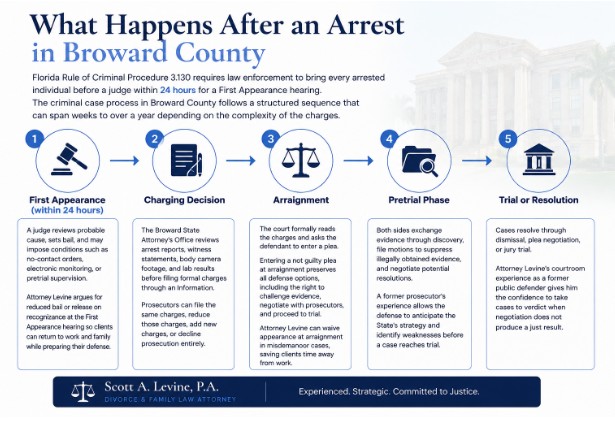
Florida Rule of Criminal Procedure 3.130 requires law enforcement to bring every arrested individual before a judge within 24 hours for a First Appearance hearing. The judge advises the defendant of the charges, explains constitutional rights, and determines bail and conditions of pretrial release under Florida Statutes §903.046.
The criminal case process in Broward County follows a structured sequence that can span weeks to over a year, depending on the complexity of the charges.
First Appearance (within 24 hours): A judge reviews probable cause, sets bail, and may impose conditions such as no-contact orders, electronic monitoring, or pretrial supervision. Attorney Levine argues for reduced bail or release on recognizance at the First Appearance hearing so clients can return to work and family while preparing their defense.
Charging Decision: The Broward State Attorney’s Office reviews arrest reports, witness statements, body camera footage, and lab results before filing formal charges through an Information. Prosecutors can file the same charges, reduce them, add new ones, or decline prosecution entirely.
Arraignment: The court formally reads the charges and asks the defendant to enter a plea. Entering a not guilty plea at arraignment preserves all defense options, including the right to challenge evidence, negotiate with prosecutors, and proceed to trial. Attorney Levine can waive appearance at arraignment in misdemeanor cases, saving clients time away from work.
Pretrial Phase: Both sides exchange evidence through discovery, file motions to suppress illegally obtained evidence, and negotiate potential resolutions. A former prosecutor’s experience allows the defense to anticipate the State’s strategy and identify weaknesses before a case reaches trial.
Trial or Resolution: Cases resolve through dismissal, plea negotiation, or jury trial. Attorney Levine’s courtroom experience as a former public defender gives him the confidence to take cases to verdict when negotiation does not produce a just result.
When your arrest feels like the end of the road, a former prosecutor who now fights for the defense can show you every available path forward — talk to Scott A. Levine today.
What are the Common Criminal Charges in Fort Lauderdale?
Broward County prosecutors file misdemeanor and felony cases each year, ranging from minor infractions to complex financial crimes. Scott A. Levine, Esq. represents clients charged with offenses across all classifications in both county and circuit courts, so you can challenge the State’s case at every stage before a conviction alters your future.
| Charge Category | Florida Statute | Classification | Key Penalties | Additional Consequences |
| DUI (first offense) | §316.193 | First-degree misdemeanor | Up to 1 year in jail | Mandatory license suspension, DUI school completion; repeat offenses escalate to felony with mandatory minimums |
| Domestic Violence | §741.28 | Misdemeanor or felony (varies by act) | Varies by underlying offense (assault, battery, stalking, kidnapping) | Permanent no-contact order, firearm prohibition, 29-week Batterer’s Intervention Program |
| Drug Possession (cannabis < 20g) | §893.13 | First-degree misdemeanor | Up to 1 year in jail, $1,000 fine | Trafficking thresholds under §893.135 trigger mandatory minimum prison sentences |
| Petit Theft (≤ $750) | §812.014 | Misdemeanor | Up to 1 year in jail (first-degree) or 60 days (second-degree) | Repeat convictions reclassified as felonies under Florida’s repeat offender provisions |
| Grand Theft (> $750) | §812.014 | Third-degree felony (minimum) | Up to 5 years in prison, $5,000 fine | Penalty escalates with property value; $20,000+ triggers second-degree felony |
| Simple Assault | §784.011 | Second-degree misdemeanor | Up to 60 days in jail, $500 fine | Aggravated assault with a deadly weapon under §784.021 rises to a third-degree felony |
| Battery | §784.03 | First-degree misdemeanor | Up to 1 year in jail, $1,000 fine | Rises to second- or third-degree felony with great bodily harm or prior convictions |
| White-Collar Crimes (fraud, embezzlement, forgery, identity theft) | Varies by offense | Misdemeanor or felony (varies by dollar amount) | Penalties escalate with the dollar amount involved | Complex financial evidence requires a document-intensive defense strategy |
A domestic violence arrest in Fort Lauderdale often triggers a domestic violence restraining order in addition to criminal charges, and each carries its own legal standard and timeline.
Attorney Levine represents clients facing both a criminal domestic violence case and a related restraining order petition, coordinating defense strategy across both proceedings so decisions made in one do not undermine the other.
How Does a Criminal Defense Lawyer Build Your Defense?
A criminal defense lawyer in Fort Lauderdale builds a defense by examining every piece of evidence the prosecution plans to use, identifying constitutional violations, and developing a strategy tailored to the specific charges and circumstances of the case.
Motion to Suppress Evidence: The Fourth Amendment prohibits unreasonable searches and seizures. Attorney Levine files motions to suppress evidence obtained through illegal traffic stops, warrantless searches, or coerced confessions. Excluding illegally obtained evidence can lead to reduced charges or complete dismissal.
Challenging Witness Credibility: Criminal cases in Broward County rely on eyewitness testimony, which research consistently identifies as one of the least reliable forms of evidence. Cross-examination during depositions and trial exposes inconsistencies, bias, and perception errors that weaken the State’s case.
Negotiating Pretrial Diversion: First-time offenders charged with qualifying third-degree felonies may enter pretrial intervention programs that, upon successful completion, result in the dismissal of charges. Diversion programs allow defendants to avoid a permanent felony conviction by completing counseling, community service, or supervision requirements.
Plea Negotiation: Cases where the State has strong evidence but mitigating factors exist — such as a lack of prior criminal history, cooperation with law enforcement, or evidence of rehabilitation — open the door to plea negotiations that reduce charges, lower penalties, or secure a withheld adjudication.
Jury Trial: Cases with viable defenses and favorable facts proceed to trial, where Attorney Levine presents evidence, cross-examines prosecution witnesses, and argues the defense before a Broward County jury. A not-guilty verdict results in a full acquittal and no criminal record.
Withholding of Adjudication: Florida law allows judges to withhold adjudication in eligible cases, meaning the defendant completes probation or other conditions without a formal conviction being entered on the record. A withheld adjudication avoids the automatic loss of civil rights that accompanies a felony conviction, so you can preserve your employment eligibility, professional licenses, and voting rights.
Why Prior Prosecution Experience Strengthens Your Defense
Scott A. Levine began his legal career as an Assistant Public Defender in Broward County, Florida, where he tried over 45 jury trials as lead counsel.
That experience provided direct exposure to how law enforcement builds cases, how prosecutors evaluate evidence, and how judges in the 17th Judicial Circuit respond to legal arguments, so you can benefit from defense strategies informed by firsthand knowledge of prosecution methods.
Before establishing the firm, Attorney Levine also served at Michaud, Mittelmark and Asrani, P.A., in Boca Raton, and at Feldman Gale in Miami, gaining experience in civil and criminal litigation in South Florida’s most demanding legal environments.
Attorney Levine graduated Magna Cum Laude from Nova Southeastern University School of Law in 1996, ranking in the top eight percent of his class.
He served as Technical Editor for the Journal of International and Comparative Law and earned recognition in Who’s Who Among American Law Students, 1995 edition.
The legal community has recognized his professionalism and knowledge with an AV Peer Review Rating — Martindale-Hubbell’s highest rating — in Family Law, Criminal Law, and Litigation.
Scott A. Levine is admitted to practice before all courts of the State of Florida and the Federal District Court of the Southern District of Florida. He represents clients in criminal defense matters throughout every city in Broward County.
What a Criminal Conviction Costs Beyond Jail Time
Jail or prison sentences represent only one layer of the consequences a criminal conviction imposes. Collateral consequences affect a defendant’s employment, housing, civil rights, professional licensing, and immigration status, often lasting far longer than the sentence itself.
Employment: Most employers conduct background checks. A felony conviction disqualifies candidates from positions in healthcare, education, finance, and government. Misdemeanor convictions involving dishonesty or violence can trigger automatic disqualification from licensed professions in Florida.
Housing: Landlords and property management companies in Broward County routinely screen applicants for criminal history. Felony convictions, particularly for drug offenses or violent crimes, can result in automatic denial of rental applications.
Civil Rights: A felony conviction in Florida results in the loss of the right to vote, serve on a jury, and hold public office until civil rights are restored through executive clemency. Federal law under 18 U.S.C. §922(g) prohibits convicted felons from possessing firearms.
Professional Licensing: Florida’s Department of Business and Professional Regulation can deny, suspend, or revoke professional licenses based on criminal convictions. Attorneys, real estate agents, nurses, contractors, and other licensed professionals face disciplinary proceedings that can end careers.
Immigration: Non-citizens convicted of crimes involving moral turpitude or aggravated felonies face deportation, denial of naturalization, or inadmissibility under federal immigration law. Misdemeanor convictions classified as crimes involving moral turpitude can trigger removal proceedings.
The financial, professional, and personal consequences of a conviction extend for years beyond the courtroom — schedule a consultation with Scott A. Levine, Esq. to explore every option to protect your record and your future.
Frequently Asked Questions
What should I do immediately after being arrested in Fort Lauderdale?
Exercise your Fifth Amendment right to remain silent and request an attorney before answering law enforcement questions. Statements made without counsel present become evidence the prosecution uses at trial. Contact a criminal defense lawyer immediately after booking to begin your defense.
How long does a criminal case take in Broward County?
Misdemeanor cases in Broward County typically resolve within 30 to 90 days, while felony cases can take 6 months to over a year, depending on the charge’s complexity and whether the case proceeds to trial. Pretrial motions, discovery disputes, and scheduling delays affect the timeline.
Can a felony charge be reduced to a misdemeanor in Florida?
Prosecutors in the Broward State Attorney’s Office have discretion to reduce felony charges to misdemeanors during plea negotiations when mitigating circumstances justify a lesser charge. Defense attorneys can present evidence of rehabilitation, lack of prior criminal history, or weaknesses in the State’s case to support a reduction.
What is the difference between adjudication and withheld adjudication?
Adjudication means the court enters a formal conviction on the defendant’s record, triggering all statutory penalties and collateral consequences. Withheld adjudication means the judge imposes conditions such as probation without entering a formal conviction, preserving the defendant’s eligibility for record sealing under Florida Statutes §943.059.
Do I need a lawyer for a misdemeanor charge in Fort Lauderdale?
A misdemeanor conviction creates a permanent criminal record visible on background checks conducted by employers, landlords, and licensing boards. First-degree misdemeanors carry up to one year in jail and a $1,000 fine. Attorney Scott A. Levine evaluates every misdemeanor case for opportunities for dismissal, diversion eligibility, and negotiation leverage.
What is a motion to suppress and how can it help my case?
A motion to suppress asks the court to exclude evidence obtained in violation of Fourth Amendment protections against unreasonable search and seizure. Suppression of drugs found during an illegal traffic stop or statements taken without Miranda warnings can force prosecutors to drop or reduce charges.
How much does a criminal defense lawyer cost in Fort Lauderdale?
Attorney fees for criminal defense in Fort Lauderdale vary based on the severity of charges, the complexity of evidence, and whether a case proceeds to trial. Scott A. Levine, Esq. offers consultations to discuss the specific circumstances of each case and provide a clear explanation of legal fees and payment structures.
Can I get my criminal record sealed or expunged in Florida?
Florida Statutes §943.0585 and §943.059 allow eligible defendants to remove or restrict public access to criminal records. Defendants who received withheld adjudication or whose charges were dismissed may qualify. An attorney files the petition with the Florida Department of Law Enforcement.
What happens if I violate probation in Broward County?
A violation of probation hearing in Broward County allows the judge to revoke probation and impose any sentence up to the statutory maximum for the original charge. The standard of proof for a probation violation is a preponderance of the evidence, which is significantly lower than the beyond-a-reasonable-doubt standard required at trial.
Does a DUI count as a criminal offense in Florida?
Florida Statutes §316.193 classifies DUI as a criminal offense. A first DUI is a first-degree misdemeanor carrying up to one year in jail and mandatory license suspension. A third DUI within 10 years becomes a third-degree felony with up to five years in prison.
Does a domestic violence restraining order affect my criminal case?
Yes. A domestic violence restraining order is a civil injunction separate from any criminal charge, but statements and evidence from one proceeding can be used in the other. Attorney Levine coordinates the criminal defense with the restraining order case to protect a client’s rights in both.